Wednesday, January 7, 2015

It's name is Sunny! Maybe it's B-210. Well at least it's by Datsun. It might be by Nissan though . . .

SUPER ECONOMICAL FRUMPSTER
I recently walked by this little econobox straddling the Gowanus/Park Slope border that is 4th Avenue. Tiny Japanese cars from the '70s and '80s are something I like a great deal, so here it is!
This is a 1980 or '81 Datsun 210 in the original color choice of Regal Mist Poly. This car was known to the rest of the world as the Nissan Sunny. Basic transportation was the name of the game for 210. We're talking a 1.4 liter 4 cylinder engine mated to a 5-speed manual transmission (rear wheel drive of course). This setup produced a whopping 60 to 85 horsepower! Top speed was somewhere in the vicinity of 80 to 85mph.
The dimensions are tiny and the overall shape looks like what you'd get if you asked a child to draw a car. Somebody's going for it with the mag wheels but I'm not convinced!
To find a Datsun from of this vintage in the Northeastern U.S. these days is downright remarkable. They rusted almost immediately, and not because the paint was deficient, but because they were made of from particularly thin metal. This meant that they were very light cars and very inexpensive when new. I've seen ads from the era bragging that the price was under $3,800 and that it could get up to 50 miles to the gallon. Those are modern hybrid numbers and this thing has a carburetor!
This car hails from the era when Nissan was starting to phase out the name Datsun, so they were given these dual emblems.
The rear windows on these 2-door coupes had a hinge in the front and popped out at the back for ventilation. Every step was taken to ensure the lightest, simplest, cheapest car to build and own.
From this angle there seems to be some color variation from the front to the back, so I'm guessing there are hidden rust repairs looming underneath.
The smoked headlight and turn signal thing is strange to me, but my '83 Corolla had them as well.
When I was 16 or so I was in California for the summer when a friend who lived out there announced that he was able to borrow his mothers '81 210 for the week. 3 of us drove the brown (and I mean BROWN) little Datsun all the way down the coast from the Bay Area to San Diego, camping and sleeping on beaches for the most part. We somehow stretched the trip to 8 or 9 days on our extremely meager funds, battling an overheating problem the entire time. When we got back to town we found out that he'd just taken his mothers car without permission! Never hung out with that guy again. It was great fun while it lasted though; driving around Compton and Beverly Hills, renting ATVs to ride on the dunes of Pismo Beach, and getting to within a few miles of the Mexican border before heading back on one long drive with all of us pooling our last $10 for gas. I don't know who else would feel a rush of nostalgia when seeing this little ride, but I certainly did! Hats off little Datsun-Nissan; keep on truckin'!


Tuesday, January 6, 2015

Twofer Tuesday returns with back-to-back episodes of Mr. Belvedere!

BELVEDERE VS BELVEDERE
Finding just one of these cars was plenty exciting for me, but finding another was just crazy! Without further ado I present 2 1955 Plymouth Belvederes:
This first one is a bit of a beater, but it was sporting current plates and valid registration & inspection stickers so I suppose it's mobile. Unfortunately the hood looks to have been used as a surface for laying something down that needed to be spray painted black. That's just lazy! Wasn't there a piece of cardboard or newspaper around? You HAD to use the hood of a 60 year old car wearing its original paint? And what's with the drivers side headlight getting a blast of black paint too? Animals!


 Regardless this is a '55 wearing at least some of its original Miami Blue paint. I encountered this up in a quiet corner of Astoria that was fully stocked with parked classics. Sometimes you pass a rockabilly loft with several cool Kustoms, other times there are a couple of body shops near each other resulting in a bevy of old rides being scattered about. I think this was a combination of the two.
Belvedere in script makes for a quick identification on this ride. Plymouth had 3 trim levels in '55, with the Belvedere being the top of the heap. Below this was the mid-level Savoy and the truly spartan Plaza. The trim levels were all named after famous hotels while the color choices are all named after towns in both Florida and California (some color examples are Biscayne Blue, Glades Green, Palm Beach Gray, Mohave Brown, Santa Rosa Coral, and San Diego Gold). The forward-leaning front announces the fact that this is the first example of legendary designer Virgil Exners Forward Look. The spare tire from a modern car? At least it's keeping it off the ground.


Oh, ok, here is a perfect example of why Bondo should be practiced on a junkyard car first by the amateur. I don't know the level of rust that this is hiding but it looks like paper mache now! I do love the fuel filler door with the airplane motif.


This is pretty plain-as-day for a Belvedere. The fact that the chrome spear on the side is an unbroken horizontal line means that this is a one-tone car. If there was an optional PowerFlite automatic transmission in this car it would've been announced in chrome script on the right side of the trunk lid so I think this has the standard Syncro Silent trans. The gearshift for '55 was a one-year-only setup where a small chrome shifter came right out of the dash. The next year they would change that over to the fabled push button transmission.


Basic, but well proportioned is how I would describe the '55 Plymouths. They are notably restrained compared to the gaudiness of other domestic cars of the day.


One last detail to point out on this ride; that free-standing chrome emblem on the front of the hood between the ornament and the grill is horizontal. This means that this car was equipped with the PowerFlow 6 cylinder engine. If it was built with the Hy-Fire V-8 that emblem would be in a V shape (like the one below). The spelling for both of those engines is exactly how it was written in their brochure by the way. Now on to a nicer example!


Alright now we're talking! This, too, is a '55 Belvedere but this one has the aforementioned V8 as announced by the hood emblem. I encountered this sweet ride in the Kensington/Borough Park area of Brooklyn.


This thing is beautiful and I would have gladly used it for Show Car Sunday had I not run across the other one. Here we can see the difference in chrome side trim for cars ordered with the 2-tone paint.


These are the correct original hubcaps for this car which to me seem somewhat cheap and unfinished. They further support the understated overall design I suppose.


This is a curious little item. Listed as a "Distinguished Medallion" in the Plymouth literature, it is trumpeted as a hallmark of quality. It was supposed to be found on only the convertible and 2-door sport coupe, but I'm guessing it went along with any 2-tone cars that had this chrome treatment.


This is a damn fine looking ride in its 2-tone scheme. I think the blue color is Tampa Turquoise with the black being listed simply as Black.


This ride has the optional PowerFlite installed. This transmission only lasted from '54-'61 but has a reputation of durability to this day.


I have no doubt that you could jump in this thing and drive off immediately. Some cars look shiny and nice but there's a feeling about them where they probably don't get much use. This car sits level on properly inflated matching tires and all the minutia such as mirrors are adjusted for use.


2-tone cars were huge in the 1950s, with some automakers even producing tri-tone schemes as well. This setup with the roof and lower-rear body being different from the rest is about as standard as it gets. This is the first year for the wraparound windshield which Plymouth refers to as the New Horizon. Combine that name with the Forward Look and you can see how much they were selling the modern American optimism as much as their cars.
This has a set of chrome eyelids installed which cover the top half of the headlights. I'm usually not into them, but this poodle-skirt edition Plymouth is just the sort of ride that would have had them installed way back when so I'm alright with it. I doubt I'll have too many Twofer Tuesdays with cars this old or cool, but at least I was lucky this time.
*One detail to let you know you're way out on the outer boroughs; all those power lines in the background! There haven't been overhead wires allowed in Manhattan since 1884 (though it took a blizzard in 1888 that too down most power lines for the electrical companies to follow suit). Brooklyn was given the same law in 1885 ordering the borough to bury their lines but the telephone (and now cable) wires were allowed to remain.

Monday, January 5, 2015

Beauty is in the eye of the (original) beholder

BROOKLYN REDBIRD
I was riding the bike out somewhere in the vicinity of Midwood in deepest Brooklyn when this red sleepy-eyed beast caught my eye. I love these cars!
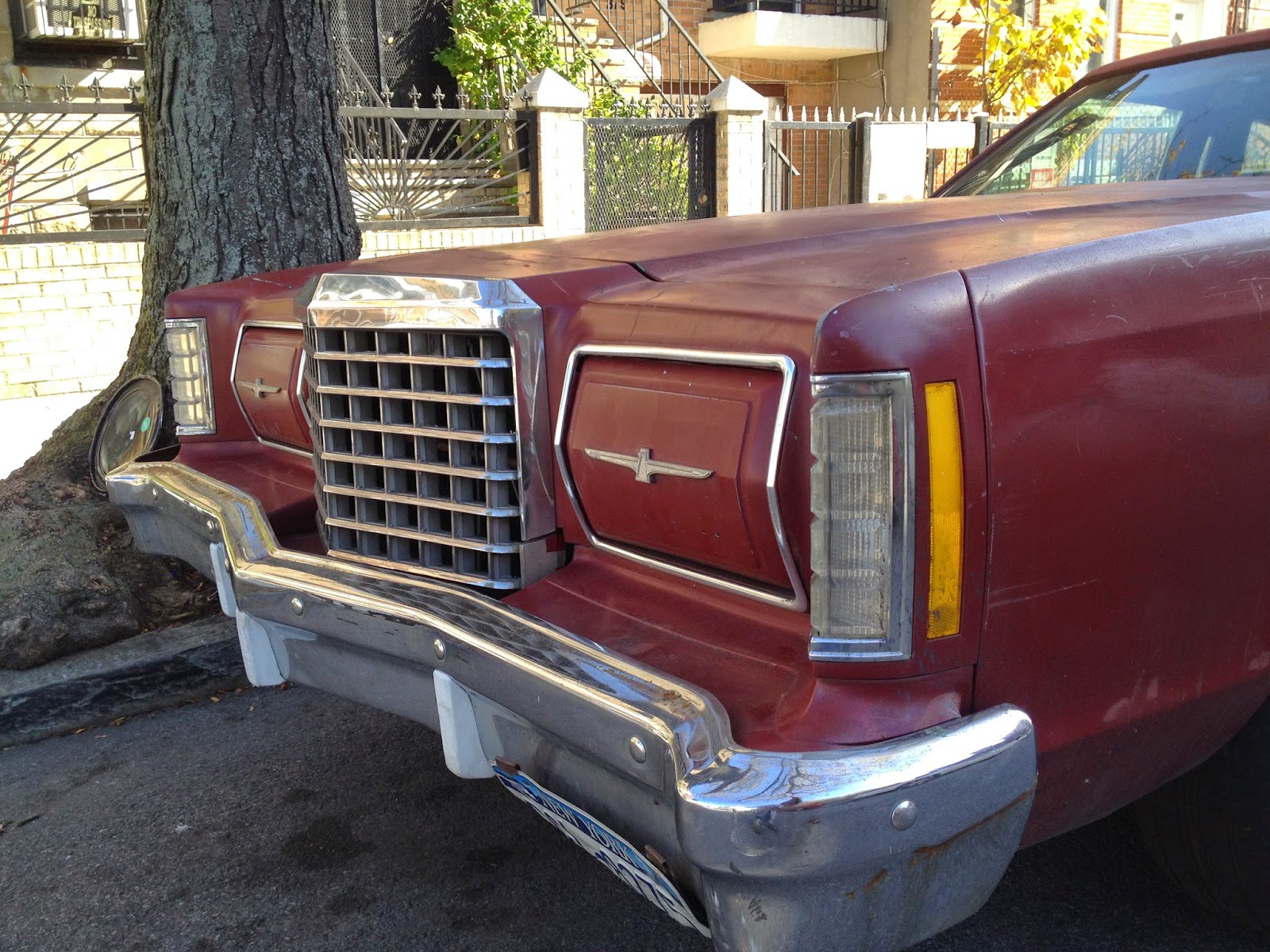
What we have here is a 1978 Ford Thunderbird in Dark Red. We can tell it's a '78 because the stylized bird over each headlight cover wasn't there in '77, and the grill was made up of larger squares in '79.
This car has everything I want in an N.Y.C. Hooptie; cool car from a different era, plenty of scrapes, knocks, and evidence of urban use, mismatched wheels and tires, and sheer presence.
This does of course hail from the very darkest of automotive decades, so it's underpowered and overweight. However, this is actually an intermediate car compared to the truly colossal T-Birds of '76 and earlier. The older cars were 10 inches longer and a full 900 lbs heavier than this generation! It seems impossible that this is only a mid-size car when it's far and away the largest thing parked within several blocks, but there it is.
It's not often that I encounter the owner of a car when I'm shooting it, but in this case he was working on a car across the street from this one when I walked up. He paused when I got off my bike and walked up to the red car so I asked if it was his. He said it was and was totally unsurprised when I asked if I could take some pictures for my old car blog. Bob told me he was the original owner and that the car had a mere 60,000 miles on it from new. Most people might see this as a frumpy wreck on the street but not Bob. Like a husband glancing over at his wife of 40 years all he saw was the same pretty young girl that first caught his eye.
Bob went on to explain the unfortunate rear-ending that this T-Bird had been through happened earlier this year when an out of control driver came zig-zagging down the street scraping other cars. The out of control driver never let off the gas, finally launching off of a speed bump into the car parked behind this one, totaling it. This damage came from the totaled car being shoved into this one.
It is a shame that the taillight housing got smashed up because it really makes the rear of this ride look pretty cool when it's intact.
The huge late-'70s era bumper that I usually love to hate did an admirable job of protecting this ride though. When it was new this bumper was opposed to be able to absorb a 5mph crash with no discernible damage. This T-Bird weighs in at over 4,000lbs! Think of how fast a car would have to be going to push another parked car into this one to do this much damage.
She's still a cool old cruiser even in this condition. If you look through the back window to see where the back seat is you get an idea of just how much trunk space this is packing.
There's the owner Bob putting the wheel back on his other red car.
The little opera windows between the front and back windows are ridiculous hallmarks of the personal luxury era. That little window is set into a structural support that acts as a built-in roll bar. If you look closely you can see the lines of it going over the roof. If this car was ordered with a vinyl top it would have been installed in 2 sections; from the top of the windshield back to the raised roof section at the back of the front side window, and from the top of the back window to the rear raised roof section. The body color would still continue over the roof! These rides were available with T-Tops as well which look great on such a big ride.
That Club is doing it's job! Yes the car was full of parts but at least that's better than garbage. 1980s cassette deck is holding it down for those infrequent cruise nights to Coney Island.
From this angle it looks pretty good! This car's been rolling these mean streets since 1978, parked on this very block the entire time according to Bob, so she's actually holding up very well.
Of course the hood ornament is long gone. It was probably gone in late '78 when crime in the city was worse than it is now (still nothing compared to the brutality of the late '80s/early '90s).
This is my favorite year for Thunderbirds from the 1970s. I've always loved drawing this car due to it's collection of sharp angles. The headlight covers give the impression of a squinting old man trying to read the paper, and the front bumper juts out like the prow of a ship. One detail I had no knowledge of before this day was about to be demonstrated for me by Bob. See that break in the side of the chrome grill near the bottom?
The grill of this 'Bird is hinged at the top so that it will push out of the way in a small front-end collision as opposed to being destroyed! I had no idea and was downright giddy in my auto-geekdom to be shown this forgotten footnote of Thunderbird history. The '70 and '71 T-Bird had a ridiculously pointy grill that almost always got damaged during regular city parking, so maybe this was a solution harkening back to those days? More likely the front bumper couldn't quite make the 5mph crash test due to cracking grills so they put in a little-known quick fix. Regardless I'd like to thank Bob for showing off his fair lady to me!

Sunday, January 4, 2015

Show Car Sunday returns with a Glitzy Lincoln finally gets its due!

DESERT BUFF BEAUTY
The dog days of winter are just settling in and I've finally got some free time to go through the backlog of great rides I've encountered over the past year. We'll start off 2015 with a majestic yacht that was (and may still be) parked at Brooklyn Crab in Red Hook. I was there celebrating my 40th birthday, Zach Galifianakis was sitting at the table next to us, and this mighty beast was parked below:
This thing is in command of the situation! What we have here is a 1957 Lincoln Premiere in the factory color Desert Buff. This is the only year the Premiere looked like this; the 1956 had a single light on each side, and the 1958 had stacked lights that were at a V angle pointing in towards the bottom. This is a rare and well-appointed example of 1950s American optimism and luxury.
Very busy, very flashy styling was the name of the game for '57. Just look how complicated this side of the front is! We have 2 different size headlights, a turn signal and running light built into the same wide housing, a faux vent/light running toward the middle of the car from the center of the headlight housing, both of which sport a textured metal grid design. It goes without saying that everything is outlined in chrome of various thickness. One detail I absolutely love is the tiny line of body color paint in front of the lower edge of the faux signal; just enough to show that it is set back. 
This is a well-proportioned car in light of its immense size. The chrome molding running along the side is much more subtle that most of the rides of this era. The engine powering this 4,900lb beast is the Lincoln 368 Y-block V8. This engine was only used in Lincolns, and only for '56 and '57, so getting rebuild kits and parts can be worrisome. A 3 speed automatic transmission was standard.
Another faux vent whose main purpose is to make the car look even cooler. It does manage to mimic the angle of the taillight housing though, adding continuity to the design.
There isn't a detail that was overlooked by the design team at Lincoln in the '50s as illustrated by the sleek door handle, covered keyhole, and ergonomic indentation that is wider at the top than the bottom much like the shape of a hand opening the door. Lincoln had 3 models in '57; the Capri at the bottom, Premiere in the middle, and Continental at the top. All Lincolns were the pinnacle of the Ford Motor Company lineup above Edsel, Mercurey, and Ford (in that order).
It's 1957 people; fins grew out of just about every domestic car except for Nash/Rambler. This is a relatively restrained example with the slightly angled gothic taillights emerging from almost perfectly level fenders. LINCOLN is just barely legible in this pic hidden amidst the striped chrome panel. Reverse lights were far from a standard feature in '57, but Lincoln owners got all the bells and whistles.
Ugh, awful, WHY DO THIS?
Here, ladies and gentlemen, is my most-hated automotive accessory; the Continental Kit. It consists of a spare tire being mounted outside of the trunk, in this instance with a greatly extended bumper. It all started way back when in automotive history when the spare tire(s) were mounted to the outside of a vehicle that had no trunk space. It reemerged in 1956 when Henry Ford II complained that he couldn't fit his golf clubs in the trunk of the Thunderbird. The designers used a continental kit as a 1 year answer until they could stretch the trunk itself for '57. However, it remained an option in '57 as well as a popular aftermarket customization. This one looks to be factory to me but it doesn't mean I like it!
This little glass sphere with the stylized L is a nice detail.
Inside we have more glitz and a pack of Newports. That chrome circle on the door panel looks like a crank to roll down the window but it's actually the handle you pull back to open the door. The power (obviously!) windows are controlled by the switches you can just barely see through the steering wheel under the corner of the wrap-around windshield. The radio is AM only which isn't too surprising for '57, but it does have buttons to program 6 stations.
This sleek cruiser is a true hardtop; when the front and back windows are rolled down it's just one large opening. Check out the absurd length of the fender skirts!
Of course these are the original hubcaps, and it's a good thing too as they run around $75 a pop if you can find one. The aged paint on the rim makes it seem as if this has the original wheels as well.
One last bit of ornamentation can be found in the hood ornament. With the combination of chrome and glass this is now a very rare item; there was one recently for sale for $275!
The chrome on this car has pitting but it is so original-looking and honest for a 58 year old car that I happily declare it Show Car Sunday worthy. There were about 35,000 Premieres in every body style built in '57 which means they're pretty scarce today. If you find one for sale it's usually been restored already from a nice original and priced accordingly. Buying a beat-up '57 Lincoln means an extremely difficult and expensive restoration or the coolest rat rod out there.