Thursday, December 22, 2016

A Valiant effort (groan)

POSSESSING OR SHOWING COURAGE AND DETERMINATION
I was way out in the hinterlands of either Brooklyn or Queens when I passed by this dirty little ride. At 50 years old it holds up nicely!
This is a 1966 Plymouth Valiant 200 in White. There is a Plymouth Beige that's not far off from this but the color chips I could find from this year show a White that's not super bright so I think this is it.
Plymouth in the '60s was an exercise in doing a lot with a little. Each year brought frugal changes that drastically altered the appearance. For instance the grill and taillights changed each year making essentially the same car seem fresh with each vintage. However behind this grill is an identical opening to the years before and after this ride.
This little Plymouth looks like it's cowering and dejected with that one dead eye. It's a shame because overall it's in great shape. The windshield looks like it was replaced hastily with that thick black rubber all over the surround.
These Valiants and their siblings the Darts were considered compact cars in their day. The lines are clean as a whistle and the dimensions are nicely balanced. I love the no nonsense approach to Mopar in the '60s.
These cars remain very usable today. The compact dimensions are about the same as a modern Accord, the performance of the Slant-6 or small 273 V8 engines is adequate, and the miles per gallon can easily be in the mid to upper 20s.
Plastics were in heavy use in the interior with the cool off-center speedometer and gauge cluster sporting faux chrome. A missing radio and lack of air conditioner means this is basic transportation.
This ride is fitted with the legendary Torqueflite automatic transmission. The Torqueflite (written some years as TorqueFlite) was introduced in 1956 and continued in production all the way through 2015! This is fantastic news when you own one of these cars and need a replacement. I had a '72 Plymouth Duster with a slant-6 and the Torqueflite. After delivering pizzas with it for a couple months it needed to be replaced. I found a rebuilt unit for $300 with a 1 year warranty!
The taillights are different for each year in the '60s but I find this year to be exceptionally tidy. The top lens is the brake/turn signal, the center a reflector, and the lower are nicely incorporated reverse lights. I believe '66 was the first year where reverse lights were federally mandated.
I'm not buying that single out of state plate on the back. I've said it before but all you need to do to park with impunity in the outer boroughs is to tack an out of state plate on your ride and every cop will walk by it forever. I've seen several cars roosting on side streets for years with a sketchy plate.
The 200 was the mid-tier trim level in '66. The base model 100 had no chrome trim whatsoever and could be ordered in a very frugal package; small 6 cylinder with a three on the tree manual, radio delete, and even heater delete for the warm climate penny pincher. The highest trim level was the Signet series which offered the only convertible in the lineup.
I love this detail so I always point it out on '60s Mopars. This little Pentastar logo can only be found on the passenger side fender. The thought process is that when it is parked passersby will see it from the sidewalk.
The name Mopar covers all of the Chrysler/Dodge/Plymouth lines. It stands for Motor Parts which is the official name of the company parts manufacturer. As a result there are Mopar car clubs and the like.
Well that's where we'll leave this smart little Plymouth. I highly recommend any '60s (and most '70s) Mopars for people looking to buy a classic car as a daily driver. I've had both the aforementioned Duster as well as a '74 Dart and both were totally reliable. These cars never want to die, especially with the slant-6 engine. Aside from the fragile plastic dashboard components parts are widely available. Hats off Valiant!  


Tuesday, December 20, 2016

Sweet little red Jeep-killer

小さな赤いジープキラー
I was out in Bed Stuy somewhere near the Kingston-Throop station on the C line when this little lunchbox stopped me in my tracks:
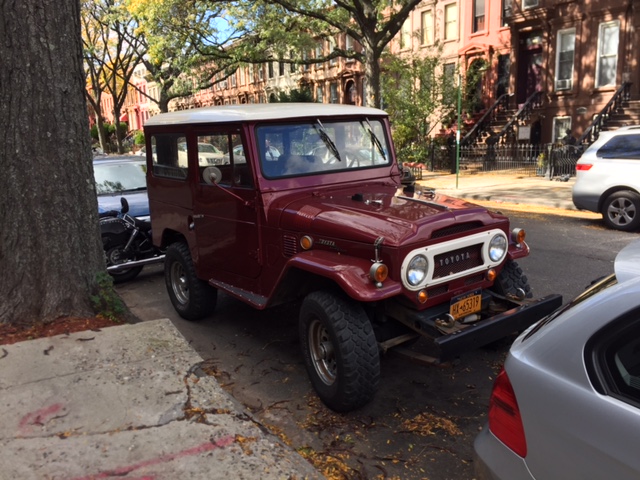
Righteous! This is a Toyota Land Cruiser from the '60s (my guess is 1965) in either Carnival Red or Spanish Maroon. I like to be specific but these little beasts were produced from 1960-1984 worldwide and all the way through 2001 in Brazil without too many changes.
These trucks are exactly what they seem to be; Jeep-like trucks built to make their way through any sort of terrain. They are simple, rugged, and as charming as can be.
All these vents and louvers. What do they do? Who knows? I imagine the design team upgrading some component of the engine or something where they could use more air flow and just adding louvers wherever and whenever necessary.
This is shockingly rust free and solid for an older Toyota. Those little curved windows are an indication of Toyotas genius in design over the decades; if there's a blind spot add a window!
The heavy duty black steel acting as a bumper is basically the frame. As cute as this is it is a seriously heavy duty vehicle.
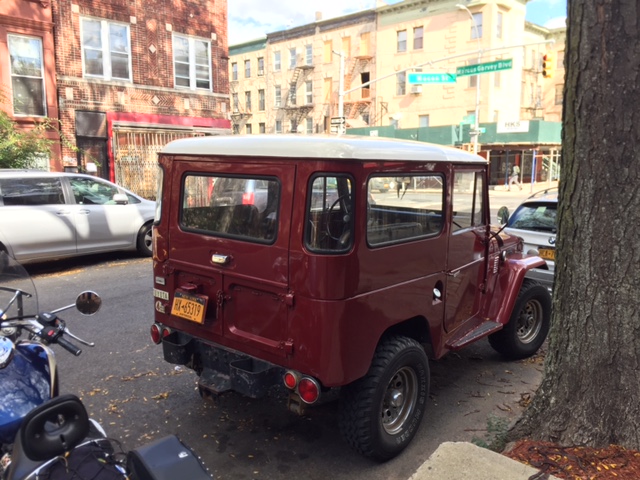
From this angle you can see that the tailgate is a 3 door affair; the liftgate which is attached to the roof, and 2 little doors that swing out to the sides as a tailgate. Above the TOYOTA emblem you can see the one little reverse light.
The white roof is the perfect à la mode for this ride. In a more practical sense a white roof on a truck with lots of window glass and probably lacking air conditioning helps to keep the interior cool in summer. *I love the little triangle of non-slip material on the step that's built onto the back of the front fender.
Like the Jeep the roof is removable. That line above the rear wheel well is the seam so you can see how low the body is with the roof off. Also like the Jeep the windshield folds forward and can be latched flat to the hood and the doors are easily removed. With that configuration you can easily amble through dense jungles and forests as your clearance would be the top of the steering wheel.
SO BASIC. There are no door panels just the stamped metal interior. The seats are plain as day, the steering wheel looks like a truck from the 1930s, and the switches and knobs on the dash look like the cheapest most straightforward items you can buy from the hardware store.
Those round turn signals on the fenders indicate that this is a '60s model as they would become big squares in the '70s. The bumper is an unapologetic push bar with plenty of space for a winch.
I've always loved these rides since our neighbor Pat drove one when I was 7 or 8 years old. They enjoy a well deserved cult collector status and the values can be surprisingly high for a nice example. If you find a rare body style like the long wheelbase passenger version of the pickup truck you can expect to pay over $50,000 for a mint example, even into the 6 figures. Trucks like the one here routinely go for between 20-30 grand. Great rig if you don't mind trading creature comforts for coolness and off road ability.

Friday, December 16, 2016

Extremely Cosmopolitan

EXTREMELY COSMOPOLITAN 
I was driving around the furthest corner of Brooklyn where the edges of neighborhoods are bordered by marshes leading into Jamaica Bay when this beached whale presented itself. Gadzooks!
This improbable beauty is a 1950 Lincoln Cosmopolitan Sport Sedan in Admiral Blue.There weren't many produced (I found a production number of just 1,315 for the 2 door Club Coupe) and to find one today in NYC is crazy.
This has a slightly unnerving leer from the front. That wide grill not only cools the Flathead 337 V8 within but also contains a modern (for the time) fresh air ventilation system. The Flathead replaced the trouble-prone if awesome V12 from previous years! 12 cylinder engines can be smooth as silk when tuned perfectly but they are a handful to maintain. The distributor cap for a V12 looks like a flying spaghetti monster with all its wires coming out of everywhere.
This generation was introduced in 1949 and represented a vast leap from the timeworn designs carried over from pre and post WWII. The '50 Mercurys are some of the most popular cars for customization, usually by chopping the top and making each one into a Lead Sled. The Lincolns were always more luxurious than their sibling Mercury. In 1951 power windows became standard which was unheard of for the era.
Here we can see the headlights which are frenched from the factory (when something is frenched it means it is set into the body as opposed to attached to the exterior). The paint looks pretty correct for such an old car. Clearcoat wasn't a thing 66 years ago so the paint would have this thick look. Getting paint of this vintage to a show car shine requires lots of polishing by hand.
That jet hood ornament ushers in the Jet Age when airplane motifs became ubiquitous.
Those fuzzy dice are the worst. The interior is in great shape overall with seats and door panels in fine condition. This ride is fitted with the optional GM Hydramatic transmission! By 1949 the Ford motor company had to eat humble pie and order transmissions from their archrival as they hadn't developed one to that point.
There is a space for the original radio but with the knobs and station memory buttons missing I'm guessing the unit has been removed. You can just see the speaker grill under the dash.
Clean and clear style was the order of the day. Compare these understated taillights to those of 10 years later in the era of fins.
Here we see the bathtub shape in full display. The trunk, like everything in this ride, is massive.
I pulled over and asked some folks standing across the street if they minded if I took some pictures. The response was "yeah sure, it belongs to our neighbor. Maybe he'd want to sell it; he owes me money!".
The owner of this Lincoln pulled up just in time to hear this and they got in a huge cursing and screaming match all the while both being nice to me. It was totally bizarre and had something to do with an electric bill or something so I snapped my pics and took off. I did however learn that this car was from Southern California (which explains the condition) and that it was heading back there with the owner the following week. I can only assume it is there now so I was lucky to see it when I did.

Thursday, December 15, 2016

Cold blooded assassin in wolfs clothing

COLD BLOODED ASSASSIN IN WOLFS CLOTHING
I was on a much needed coffee run in Gowanus, Brooklyn recently when a combination of the Jaws theme and Al Jarreau started playing in my head. I looked to my left and there it was!
Let's get this out of the way first for the uninitiated: this car is AWESOME. Yeah yeah yeah it looks like any old Bimmer but it's actually a legit luxury supercar from the go-go '80s.
What we have here is a 1983-1989 BMW M6 in Lapis Blue.
This little badge lets the public know that this is more than your standard 635. The M stands for Motorsport which is an abbreviation of the specialty racing division of BMW that produces the M cars (the full name is BMW Motorsport GmbH). This division was established in 1972 to ramp up the racing presence of the company. The first M-Series car in its own right was the legendary 1978 M1. The M1 was a true supercar; more a race car with a passenger seat and heater than an everyday auto.
In 1983 the M6 was released to worldwide acclaim. The motor from the M1 was fitted into a 6-Series coupe, and upgrades were made to every facet of performance such as suspension, brakes, transmission, etc. To me this is the best of all worlds: a big comfortable car that performs like a race-prepped rally winner.
This forward-leaning aggressive schnoz gave way for the nickname of the Shark for this era. The BBS wheels are original to the M-Series, as is the front spoiler.
 Bruce Willis drove an '80s BMW 6-Series in the show Moonlighting. Here is the theme song by Al Jarreau in the most '80s show opener ever.
A mere 1,767 of these first generation 6-Series M cars were sold new in all of North America between '83 and '89 which makes this a seriously rare bird.
This little wing is another detail specific to the M6. In non-performance trim this car is the E24, or 635CSi. It is the evolution of the elegant and beautiful 3.0 from the '70s.
Each of the engines for the M-Series were hand built to exacting performance standards. Not only that, but each and every M was tested at the Nürburgring race track complex. This is arguably the greatest complex of racing tracks in the world, the largest of which boasts a 16+ mile meandering loop that has over 1,000 feet in elevation change.

As befitting the performance ethos this car was only available with a 5 speed manual.
It wasn't the sort of setting where I could really lean in and snap the interior but even from this distance you can see the nice leather seats. Overall this interior is extremely well appointed with a full compliment of creature comforts such as air conditioning, stereo, and power windows.
When this car came out it was an exercise in subtlety. The previous generation of muscle cars sported massive decals, garish colors, hood scoops, and other calling cards that said "LOOK HOW FAST I CAN GO" before they were even turned on. Then the M6 comes along with only tiny identifying features visible, yet this ride was able to achieve a governed 155mph without issue. Rally driver Rug Cunningham got his 1989 M6 up to a recorded 176mph while running the Mexican La Carrera Classic. We're talking top speeds within 10mph of the Lamborghini Countach in a totally reliable comfortable package complete with rear seats!
I've loved these cars since I was a kid and always had a fascination for the M6 specifically. I remember a car magazine featuring a company called Dinan that made ultra high performance upgrades for BMW back in the '80s (and up to this day). They featured an M6 with the full compliment of Dinan upgrades including a turbocharger. They called it one of the fastest cars they ever tested, and I've wanted one ever since. To find one a block and a half from the Gowanus Canal just about blew my mind.

Tuesday, December 13, 2016

The 'bird that Jim Rockford rejected

THE BIRD THAT JIM ROCKFORD REJECTED
Ah sweet Chico, California; the land where cars sit in stasis. You could pour salt water on the hood of your car every day for a year and the paint would be ruined but the car would still refuse to rust. To this day it's common to see little old ladies piloting massive '50s cars to the local supermarket. It was someone just like that who pulled this beauty into the library parking lot one day:
This is a 1979-1981 Pontiac Firebird Esprit in Nocturne Blue. The Esprit was the luxury edition of the famous muscle car that came with sound deadening insulation, enhanced trim pieces, and the deluxe interior.
The entire front piece is made of Urethane. This isn't exactly a plastic or rubber but it's own hardy concoction. The warping visible below the headlights here might be attributed to gentle parking knocks but also somewhat due to heat. Summertime in Chico can produce weeks of 100+ degree weather.
The hood is spray painted where the famous "flaming chicken" would be located. It's awfully suspicious and so I can only guess there was a decal originally that was peeling off.
James Garner always drove a gold Esprit as Jim Rockford in the Rockford Files. For those who remember it and don't mind having it echo in your brain for the next hour here's the awesomely synthy theme song. Rockford drove a new Esprit every year in the show until '78. He disliked the redesign shown here and as a result used a '78 Pontiac for the final 2 seasons.
Chrome outlining on the wheel wells, surrounding the windows, and along the rocker panels are all Esprit hallmarks. The wheels are stylish Pontiac originals, but less aggressive than the famous Snowflake heels worn by the Bandit car.
The Trans-Am and other higher horsepower Firebirds had front and rear spoilers that wrapped around the wheel arches as well s a rear wing.
The full-width taillight opening looks great to me on this ride. Cars that have the wing on the back make the same taillight look totally different somehow.
The trunk looks like a replacement or at least a different shade from the rest of the car. The intense sunlight in central California can wreak havoc on paint to be sure, but the roof looks alright on this ride. Maybe they had the sides repainted for some reason? Who knows?
From this angle you can see the heritage in this body style. This is still only the 2nd generation of Firebird even though the name was introduced back in 1967. This body was first released in 1970 and still managed to look fresh a decade later due to subtle front end changes. Remarkably the 1979 model year was the highest production Firebird ever at 115,535 sold. For a 10 year old design it is an amazing achievement. 

Nocturne Blue is a rarely seen but beautiful color. Every collector wants a Bandit edition '77 Trans-Am in Black with Gold trim, but there were many other colors available. In fact there was a series of special edition Esprit models in '77 with unique exterior and interior color combos: the light blue Skybird, bracingly yellow Yellowbird, and the fire engine red Redbird all debuted in 1977.
Here's a small version of the mighty flaming chicken that would have covered most of the hood. There were actually many iterations of the chicken decal over the years and across different models. Anyone with a curiosity on the subject can check this link out.
It looks like this ride had the original radio intact. The steering wheels is definitely the deluxe version as opposed to the much more aggressive Trans-Am wheel.
 I love the ingenuity of the homemade cup holder straddling the console! No Big Gulps for this driver as both openings seem can sized.
That's where we'll leave this bird to roost.
Like most guys of my generation I've loved this car since Smoky and the Bandit came out. In high school they were still cheap and widely available rides. One of the fastest (and scariest) cars I ever rode in was a late '70s Firebird with the entire front piece missing. There were 4 square headlights and a radiator exposed in the wide open front but the car could just barely lift the wheels off the ground when you stomped on the gas and hit 130mph on Route 84. After that hellride I was captivated! Only in the last couple years have the values started to soar. If you want one of these I would buy one right now as they won't stop climbing n value soon.