Showing posts with label USA. Show all posts

Sunday, February 10, 2019

GMC Palm Beach

GMC PALM BEACH!
I was riding my bike along a grimy stretch of 58th Street in Brooklyn between 1st and 2nd Avenues when this mighty vision presented itself:
Abbondanza!
This colossus is a 1973-1978 GMC Motorhome wearing its original Palm Beach livery.
These capsule shaped RVs are unique for several reasons. First of all they are the only motorhome manufactured by a major automaker in history. The fact that the truck division of General Motors designed and built this RV start to finish in-house means the components all worked together beautifully and parts remain available.
The other wholly unique feature is that these motorhomes were all front wheel drive! They incorporated the Olds Toronado running gear, starting with the 455 V8 and moving to the 403 in later years. Some of them used the Cadillac 501 that came in the Eldorado
Because the engine and transmission were sitting with the drive wheels up front there was no need for a driveshaft hump that would require a higher floor. Much like the Toronado and Eldorado, these rides boasted a low, flat floor front to back. One quirky solution to keep the low floor full-length is that the rear wheels are not connected by axles! Each pair of wheels on each side were connected to each other, but not to the ones opposite. Only the wheel wells themselves would encroach on the interior, and not by much.
From the above angle we can see that this is the full size, 26 foot model. There were some 23 foot ones too but they are much more rare.
While it's not a door the entire rear panel can be taken out by removing all of the bolts you can see here. This allows for an easy remodeling of the interior or even installing an entire store-bought bed.

This single door is the only way in or out. The body is fiberglass over an aluminum frame which was strong and aerodynamic.
The fact that it was a large fiberglass shell allowed for more window space than any RV previous.
You've gotta love the original color scheme and decals. Palm Beach only denoted this color combo as well as matching interior. The 260 designation meant that this was the 26 footer.
That huge roll out awning on the door side would give you a righteous side yard. From this angle you can see the burgundy and silver model lurking in the background. Either these folks are rolling insanely deep or one of these is a parts rig.
Well there you have it; an innovative motorhome parked amidst crumbling warehouses. A total of 13,000 of these were built by GMC over the span of 5 years, and an impressive 7,000 of them are still registered today! That makes this one of the most durable and reliable vehicles ever made, which on the surface seems absurd. If you have the parking space and want a vacation cruiser I think this is the way to go. There are serious fan clubs and aftermarket suppliers looking to keep every one of these on the road. For $15,000 you can find one in just about perfect condition with all the mechanicals rebuilt and the interior upgraded. Happy Trails!

Saturday, February 2, 2019

Topless Americana

TOPLESS AMERICANA
Robin from Omaha sent in these pics over a year ago. I don't remember exactly but I think he might have been visiting some friends along the southern shore of Long Island. Regardless, look at this all-American beauty!
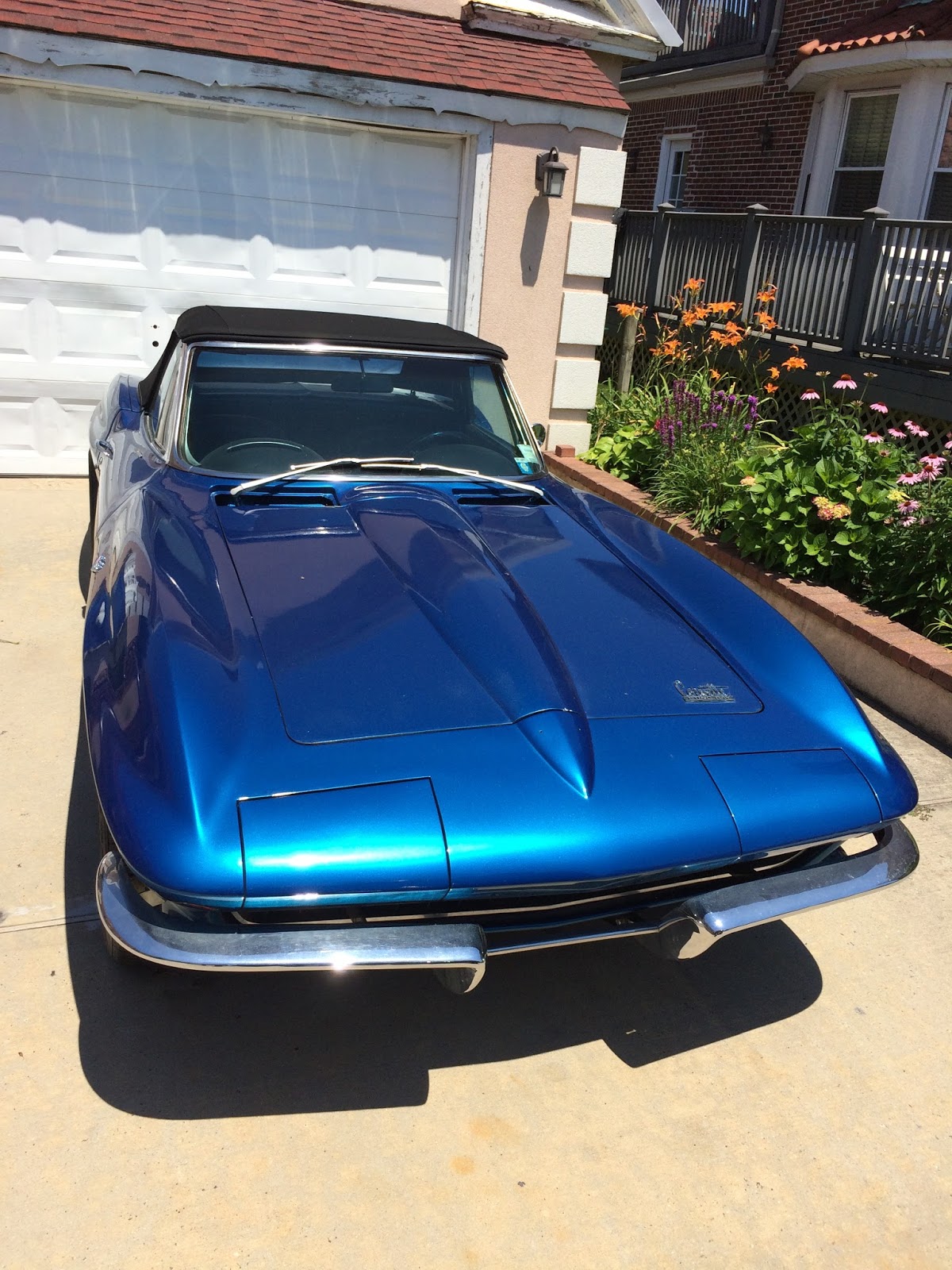
This is a 1966 Chevy Corvette convertible in some aftermarket blue (the closest factory color I could find was Marina Blue but that's not as dark). These mid-'60s 'vettes are some the of the quintessential years of the brand.
Dig this long nose with the hideaway headlights. The engine would originally have been a 327 V8. There was a 427 available as well but the hood would have a prominent bulge just to fit it.
This is one athletic, sexy ride. As with all Corvettes the body is fiberglass, engine up front, and drive wheels in the rear. The big wheel wells and rounded fenders make this thing look like it's going to pounce at any second. Those rims are from a late '70s 'vette.
Behold one of the worst gas cap placements for paint jobs ever - right in the middle of the trunk! This flip-up fuel door looks super cool, but dripping on the body is pretty much guaranteed.
That body-width line above the gas cap is the hinge side of a lid covering the space where the convertible top lives when you lower it. To access that hidden well you simply lift up on the rear edge of the top which will disengage and swing forward. Then there is a button under the front of the lid behind the seats to unlock the lid. It opens to the rear, allowing for the entire top to fold back into the space behind the seats. When you close it again the look is sleek as the top is completely hidden.
1965 and 1966 Corvettes were almost identical from the outside but there is one telltale clue: the Corvette script on the front driver's side of the hood means it is a '66. The '67 looked similar but those 3 big gills on the side would be 5 smaller ones. If this were a 1964 'vette there would be two indentations on the hood on either side of that middle spear. 
This is a perfect example of "if it ain't broke don't fix it". The 1965 Corvette sold like crazy. Then this 1966 comes along with basically zero changes and it continues to sell like nobody's business. The combination of lightweight, sexy body and enormous motor proved irresistible to the public. The next generation would come along in 1968 looking like a mako shark. It would continue all the way up into the '80s, proving that Chevy had a real winner on their hands for decades. 

Friday, January 18, 2019

Type-10, or "A Cadillac Cimarron with Cloth Seats

Type-10, or "A Cadillac Cimarron with Cloth Seats"
Sometimes the rarest classic car on the block is a well kept secret hiding in plain sight. Even calling the gray doorstop below a "classic car" would get the blood up of many collectors and aficionados my age. Regardless, behold the tiniest patch of fog in Bay Ridge!
This is a 1987 Chevrolet Cavalier Type-10 in one of five colors GM called Silver Poly that year (itself a damning testament to the automotive landscape of 1987). This is the last year of the first generation which debuted in 1982. As a reliable and efficient front wheel drive compact the Cavalier was popular for its entire run through 2005.
Type-10 was the name given to all 2 door Cavaliers, which included a notchback as well as this hatchback. 4 door sedan and wagon versions vastly outnumbered the Type-10s which makes this a rare beast indeed. As an example just over 6,000 of these were built in '87 compared to over 150,000 of the 4 door. I have a friend who owned a 4 door BROWN Cavalier with a manual transmission back in the day that I loved. At the time I had my '63 Beetle and we even traded cars for a week while living 2 states away. There was something so unabashedly uncool about a 1980s compact sedan that the stick shift made it a secret weapon: the ultimate 90 horsepower sleeper, complete with White Zombie stickers on the dash.
I'd like to point out that this car is missing its front passenger side hubcap. Unlike most, this is literally a small cap to cover the wheel hub itself.
The shape harkens back to the X-Body (Citation, Phoenix) 4 door that bowed out in 1985. This ride is built on the J-Body platform, which brought you such hits as the Pontiac Sunfire, Olds Firenza, and Buick Skyhawk. The Skyhawk and Sunfire offered bizarre power headlights in the form of little doors that lifted up like eyelids while the headlights stayed in place. The Pontiac power headlights were never fully closed, with the lower thirds of the bulbs visible under the doors giving a sleazy, heavy-lidded look.
You can't tell me that this rear end doesn't look like the fabled DeLorean! The gridded multi colored taillights are very similar, as is the long sloping rear window. Those quarter windows have a small black dot near the top edge. This is the pop-out mechanism for ventilation, otherwise this thing would fishbowl so bad in the sun.
For anyone that wants to try and date one of these they might run across in the wild, the word Chevrolet was on the right side of the rear fascia until 1986. The CS designation is a trim level one baby step above the base model. There was a much faster sport version called Z24 starting in 1986 originally only for the Type-10s.
From this angle you can actually see some styling effort. The lower edge of the rear window is inset into the body, and a faux wing indentation above the taillights. It's not much but it's something!
Cavalier is such a funny name for such low-hanging fruit. The main definitions are offhand, indifferent, casual, and dismissive (which sums up this owners parking style). Chevy had a cavalier attitude about delivering the best possible design for the '80s I suppose. The Cavalier was the basis of one of the greatest crimes in recent automotive history though.
 In 1982 Cadillac decided to take its heralded luxury nameplate and shove it into a J-Body sausage casing, resulting in the Cimarron. Widely and famously known as the most egregious case of badge-engineering gone wrong, the Cimarron was obviously a Cavalier with a fancy grill & hood ornament. No matter if leather seats and sound deadening were a part of the package, the Cimarron's disguise didn't fool anyone. Cadillac barely slipped the cinderblock tied to its legs to come back to the surface.
This is the standard GM interior of the mid to late '80s. That pull-out door handle in its plastic square, the flat expanse of the dash and glove compartment, and the tall block housing the gearshift are all too common across the likes of Corsica, Lumina, Beretta, and Pontiac 6000. The factory stereo has a cassette delete in the form of a plastic cover even bigger than the cassette door would've been. This is the interior of my high school friends cars.
Looks like this frumper took a good knock to the jaw at some point, but it's still standing strong. Besides this spot the overall condition is pretty damn good for a 30+ year old car. Most GM products of this era have paint jobs that look like they reentered the atmosphere. This "color" is as boring as it gets, but it is intact.
Well there we have it: a pseudo sporty yawn on wheels from the deepest corner of the Malaise Era. Just for kicks I looked up the current values on this ride and found that it starts at $195 for salvage condition and makes its way up to $5,850 for an absolutely pristine, flawless, museum quality example. In reality there might be 2 mint examples of this ride on earth, and to the middle aged success story who had this as a first car the value might reach 15 or 20 grand (stranger things have happened). If you stumble upon one being sold by the relative of a recently deceased owner who kept it in the garage and serviced it at the dealer I say pick it up! Parts are easy to get, and it will turn as many heads as a Chevelle at most 2019 car shows. Mark my words oh Grumpy Baby Boomer: the J Body will have its day, just as easily as mid-'70s gas crunch rejects are having theirs today.

Wednesday, December 27, 2017

Ever see the end credits for Superbad?

THE OLDEST CAR I'VE EVER OWNED (YET)
I believe these pics were sent to me from the man on the street, Robin of Omaha. Somewhere under the BQE between Williamsburg and Greenpoint roosts the following XXX beauty:
This is a 1947 Dodge D24 Custom Town Sedan in what I think is Panama Sand. It is filthy and as a result has been festooned with penises. Somewhere out there is a person with a dirty mind and a dirtier finger, and for that I salute them!
Look at this big dumb mug.
This represents a slightly improved holdover from the pre-WWII years. From this angle we can see that the hood is hinged down the middle, with each side opening up like wings. The massive fenders are mostly separate from the body which would look ridiculously outdated within a couple years. Those big square turn signal lenses are made of thick glass with magnifying facets like those of a lighthouse light. These cars were 6 volt so the puny lights needed the extra help. 
There are no hubcaps on this side and even a donut on the back!
The Custom was the highest trim level of the D-24 series, with the Town Sedan being a specific body style. The easiest way to discern a Town Sedan is that the rear doors are hinged in the front whereas the other 4 door models had suicide doors in the rear. Another detail is that there is no rear quarter window behind the rear door which all other 4 doors had. Lastly the Town Sedan came on a wheelbase 18" longer than the others. Think of this as the modest mans limo.
The sheer amount of manhood somebody scribbled on this ride is incredible!
The trunk on this ride is so mighty that the spare tire stands upright to one side within. 
Looking good with wide white walls, hubcaps, and beauty rings on the driver's side! This beast is powered by the 230 inline 6 cylinder mated to a 3 speed standard transmission. A notable option for this era was the Fluid-Drive; a semi-automatic transmission where you didn't need the clutch to shift into 2nd or 3rd gears. If it were so equipped it would have Fluid-Drive in red script on the rear bumper.
Well that's where we'll leave this slumbering behemoth waiting for a bath.
The oldest car I ever owned was a 1947 Dodge. While driving through North Providence one day back in the '90s when I passed it sitting on a dirt lot with "$850 - runs" written on the windshield. I made my way to a pay phone (!) and dialed the number on the spot. The guy came down and it fired right up. After driving it around the lot a few times I went to the bank and gave him the 850. It was massive and handled like a dump truck but was equipped with Fluid Drive and was in really good condition actually. A few weeks into my brief ownership I lost the brakes completely on my way down a gentle hill (the pedal dropped to the floor like dropping a book on a table - NO brakes!). I slowly ran a red light on my way back to the friends driveway I was parking it at and managed to park it without issue. Realizing I was in over my head (in college without a garage or money) I sold it for what I paid for it to a local guy. They aren't worth much today but I still get nostalgic when I see one.

Friday, October 13, 2017

Mad Men, Tin Men, and Made Men all agree

MAD MEN, TIN MEN, AND MADE MEN ALL AGREE
I was riding my bike along the warehouses of lower Sunset Park when this mighty vision appeared:
Yes! This is a 1962 Cadillac Series 62 convertible in the appropriately named Olympic White.
I've said it before and I'll say it again; the streets of Brooklyn are littered with old Cadillacs but this one manages to tower over the rest even in shabby condition.
Cadillac was the undisputed king of class in 1962. There were more expensive cars out there (not many) and several that were more exclusive but none more damn American than this. One look at how stylized the logo here had become will show you how streamlined the entire look was.
It is a coincidence that this is a Series 62 from '62 as the Series 62 name was used from 1940-1964. It represented the entry point for Cadillac but let's put that in perspective. First of all this is absolutely a luxury car, and a convertible to boot. The lowest Caddy is like the most humble Rolls Royce.
*The one surefire way to pinpoint the vintage on this ride is the shape of the turn signals. The otherwise identical 1961 Caddy had perfectly round signals as opposed to these rectangles.
This sleek front end treatment was only produced from '61-'62. The massive yachts of the '50s had brooding eyebrows hanging over the headlights, a look that would return from '63 on. For these 2 years there is a fresh faced eagerness to these big rides that suits it beautifully.
One great design element left over from the previous decade is the fact that the front bumper makes up the leading edge of the wheel well. These bumpers are absolutely mammoth.
My favorite features of the '61-'62 Caddys are the lower fins that start just behind the front wheel and emerge as sharp points in the rear. This car has 4 freaking fins! At the same moment when they were leaving the automotive scene Cadillac decided to double down.
Few cars are such natural convertibles as these big Caddys.
Dig the faux grill treatment on the rear - another design holdover from the 1950s. The Ecto-1 from Ghostbusters was based on a Caddy from just 2 years before this example. These fins, while prominent, are massively downsized from the 1959 peak.
Even grubby and schlubby the lines on this ride are unbeatable. A little bit of black electrical tape is securing the end of the fin. Those fin lenses do light up with the larger taillights by the way.
A free breathing 390 V8 lurked under the massive hood which had plenty of grunt to toss this beast around as if it were a much smaller car. Cadillac was proud of the performance and handling, something you might not expect from a 4,600 lb car. Since they were the flagship of the entire General Motors company they spared no expense in perfecting these rides as best they could. Starting price for this ride before options was a whopping $5,588!
Anyone who watched Mad Men knows the deal with this ride and they weren't exaggerating the lifestyle. This Caddy came from the factory with 4 individual cigarette lighters and ashtrays! If they offered an ice machine and martini bar option they would've sold a million of them. The somewhat forgotten Danny DeVito/Richard Dreyfuss movie Tin Men featured Caddys like this as part of the backdrop. It goes without saying that this was THE car of choice for the Mafia (not that there is a Mafia of course because the Mafia doesn't exist).
If those pointy spoke wheels didn't already give it away we can see from the interior that this ride has led a couple lives. This is flashy period correct early '80s lowrider style upholstery. Seeing the fender skirts in the backseat means that this ride is only missing a front signal lens.
Chrysler tried with the Imperial and the Ford Motor Company tried with their Lincoln Continental (losing money on every one they sold) but nobody made a convincing attempt to topple Cadillac from the top of the automotive heap. In this era the Old World stalwarts Rolls Royce and Bentley produced bloated, out of date cars by hand. As a result the production would remain minuscule and prices astronomical. Cadillac produced 16,800 Series 62 convertibles in '62 alone while Rolls and Bentley combined for less than 6,000 cars.
Out of the many vintages of desirable Cadillacs the '62 is a wonderful choice for the collector or classic car fan who wants a drivable ride. The mechanicals are widely available and easy to work on. You'll never save on gas money with one of these but you can sit in it while parked and still outclass everything on the street.

Tuesday, October 10, 2017

The greatest wrong car at the wrong time

E FOR EXPERIMENTAL, EDSEL, AND EXTINCT
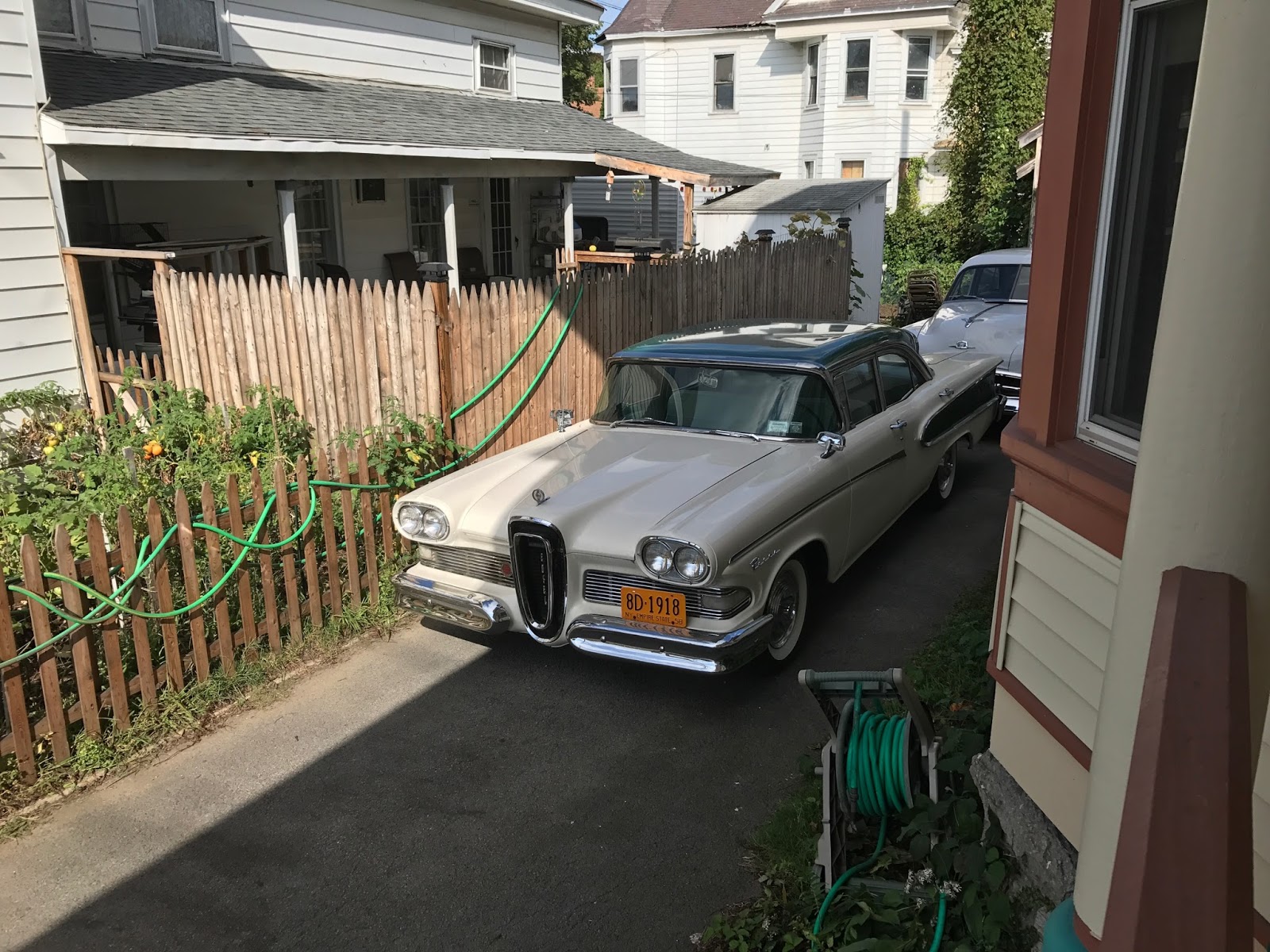
Big thanks to Neen from the Empire Region who sent these lovely snaps in of a landmark footnote brightening up a driveway in Glens Falls, NY!
There are a few automobiles in history that have a reputation that transcends reality. Not every Ford Pinto is going to explode if hit in the rear. Not every Rolls Royce is a great car (I'm looking at you, Carmague). The hardest sell to the general public will be this statement: The Edsel is not and never was a bad car!
This is a 1958 Edsel Pacer in two-tone Snow White over Spruce Green Poly. This beast is a Greatest Hits of late '50s styling; flashy chrome, tall and wide shape, and Jet Age features like the head and tail lights jutting out in their own enclosures. Still there is one big, rounded design elephant in the room that the public couldn't see past. 
That wide open Horse Collar center grill looks like a jet engine intake to me, and I'm sure that was the intention of the lead designers. I don't know if it was too advanced or too ugly, but once an auto journalist proclaimed that it looked "like an Oldsmobile sucking a lemon", that's all the public could see.
Horse collar was one commonly used term, toilet seat was another. Regardless this center grill opening proved too daring for 1958. The following year would see this same basic look toned way down. The 1959 Edsel had no space between the three grill components and the center collar was much smaller. The hood ornament is an E suspended in glass which is a neat look.
*E was the given name for this ride while it was in development, standing for Experimental. After a committee within Ford tossed around dozens of potential names they chose Edsel. The name proved too hard to place for the public, one of the many missteps in this sad story.
The dimensions are pure Ford of this era. This one is as minty fresh as can be! The fit and finish where the grill and headlight surrounds meet the body is flawless. That chrome spear running along the fender is laser straight. Everything about this Edsel says "show winner".
The shape of the vent window shows just how far the wrap-around windshield goes. That green upholstery is perfect and correct.
The Edsel was the most expensive car to build up to that point at 250 million dollars just in research and design. This made it all the more tragic once it was deemed a flop after just 2 years (not to mention it takes its name from Edsel Ford; son of the company founder Henry Ford.

All that design money went into myriad innovations, some of them downright bonkers. For instance take a look at the center of the steering wheel. Where 99% of auto makers put the horn the '58 Edsel had their Teletouch system; a push button automatic transmission. That's all fine and good when operating under normal conditions, but when you truly need the horn you're instead slamming your palm into a cluster of buttons, throwing the car out of gear in the process! As you might imagine this lasted only 1 year before switching to a traditional column shifter.
Another cool feature was the speedometer which is barely visible in the pic above. Through the vent window there is a round dial identical to the one on the other side of the wheel. Above that dial you can just about see what looks to be a glass dome laying flat with a chrome band along the bottom. Within that dome is a round speedometer where the numbers are written around the angled edge. The inner dome would circle around while the needle was stationary. 
From this angle all we see is a beautiful 1950s sedan with its two-tone cove and rear panel.
The wheel wells lean forward giving the impression of movement. The trunk is gargantuan!
Unfortunately the Edsel was such a horrific disaster that its name became synonymous with failure. Not only did it look odd, but it was released into the now-forgotten mini recession of 1958. They never had their own dedicated factory, with Edsel being built in Ford and Mercury plants, usually at the same time. Imagine assembling 30 Mercurys in a row and then 3 Edsels come along on the assembly line! As a worker you have to grab the necessary tools for the Edsel out of another bin, perform your tasks, and then switch back to your usual Mercury gear. As a result there was great variation in build quality.
I had an Edsel once. When I was home from college I passed by a 1959 Edsel Ranger 2 door with $450 written on the windshield. Being a '59 it wasn't quite as odd as the '58 but it still captured everyones imagination who saw it. Registering it involved forging the signature of a man who'd been dead over 10 years as it had been sold several times but never registered after the 1st owner. My ownership of this heavily neglected beast was brief but entertaining. One day while driving I realized there was a mini pedal under the dash to the right of the accelerator. I stepped on it and the windshield wipers moved once! A great and forgotten feature from a maligned and wrongly accused car.