Showing posts with label Exotic. Show all posts

Tuesday, October 10, 2017

The greatest wrong car at the wrong time

E FOR EXPERIMENTAL, EDSEL, AND EXTINCT
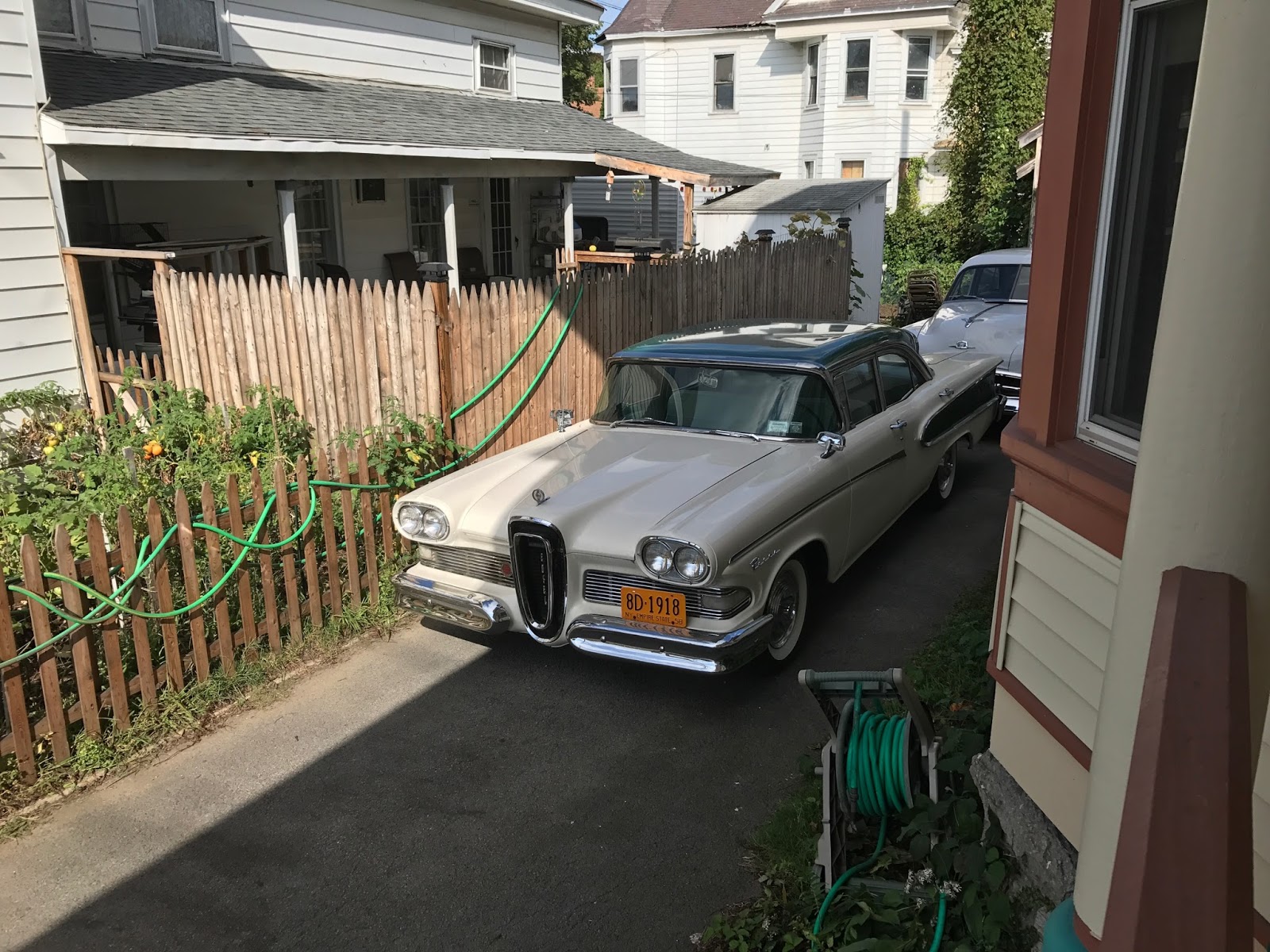
Big thanks to Neen from the Empire Region who sent these lovely snaps in of a landmark footnote brightening up a driveway in Glens Falls, NY!
There are a few automobiles in history that have a reputation that transcends reality. Not every Ford Pinto is going to explode if hit in the rear. Not every Rolls Royce is a great car (I'm looking at you, Carmague). The hardest sell to the general public will be this statement: The Edsel is not and never was a bad car!
This is a 1958 Edsel Pacer in two-tone Snow White over Spruce Green Poly. This beast is a Greatest Hits of late '50s styling; flashy chrome, tall and wide shape, and Jet Age features like the head and tail lights jutting out in their own enclosures. Still there is one big, rounded design elephant in the room that the public couldn't see past. 
That wide open Horse Collar center grill looks like a jet engine intake to me, and I'm sure that was the intention of the lead designers. I don't know if it was too advanced or too ugly, but once an auto journalist proclaimed that it looked "like an Oldsmobile sucking a lemon", that's all the public could see.
Horse collar was one commonly used term, toilet seat was another. Regardless this center grill opening proved too daring for 1958. The following year would see this same basic look toned way down. The 1959 Edsel had no space between the three grill components and the center collar was much smaller. The hood ornament is an E suspended in glass which is a neat look.
*E was the given name for this ride while it was in development, standing for Experimental. After a committee within Ford tossed around dozens of potential names they chose Edsel. The name proved too hard to place for the public, one of the many missteps in this sad story.
The dimensions are pure Ford of this era. This one is as minty fresh as can be! The fit and finish where the grill and headlight surrounds meet the body is flawless. That chrome spear running along the fender is laser straight. Everything about this Edsel says "show winner".
The shape of the vent window shows just how far the wrap-around windshield goes. That green upholstery is perfect and correct.
The Edsel was the most expensive car to build up to that point at 250 million dollars just in research and design. This made it all the more tragic once it was deemed a flop after just 2 years (not to mention it takes its name from Edsel Ford; son of the company founder Henry Ford.

All that design money went into myriad innovations, some of them downright bonkers. For instance take a look at the center of the steering wheel. Where 99% of auto makers put the horn the '58 Edsel had their Teletouch system; a push button automatic transmission. That's all fine and good when operating under normal conditions, but when you truly need the horn you're instead slamming your palm into a cluster of buttons, throwing the car out of gear in the process! As you might imagine this lasted only 1 year before switching to a traditional column shifter.
Another cool feature was the speedometer which is barely visible in the pic above. Through the vent window there is a round dial identical to the one on the other side of the wheel. Above that dial you can just about see what looks to be a glass dome laying flat with a chrome band along the bottom. Within that dome is a round speedometer where the numbers are written around the angled edge. The inner dome would circle around while the needle was stationary. 
From this angle all we see is a beautiful 1950s sedan with its two-tone cove and rear panel.
The wheel wells lean forward giving the impression of movement. The trunk is gargantuan!
Unfortunately the Edsel was such a horrific disaster that its name became synonymous with failure. Not only did it look odd, but it was released into the now-forgotten mini recession of 1958. They never had their own dedicated factory, with Edsel being built in Ford and Mercury plants, usually at the same time. Imagine assembling 30 Mercurys in a row and then 3 Edsels come along on the assembly line! As a worker you have to grab the necessary tools for the Edsel out of another bin, perform your tasks, and then switch back to your usual Mercury gear. As a result there was great variation in build quality.
I had an Edsel once. When I was home from college I passed by a 1959 Edsel Ranger 2 door with $450 written on the windshield. Being a '59 it wasn't quite as odd as the '58 but it still captured everyones imagination who saw it. Registering it involved forging the signature of a man who'd been dead over 10 years as it had been sold several times but never registered after the 1st owner. My ownership of this heavily neglected beast was brief but entertaining. One day while driving I realized there was a mini pedal under the dash to the right of the accelerator. I stepped on it and the windshield wipers moved once! A great and forgotten feature from a maligned and wrongly accused car.

Saturday, July 1, 2017

ALFA ROMEO TIPO 102 - testarossa bella!

ALFA ROMEO TIPO 102 - testarossa bella!
Robin of Omaha was recently walking the increasingly pleasant streets of Gowanus when he encountered one of the most beautiful cars ever produced. Just look at this sexy ride:
Dayum! This is a 1959 Alfa Romeo 2000 Spider in Alfa Red. The company referred to this car as the Tipo 102 (Tipo meaning Type). This is just an insanely good looking car on par with the 007 Aston Martin DB5 in my opinion.
That shield shaped center grill is now as iconic to the brand as the kidney grill is to BMW. Alfa Romeo started producing cars in 1910 but it wasn't until 1939 that the shield debuted. This entire front end is fantastic with it's side grills inset into openings that protrude slightly. The turn signal/running lights are more complicated than first glance might suggest. That double snorkel hood feeds air to a 1,975cc inline 4 cylinder. Top speed was 110mph in stock form but Alfas are really race cars waiting to be tuned up.
This car was only built from 1958-1961 and less than 3,500 total were produced. It's always interesting how certain classic cars end up where they do. There's obviously a concentration of wealth in NYC but why should this ride be parked between 3rd Ave and the Gowanus Canal? The "Oldest Italian Restaurant in Brooklyn" is on this block (their claim) so maybe it has something to do with that?
There ought to be a soft convertible top under that boot. Most seem to have a removable hardtop as well that looks great when installed. This is a pure Grand Tourer as it's a 2 seater.
From the rear quarter angle this has more than a passing resemblance to the Ferrari GT California made famous in Ferris Bueller's Day Off. Italian cars tend to be beautiful more often than not (especially in this era) and most convertibles were handbill by separate coachworks. This car was bodied by either Bertone or Touring. Bertone is also responsible for legendary models from Ferrari, Lamborghini, and Maserati so we're talking first class all the way.
Take a good look at those legit and mint spoke wheels with knock off spinners.
The Giulietta was Alfa Romeo's more common and popular car in the late '50s. It was available in both hardtop and Spider versions but it was smaller than the 2000. This ride sports unibody construction which makes for a combination of rigidity and relatively light weight.
*Dig the taillights with their graduated step.
As befitting a classic Tourer the interior is perfect. The dash has a straightforward cluster of big gauges flanked by old school toggle switches. An AM radio even roosts below the dash mounted rearview mirror! The window crank is plainly visible but the door handle placement is bizarre; all the way up at the front of the door panel. I guess you have to pull the handle and kind of use your elbow to open the door from within?
Since it is so rare I could only find one listing for a '59 2000 and the European auction estimate was €90,000 - €110,000 ($102,816 - $125,664). If I had a car this nice I wouldn't park it on a street with so much loose gravel and dirt but then again I might as well decide on a color for my personal plane.
This is far and away one of the most attractive rides that's ever graced the NYCHoopties blog. In the realm of hand built exotic classics the price is very fair (considering that similar Ferraris are well into the millions these days). If I ever see the owner I will do my damnedest to score a ride in it at least once. Bellissimo!   

Sunday, February 22, 2015

Show Car Sunday returns with a staggering find from L.A. Rob!

MIAMI VICE OR CORVETTE SUMMER?
I mean really. Look at the picture below and think about the fact that L.A. Rob just rolls down the street one day and passes this scene. This picture alone could be the Chamber of Commerce brochure for Southern California! Let's get to it;
The lighter color car is a 1963 Chevrolet Corvette Sting Ray with the one-year-only split rear window. To me this is hands-down the most desirable 'vette and really one of the most badass sports cars ever to come from the States. The "lake pipes" side exhaust and wheels are aftermarket additions but the rest, including those big gills behind the front wheels, is factory. But enough of that, there seems to be one of the rarest Ferraris of all time parked directly behind it!
What this appears to be is a 1971 Ferrari (Daytona) 365 GTS/4 Spyder. The name Daytona was actually given to the car by the automotive press after Ferrari won 1st, 2nd, and 3rd place in the 1967 24 hours of Daytona race. This car is exceedingly rare (only 122 convertibles ever produced) and valuable (trading well into the millions when they do come around). Why is it parked on the street?!?
Ferrari built the Daytona from '68-'73. Should you encounter one of these (which you WON'T) you can identify the 1971 and earlier cars by the plastic covered headlights. The '72 and '73 model years had pop-up hidden headlights instead of the covers. The Spyder (convertible) was only produced from '71-'73, so combined with the covered headlights this can only be a '71. 
Every bit of this ride is sexy and athletic. This car is notable for being the last front-engine Ferrari produced before they sold 50% of the company to Fiat in 1969. While they continued an unprecedented string of supercar successes after the merger, the models designed previously were truly hand built machines by a handful of craftsman. This is the last Ferrari built in that tradition, with body panels being hammered out on wooden frames one at a time.
It is hard to not be a bit distracted by that stunning Corvette! The race car style gas cap under the split window, 6 round taillights, and split bumpers are all class.
The 2 large vents on the Daytona hood provide air for the 4.3 Liter V12 and its 6 Weber carburetors. 
The round taillights continue as a design hallmark of Ferrari to this day. Rob says he encountered the owner who was all too happy to show off his ride, even firing it up while he was there! The owner said that this was his daily driver which makes him a king in my book. The fact that the guy sounds nice and generous with someone gawking at his wheels makes me wince a bit when I write the following inevitable truth: this is not a genuine Ferrari, but a high-dollar almost perfect replica based on a '72 Corvette chassis.
Please don't confuse this with any old kit car! In its own right this is a spectacular ride; well engineered (and possibly as powerful as an original Ferrari), beautifully appointed and assembled, and 99% correct in its approximation of the real 365 GTS/4. With only 69 Spiders imported new to the States there was always more demand than supply. Along came a company in San Diego named McBurnie who used to produce these kits in the '80s. For $8,000 you could buy all pieces necessary to transform your 'vette. If you'd rather buy the finished product ready to drive away they would sell you one for $40,000. In 1989 Ferrari won a lawsuit against the company which halted production.
Keep in mind that $40,000 in 1989 amounts to a little over $80,000 in todays money. That was enough to buy a very serious set of wheels back then, so this is no joke.
The only visible clue I can find that this isn't an original is the lack of vent windows on the front door. The McBurnie rides even came with correct Ferrari valve covers to dress up the engine (though nobody will miss the fact that it's an 8 cylinder as opposed to 12). Regardless I would absolutely LOVE to roll around town in this beast! Here she is taking off with its VICE TOO license plates. Rob said it sounded great, and I have no doubt.
*Last but not least a factoid from Rob; a replica such as this was carrying Crockett and Tubbs around in Miami Vice until Ferrari made their fury known. The producers of the series wrote the faux-Daytona out of the script by launching an RPG at it, blowing it to smithereens. Ferrari was please enough by this act to donate the Testarossa they used for the rest of the shows run.

Monday, January 26, 2015

There was a spaceship parked in Greenwich Village on the coldest day of the year

MULTICOLORE FORCE INTÉRIEURE
This car will single-handedly prove how misguided the stereotype of French surrendering is. Take it all in; this is a seriously complicated 43 year old French car living through winter on the streets of Manhattan. Steadfast, loyal, persistent, and durable are the nicknames I bestow upon this beast!
*PS - yes the person in the background is wearing pants.
Under this coat of many colors lies an incredibly important milestone in automotive history. I will break routine here and offer a direct quote from Wikipedia that sums it up nicely;
"After 18 years of secret development as the successor to the Traction Avant, the DS 19 was introduced on 5 October 1955 at the Paris Motor Show." Now let's think about this for a moment; 18 years before the debut of the DS means that research and development on this ride started back in 1937! 18 years in automotive design is a lifetime, but when the DS was introduced it still managed to set the other cars on the road back by 10 years. When you consider what France went through during those 18 years it becomes all the more remarkable.
We know automatically that this car was meant to be sold new in America because the headlights are exposed. The original European edition has a glass lens covering each headlight pod. Up close you can see the sweet styling details that make this car so sweet; reflective trim piece under the headlight corner, curved front bumper, and that funky little turn signal emerging from its concave home.
Another even more unfortunate omission on the U.S. model is the lack of directional headlights. Starting with the 1968 European DS the inner headlights turned with the direction of the steering wheel up to a whopping 80°! Why this ingenious feature wasn't allowed in the States is a question of bureaucracy.
This car looks modern today but in 1955 when the first ones were introduced it really looked like nothing anyone had ever seen. The beautiful looks can be attributed to an Italian sculptor named Flaminio Bertoni, while the groundbreaking technology under the skin is credited to Aeronautical Engineer André Lefèbvre. And the technology of this ride was groundbreaking, with myriad advances in ride quality, handling, and braking. While marketed as a luxury ride the DS went on to prove itself a great rally car, winning the Monte Carlo twice and competing strongly all the way up through the mid-'70s.
I dig the cool DS emblems on the sail panels.
Having the rear turn signals mounted so high up is a great safety feature. On this futuristic cruiser they look more like jet engines propelling this into outer space.
Part of the reason this car handles so well is that the entire roof is fiberglass which makes for a very low center of gravity. The DS also sports a fully hydropneumatic independent suspension, inboard brakes (where the brakes are mounted to the inner part of the axle as opposed to the wheels. Jaguar XKEs used these too), and front wheel drive. The hydropneumatic suspension allowed the car to be self-leveling as well as offer a variable ride height. In postwar Europe the roads were pretty beat up, but the DS would deliver a soft and luxurious ride over even the worst surfaces.
Enough fawning already; let's take a moment to enjoy just how multicolored and patinaed this car is! Most of the trim pieces and brightwork are still present with the exception of the rear corners. The trunk looks to have been sourced from some desert junkyard where the paint with dissolve in the sun and blowing sand. The amount of salt all over the sides tells me this has been parked on the city streets for a while where the plow trucks cruise by spraying salt with enough force to reach the sidewalks.
That double chevron emblem on the trunk is the logo for Citroen by the way.
Here we get a good idea of just how low the car sits when parked. In true lowrider fashion the rear of the DS would raise up by 4 or 5 inches when the car was started.
Such an odd shape overall. Just look at the line of the hood that is basically an S curve. Beat-down and heavily used this thing looks bizarre and menacing. In great shape with a nice coat of paint and all trim shiny it can cut quite the dashing presence though. 
That funky front wheel is pure Citroen. I believe the company used this exact wheel for everything from the diminutive 2CV and plastic-bodied Méhari all the way up to their "large" delivery trucks (still small by U.S. standards). The only difference I can reckon is that the smaller cars had 3 lugs per wheel while the larger had 5. Imagine the perils of losing a lug nut when you start with only 3!
The interior is in a condition similar to the exterior, but you can still see how well appointed and classy it once was. The steering wheel has only one spoke going from the center to the rim. I don't know what was standard or optional on these cars but this one is definitely loaded with am/fm radio and air conditioning. Look like someone elected to install and under-dash removable stereo at some point (most likely the late '80s/early '90s because when was the last time you saw one of those?).
*One cutesy but correct detail is the Michelin Man air freshener hanging from the mirror. Michelin is indeed a French tire company harkening back to 1889.
The original '50s version of the DS had a single headlight on each side that was exposed at the top but sitting in a concave housing at the bottom. This combined with a slightly flatter hood made the car look very much like a frog. If you haven't seen the French hit man movie classic Le Samourai I highly recommend it! The DS is featured prominently throughout this awesome flick.
Though the DS was produced until 1975 this was the last year imported to the States. It was followed by the Citroen CX which looks much like the modernized version of a DS that it is. While the follow-up CX was a massive success none were officially imported to the U.S. due to an idiotic ruling on the Hydropneumatic suspension. It's a shame too, as that suspension was so wonderfully built that Rolls Royce licensed it for use in their own Silver Shadow. Regardless, this is one of my greatest discoveries yet on the streets of NYC and I'm happy to have stumbled across it.