Showing posts with label Italy. Show all posts

Monday, October 16, 2017

The weirdest, greatest supercar you'll ever see

C'EST MAGNIFIQUE!
Robin of Omaha recently sent these pics of a true oddity. Even in stellar condition its not surprising to see this ride hunkered down at the mechanic as it is fearsomely complicated. Behold!
This is a 1972-1973 Citroën SM in Jaune Bouton d'Or (also known as Buttercup Yellow). This thing was so ahead of its time that it shouldn't even be gauged against other automotive makes.
While we're staring this thing in the face let's talk about the main visual difference between the European and U.S. models. In France the SM had 6 square headlights placed behind angled glass like the middle panel above. Also in France the headlights turned with the front wheels! The glass cover and turning ability of the lights were both illegal in the U.S. which is why we can't have nice things. 
Just look at this strange creature. It could be from outer space or the depths of the ocean. The body is extremely aerodynamic which helped take advantage of perhaps the most incredible feature of the SM: it came from the factory with a Maserati V6 motor under the hood!
Those wheels are steel with stainless trim. If you preferred a lighter weight rim they offered a first-ever carbon fiber resin wheel option. As long as this thing is it won all kinds of rallies and races when introduced. When it hit these shores it won the Motor Trend Car of the Year award, a rarity for a non-domestic model at the time.
Top speed from the factory was listed at 140mph; no small feat for an early '70s luxury touring car. It is fitted with the self leveling hydro-pneumatic suspension that was made famous by the earlier DS. Four wheel disc brakes provided for the shortest stopping distance of any car tested up to that point. The suspension system was set up so that under hard braking the car would lower evenly.
The styling is so awesomely French!
Supposedly you could drive this car for hours at 120mph with no discomfort, achieving 19 mpg the whole time. The steering took some serious getting used to however. It is a unique variable powered assist that allowed for no road feel at all. Citroën recommended 50 miles of careful driving to get used to the steering as it was so sensitive. I've never driven (or ridden) in one of these but accounts are that once you get over the learning curve other cars feel archaic and old fashioned to steer.
To add to the futurism the windshield wipers detect rain when set to the lowest setting and will turn on and off as needed. This is a feature just becoming more common now. If we could pop the hood you would see a bizarre sight; a pair of honeydew melon sized spheres painted forest green are on the top sides of the motor, attached to two green tanks. They are the hydro-pneumatic suspension components but they look crazy to the uninitiated.
This car came about because Citroën bought Maserati in 1968 and they decided to marry the high performance motor to this design which was already years in the making. Unfortunately that means maintaining one of these involves a Maserati specialist and a Citroën mechanic.
The lovely sensualists of France underestimated the immovable and indifferent federal safety regulators of the U.S. and assumed they would get an exemption to the 5mph crash safety bumper regulations coming due in 1974. They did not and as a result the SM stopped being imported overnight. It is a shame as this car represented a bright future in automotive design where speed, efficiency, and pure style could work in harmony. Instead we kept producing bloated dinosaurs until the industry almost totally collapsed at the end of the decade.
Viva la France (and Italy)!


Saturday, July 1, 2017

ALFA ROMEO TIPO 102 - testarossa bella!

ALFA ROMEO TIPO 102 - testarossa bella!
Robin of Omaha was recently walking the increasingly pleasant streets of Gowanus when he encountered one of the most beautiful cars ever produced. Just look at this sexy ride:
Dayum! This is a 1959 Alfa Romeo 2000 Spider in Alfa Red. The company referred to this car as the Tipo 102 (Tipo meaning Type). This is just an insanely good looking car on par with the 007 Aston Martin DB5 in my opinion.
That shield shaped center grill is now as iconic to the brand as the kidney grill is to BMW. Alfa Romeo started producing cars in 1910 but it wasn't until 1939 that the shield debuted. This entire front end is fantastic with it's side grills inset into openings that protrude slightly. The turn signal/running lights are more complicated than first glance might suggest. That double snorkel hood feeds air to a 1,975cc inline 4 cylinder. Top speed was 110mph in stock form but Alfas are really race cars waiting to be tuned up.
This car was only built from 1958-1961 and less than 3,500 total were produced. It's always interesting how certain classic cars end up where they do. There's obviously a concentration of wealth in NYC but why should this ride be parked between 3rd Ave and the Gowanus Canal? The "Oldest Italian Restaurant in Brooklyn" is on this block (their claim) so maybe it has something to do with that?
There ought to be a soft convertible top under that boot. Most seem to have a removable hardtop as well that looks great when installed. This is a pure Grand Tourer as it's a 2 seater.
From the rear quarter angle this has more than a passing resemblance to the Ferrari GT California made famous in Ferris Bueller's Day Off. Italian cars tend to be beautiful more often than not (especially in this era) and most convertibles were handbill by separate coachworks. This car was bodied by either Bertone or Touring. Bertone is also responsible for legendary models from Ferrari, Lamborghini, and Maserati so we're talking first class all the way.
Take a good look at those legit and mint spoke wheels with knock off spinners.
The Giulietta was Alfa Romeo's more common and popular car in the late '50s. It was available in both hardtop and Spider versions but it was smaller than the 2000. This ride sports unibody construction which makes for a combination of rigidity and relatively light weight.
*Dig the taillights with their graduated step.
As befitting a classic Tourer the interior is perfect. The dash has a straightforward cluster of big gauges flanked by old school toggle switches. An AM radio even roosts below the dash mounted rearview mirror! The window crank is plainly visible but the door handle placement is bizarre; all the way up at the front of the door panel. I guess you have to pull the handle and kind of use your elbow to open the door from within?
Since it is so rare I could only find one listing for a '59 2000 and the European auction estimate was €90,000 - €110,000 ($102,816 - $125,664). If I had a car this nice I wouldn't park it on a street with so much loose gravel and dirt but then again I might as well decide on a color for my personal plane.
This is far and away one of the most attractive rides that's ever graced the NYCHoopties blog. In the realm of hand built exotic classics the price is very fair (considering that similar Ferraris are well into the millions these days). If I ever see the owner I will do my damnedest to score a ride in it at least once. Bellissimo!   

Monday, April 3, 2017

Not-so-Grand Prix vs Little Italy

NOT SO GRAND PRIX VS LITTLE ITALY
This is the 3rd and final installment of my Grand Prix triptych. We started strong but soon fell off a cliff in condition if not style. Finally the style has devolved too into this forlorn slab. Without further ado I present the following:
Ugh. This is a 1982 Pontiac Grand Prix LJ in two-tone Cameo White over Light Redwood. Some cars just look tired. This one looks to me as if it's lived a full, hard life and is now content to be roosting in a pasture. Nature agrees as you can see the ivy starting to consume it like the further car.
The LJ was the middle trim level between the base model and the overly plush Brougham. In literature it was listed as "the sportiest Grand Prix", mentioning incidentals like the body colored side mirrors as proof. 
Alright I have to give it up for an '80s ride that has T-Tops (called the Hatch Roof in their brochure). In addition this GP has optional bucket seats and full console with floor shifter. Whoever ordered this originally definitely checked a lot of pricey option boxes on the form.
It's slightly unnerving looking this thing in the face with its cataracts and bleak expression. That little chrome stripe down the middle of the hood pinpoints the year for us though. Both the '82 and '83 models are identical except for the fact that this '82 had a hood ornament while the '83 had no hood trim whatsoever. You have to squint but the remnants of the trademark Pontiac split grill is on display here in those double bumper openings.
I have no idea what causes this rust pattern. Perhaps this had an aftermarket bra on the front and wet leaves had gathered on the hood?
Under that hood was the tail end of Malaise-Era drivetrains. 1982 was arguably the low water mark for GM engines. This, the Sporty Grand Prix, wasn't available with a gas powered V8. There were 2 Buick V6 choices and an underpowered and expensive Oldsmobile diesel V8. No matter how many luxury do-dads you add to these rides they are SLOW.
Well we'll leave that slumped disaster as it sinks into the earth. However I couldn't help but notice the frugal little Italian sedan sitting next to it.
This is a Fiat 128 from somewhere between 1975-1980 in either Dark Blue or Black. These were produced without too much change from 1969-1985. Despite being older it looks more eager to drive off the lot than the dormant GP next to it.
This is a front engine front-wheel-drive car meant for the masses. Due to its smart design, reliability, and economy it is considered the grandfather of the modern small car.
*We know it's a North American model due to those massive front bumpers.
This car was so popular that it was licensed for production all over the world. Perhaps the most infamous was that of the Zastava Automobiles company. Zastava made the tiny Koral which was essentially a cheapened Fiat 128. A charlatan named Malcolm Bricklin brought them to the United States, called it the Yugo, and history was made!

Monday, January 30, 2017

Italy + America - the worst of both worlds

ITALY + AMERICA - THE WORST OF BOTH WORLDS
I was driving around Newtown Connecticut with a couple of friends recently when I implored them to stop so I could jump out. A little old lady out of central casting was walking away from her infamous automotive Brundlefly; a TC!
This is a 1990 Chrysler TC by Maserati in Black. It is in astonishing condition throughout. I jumped out of the car I was in and caught up to the owner as she was walking into a store to explain myself and ask if she minded me snapping some pics (she was very gracious). She and her husband bought the car new for $35,000 and she said it only has like 20,000 miles on it today!
The story of this amalgamation starts back in the early 1970s when Lee Iacocca (who was at Ford at the time) developed a friendship with race car driver and builder Alejandro De Tomaso. They launched a collaboration with the De Tomaso Pantera being powered by Ford V8 engines and transmissions. 2 decades later Iacocca was at Chrysler forging a similar deal with Maserati where a Chrysler drivetrain would power an Italian sports car. The thought alone is ridiculous as Mitsubishi supplied the engines for this era Chrysler anyway. What exactly were they trying to accomplish?
Unfortunately the result looked a lot like the already available Chrysler LeBaron GTC convertible based on the *K-Car platform. I always assumed this was a K-Car tarted up with Maserati badges and leather, but it turns out I was only half right as the bodies were made in Italy.
*To be fair the GTC was built on the J platform but that was just a modified K.
Regardless here is the result which Iacocca promised would be "the prettiest Italian to arrive stateside since his mother immigrated". His poor mother!
This isn't a bad looking car and indeed it has aged pretty well in the years since production. The hardtop is removable with a manually operated canvas top stowed beneath.
It was obvious that this TC is beloved. She even parked far away from ever other car to keep it scratch and dent free.
The third brake light is very prominent due to the hardtop design. Confusion extends to the naming:
CHRYSLER'S TC
BY MASERATI
Who exactly is responsible for this car then? It seems that 2 automakers are trying to pass the buck.
The late '80s/early '90s were a curious time in U.S. automotive design. Cars were moving from the squared-off boxy angles of the '80s towards the rounded blobs of the '90s. Smaller, 2 seat convertibles were available from GM as well; the Buick Reatta and Cadillac Allante joined the TC on the roads of 1990. The Allante was also partially designed by an Italian company; Pininfarina. 
Mercury revised the Capri name on a small convertible from '91-'94, but they were sadistic enough to claim that it was a 4 seater. The rear seats were ridiculously, painfully small to the point of being unusable except for small children.
The opera window portholes on the hardtop were possibly the last of their kind. Most automakers left them behind by the mid-'80s as holdovers from the Malaise era.
The logo is a combination of the Maserati trident surrounded by the Chrysler Pentastar.
The color of the leather interior is Ginger. There were only a few choices of interior and exterior colors during the 3 year production run of 1989-1991. Interior appointments are no frills except for the small amounts of wood trim that K and J cars of the era lacked.
I'd like to point out the large airbag on the steering wheel which was standard equipment for the TC. There was no hiding these older airbags. You can clearly see the dimensions of it and the middle seam where it will give way if needed.
Well there we have it: a forgotten footnote in the history of 2 automakers. The TC was in development longer than it was actually produced. All 1991 models were actually holdovers from 1990 that hadn't been sold or titled yet. While sales projections predicted 10,000 per year leaving showrooms a total of only 7,500 were ever built. 
Amazingly Chrysler wouldn't let up on the idea of a collaboration even after the TC. More than a decade after the TC died off they offered the Chrysler Crossfire which used the mechanicals of a Mercedes Benz SLK with a domestic body that Jeremy Clarkson referred to as having the same stance a dog takes while defecating. Mercedes treated it with embarrassment and shame, pretending it didn't exist. Regardless when enough time passes these bastard offspring are entertaining to encounter in the wild. I wouldn't pay much for a TC, but I would be curious to drive one I suppose.

Saturday, December 3, 2016

Cinquecento! The tiniest Fiat.

A FRENCH BULLDOG AS AN ITALIAN CAR
Right at the end of my block this little egg appeared the other day. Where was its mother? Should I wrap blankets around it to keep it warm? It's just a baby!
Actually this little fluffy bunny of a car is a 1971 Fiat 500F in White. This is the Italian VW Beetle, yet smaller! They were built between 1957-1975 without huge differences from beginning to end.
Even though it is diminutive it has this sizeable rollback sunroof. I had a '63 Beetle that had one and with the top rolled back it was like being in a convertible with almost no wind.
This was the perfect car for the European market in the '50s-'70s as over 3 million were built. After WWII most European countries were scrambling to get transportation into the public's hands with little resources and a reeling economy. The answer was the microcar; tiny vehicles meant to carry 1 or 2 people and basically no luggage. This is one step up in size from a microcar and vastly more practical.
The engine is in the back which explains those vents under the rear window. Unlike the Beetle the 500 is water cooled. The name comes from the minuscule 500cc inline 2 cylinder engine. How much power can be gleaned from an inline 2? A full EIGHTEEN HORSEPOWER! Hold on tight!
One of the many changes that can be seen on this generation is that the door hinges are in the front like most vehicles. Until 1965 (and through 1969 on the 500D) they had reverse-opening suicide doors.
The 500F was the base model so there is little in the way of chrome trim on this ride. Another downside is that the fabric sunroof is only half-length as other models got a full roof rollback.
Look at this thing standing up straight behind that SUV. When I first noticed this car that truck was backing up in the spot in front of the Fiat getting closer and closer. I really thought the driver was going to just bump it and I think they would have if the little Fiat wasn't already gathering onlookers. The driver got out of the SUV and said "that little car stole my spot!" all indignantly to those of us who couldn't care less. Finally with myself and others gawking and fawning over the 500 she left without doing damage.
How Italian can a dashboard get? Options: ashtray, and it's open.
That round speedometer tells me this is not the Lusso model which received a square version. Perhaps the most astounding thing about this car is that the seat is moved forward meaning someone was actually in that backseat!
Just look at this stout little puppy and try not to smile. The fact that it's survived all this time and made it to NYC without being rusted or wrecked is remarkable. These are still ubiquitous in Italy and they're not worth terribly much so extensive restorations are usually reserved for the rarest models. If you're curious to see what a pricey version looks like and don't mind your heart exploding into a million pieces check out the Fiat Jolly complete with wicker seats and a tent-like cloth roof! They go for north of $100,000 these days.
Well that's where we'll leave this little crumpet looking all innocent and sweet. I once took a job working for an old man just to try and obtain a '59 Fiat he had languishing on his property. In was the Bianchina version from 1959 which had a canvas roof that rolled all the way back to the top of the engine, even folding the rear window down with it (the metal sides remained in place). After a while I finally got a good look at the inner workings and found the engine to be rusted into a solid shape, so I forfeited. However I've never even sat in a running example and would love to acquire one some day.
Arrivederci little Fiat!

Friday, December 2, 2016

Fiat by Bertone by way of Oregon

LITTLE ITALIAN WEDGE IN THE EAST VILLAGE
I was leaving a huge industry wine tasting filled with drunk wanna-be alpha males when I found this little wedge waiting for me:
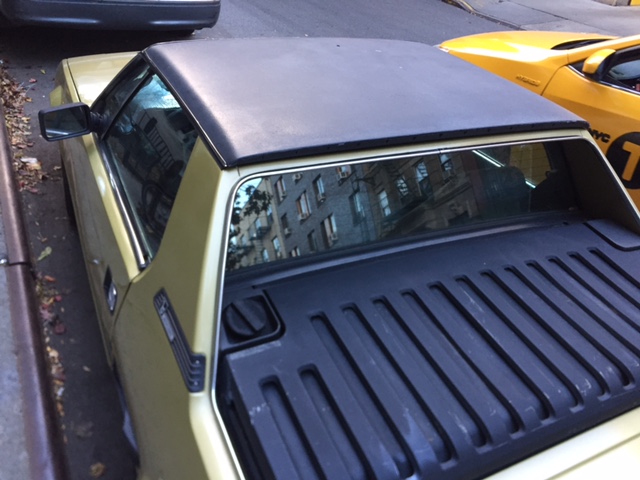
Bellissimo! This is a Fiat X1/9 by Bertone in Gold/Oro Metallic. These cars are so tiny and entertaining but you just don't see them any more.
*There is no reason for the following fun fact but in Westchester County only (and maybe a bit of southern Putnam County) NY a submarine sandwich is called a wedge. You're welcome. Rhode Island calls milkshakes cabinets too so who knows?
This one is in remarkable shape considering that the crumpled license plate indicates that it is indeed parked on city streets often. It would take nothing for a careless driver to destroy this ride while backing into a spot in front of it.
Look at this thing! The X1/9 was designed by Bertone and then manufactured by Fiat from '72 to '82. From 1982 through 1989 they continued to be built and imported to the States by Bertone. In 17 years the car barely changed its looks.
Much like the Porsche 914 this is a mid engine targa sports car meaning that the 4 cylinder engine is located between the rear wheel and the passenger seats. This setup makes for near-perfect front to rear weight balancing and as a result the handling is legendary.
These side intakes are basically the grills for the engine within.
This thing is absolutely tiny! When you walk up to an X1/9 the roof comes up to your waist. You need to take a deep breath and climb way down into it to drive. Think "steering wheel between your knees" small.
With such a delicate little car those federally mandated safety bumpers really look out of place.
Nothing says "1981" like the font in five speed.
That's the gas cap all the way up against the rear window. Refueling without spilling any on the engine cover or the paint is a neat trick.

That black roof panel comes off and stores perfectly under the front trunk (leaving space underneath for storage). This targa body style isn't terribly common and is mostly seen on imports. The 1984 Corvette actually offered a targa top but for the most part we had T-Tops in the States.
Here we can see the funky Bertone logo on that sale panel emblem. Those wheels are factory originals from '81.
This car is supremely parkable due to its scale. The gas mileage was better than most cars on the market when it was new.
Well that's where we'll leave this little wedge. I've only known one person to own one of these and they destroyed it before even driving it once by doing a valve job 100% wrong and messing everything up inside by turning the key. Occasionally they would be seen in driveways or in the parking lot of a doctors office or something but they are just about extinct in the Northeast.
Curiously enough when I started googling details about X1/9s I encountered this exact car that someone had taken pictures of parked in its native Oregon. Those pics are from 5 years ago and there is one difference; the word Fiat can be seen in the front fender portion of the black side stripe. Why they elected to get rid of that we'll never know.