Showing posts with label Brougham. Show all posts

Sunday, November 6, 2016

Show Car Sunday gets its due with a knockout punch of a classy classic!

THE CLASSIEST UNICORN IN THE FORM OF A WASP
Take a minute to soak this all in.
Here I am standing between Brooklyn Heights and DUMBO with a classic in front of me that's so rare I can't even find production numbers. This is one of the only things I've ever Googled that wouldn't eventually auto-fill what it thought I wanted to search. Just like you never know WHAT is gonna come through that pawn shop door you never know what is lurking behind a closed garage door in Brooklyn.
What we have here is a 1953 Hudson Super Wasp 5C Brougham convertible in Honey Cream. It is just so damn beautiful in person that it's hard to imagine that somebody needed to drop it off at the shop to get inspected. This car is registered and ready for daily use right now. Where exactly do you drive this? To a palace?
Hudson was an innovative automaker known for unique advances in technology that placed them at the head of the pack in many ways. The bodies of this era are what they called Mono-Bilt. The frame wrapped around the lower perimeter of the car where the rocker panels usually are and the floor pans are set down in between the rails. This allowed for a low center of gravity and vastly superior side impact protection (just about every other vehicle was a box sitting on top of the frame). It is also referred to as the step-down chassis because you literally step down into the car as opposed to climbing up into it.
This car was built solidly in the Jet-Age era. We can see from this angle that the mock hood scoop approximates a jet taking off with the dreaded chemtrails beneath (contrails for you level-headed folk). I wish I'd taken a better pic of the grill emblem as it's like a piece of jewelry.
The most famous of all Hudsons was the mighty Hornet. It looked much like this but a bit bigger. Powered with the the inline 6 cylinder engine and Twin-H-Power (dual carbs) and with the cornering help of its low center of gravity it dominated Nascar for years.
In 1952 they introduced the smaller Wasp (replacing the former smaller offering called the Pacemaker). However if you ordered the Super Wasp you got the larger Hornet 6 cylinder in the lighter body, making this one of the first factory muscle cars. This one was also ordered with the optional Twin-H-Power so it's a true screamer! This drivetrain combination proved at least as powerful as the top of the line Hudson Commodore Straight-8 cylinder engine in '53.
Everything was just about perfect on this ride. You could easily fix your hair in the reflection.
That chrome molding on the lower edge of the body is about where the frame is. The fit and finish of the top could be improved if you were headed to Pebble Beach but that's about it.
It was a brilliant bright blue autumn day and I was conscious of the mechanics watching so I just snapped a quick interior pic. It looks to me like we have a 3-on-the-tre manual transmission and a radio from the factory. The door panel is off for some reason.
The '53 Hudson brochure is online and through it I discovered a sweet detail; the Steering wheel itself and the glass covered centerpiece are color coded to match the interior!
The one thing the brochure failed to mention was the existence of a Wasp convertible at all. I know they were built in their Detroit factory because others are around with flawless provenance but production must be truly minuscule. As an example they only built 30 Commodore convertibles in 1952 but that made the brochure!
That TWIN H-POWER emblem let's folks know you mean business. I like how the Super Wasp badge is only on the front near the engine much like the engine badges of the '60s and '70s while the trunk just gets Wasp.
Well there you have it; a real deal stunner of a classic ride. The license plates, inspection sticker, road tires filled up to the proper amount, and the fact that this was sitting at a mechanic all point to this beauty being driven. I can only imagine putting the top down and going on a lazy drive through the upstate autumn leaves (with the heater on your feet of course).
Recently Hornets have been gaining real value on the auction block. A beautiful 1953 Hornet Twin-H-Power Brougham convertible recently sold for $187,000 (more than 50% over the high estimate!). That is still the rarity with most Hudsons selling under $30,000. When you think of all the hugely mass-produced Mustangs and Camaros that sell for much more than that it's a wonder these classier rides don't get all the attention.

Tuesday, July 5, 2016

Twofer Tuesday returns with a couple of Malaise-era barges

"MY 98 WAS 87 ON THE RECORD YO"
I was ambling along the tony Carrol Gardens neighborhood when this schlub got in the way:
This grubby slab is a 1983 Oldsmobile 98 Regency Brougham in White. It is filthy and beat.
That octagonal hood ornament is nowhere to be seen on every Oldsmobile 98 I can find from '79-'84. My guess is that it was snapped off at some point when the car was somewhat new and that sort of thing was common, only to be replaced with a Pontiac Grand Prix or full-size Buick hood ornament.
This was the full-size pinnacle of luxury for Oldsmobile customers in 1983. Everything about this ride says ancient technology; big carbureted V8 up front, rear wheel drive, body on frame construction, and more thought to cushy plushness than performance.
This beast is a veteran of the Brooklyn streets! You can see that the owner has welded on additional huge bumper guards to augment the smaller factory ones still in place. They've also screwed the thick black rubber to the front of the guards after heavy use.
 There are reasons most cars are some sort of sandy beige gray these days; they tend to hide the everyday grime and wear better than say a white car like this. White cars show every grain of dirt and impending rust just like black cars highlight even the smallest scratch or scuff.
Love the mismatched $15 plastic hubcaps Mr. Luxury Owner Bro.
In between the front and rear door glass you can see a vertical black rectangle. These were the original opera lights typical of Malaise-era luxo barges. When new they would cast a white glow when the headlights of running lights were on. There are no bulbs to replace as they are actually electroluminescent panels; printed layers of phospor onto a surface that conducts electricity. The result is a glow much like a nightlight. Much to my astonishment I found a 10 page tutorial online on how to restore them on your Malaise yacht. Thanks Internet!
Whoa! Up close the roof is NASTY to the point of absurdity. This thick icing treatment might be waterproof but it looks like it was applied by the same little old lady that "touched up" the Jesus portrait on a Spanish church wall a few years ago.
The overall design inspiration for this ride was a brick. Those have to be the biggest reverse light ever put into production.
This corner sums up this ride perfectly; more welded bumper guards, white touch-up paint directly over the pinstripe, and more silly putty filling up the space between the bumper and the body. At least he placed several plastic reflectors to the bumpers in case you were about to miss this beast somehow.
Something that feels strange to type is that this is actually a much more aerodynamic redesign of the 1977-1980 version! That actually was an almost perfect square.
Being a full size American car these still sold very well to everybody accustomed to such things. As hard as it is to imagine now there was still a great deal of animosity towards Japanese and German imports in 1983. My own grandfather flat out rejected a Honda my aunt purchased new until she lead him out to the metal plate on the doorjamb where he could see that it was built in California. If you want a glimpse into the state of domestic auto production I highly recommend the first film by Michael Moore called Roger & Me.
Don't you just love German Black Forest Cake?
This Regency and Brougham emblems denote the highest of gaudy luxury. It included extra plush velour seats, deep carpeting, this sweet formerly-vinyl roof, and of course those opera lamps.
Is this where I should feel bad about pointing out all the home repairs? Naaa.
Now that's a lock! Your puny Club means nothing compared to my armored neckbrace that actually contains the entire ignition switch!
The AM/FM Stereo in the dash has no cassette player that I can see. The year before this one was the last for the 8-track player in Oldsmobile. Amazingly there was the option of having an 8-track player installed by the factory in certain GM trucks all the way through the 1988 model year. Incidentally that was the year the last 8-track commercially produced came out; Fleetwood Macs Greatest Hits.
Well let's just back away from this dirty slab of cream cheese and gaze upon its sibling.
Here we have exactly the same year, make, and model in Black (though it is NOT a mighty Brougham). This one is in great shape!
This is the correct hood ornament for the '83 98.
The lack of a side parking light between the lower edge of the bumper and the wheel is an indicator of the non-Brougham model.
This ride is parked near my shop and is definitely someones pride and joy. These were winter pics when every car gets dusty but this car is usually gleaming.
The Ninety-Eight name originally meant full-size 90 Series with an 8 cylinder engine. The meaning was moot when 6 cylinder engines became available as standard from 1981-1982.
This is the standard placement for the non-Brougham opera lights. Most look like this; faded and cracking from the sun and utterly devoid of lighting ability.
This car has a small handful of aftermarket doodads but it's just short of too much. The fender skirts might have been an option, but the mudflaps and chrome visors over the side windows are add-ons.
We can see a couple of hail-Marys to curry favor from the cop running your license on the bumper; 2 American flags and an NYPD sticker. There were also a couple of police stickers attached to the windshield on the drivers side.
The black wheels look pretty tough on this ride.
There isn't much else to say about this black beast. Chuck D used to brag about driving his Olds 98 on his first couple of albums. Eventually though his "98 was 87 on the record yo, so now (he drove) Bronco". Rolling effortlessly from GM to Ford? Chuck D is a magnanimous customer.
Well there we have it; two of the biggest last-gasps of the Malaise era. The punitive Federal bumper regulations of the '70s were rolled back in '84 meaning that these were the last vehicles with egregiously massive guardrails hanging off the ends. The following year would be the last for rear-wheel drive 98s. It also happened to be the first year for the FWD replacements making it possible to go into a dealership and have the old and new next to each other for sale. Whatever, over and out.

Thursday, April 23, 2015

Mopar Graveyard roundup!

MOPAR GRAVEYARD UP NORTH
Last year I was kicking around up north with an old friend when he mentioned that there was a gas station that sometimes had old cars laying around. It turned out to be the find of the year because they had the winged '70 Superbird roosting in the gravel lot (that post can be found here: http://nychoopties.blogspot.com/2014/10/the-holy-grail-of-nascar-vehicles-show.html). While the 'bird stole the show there were several other relics hidden about that I swore I'd get to eventually, so here's the Mopar treasure trove roundup!
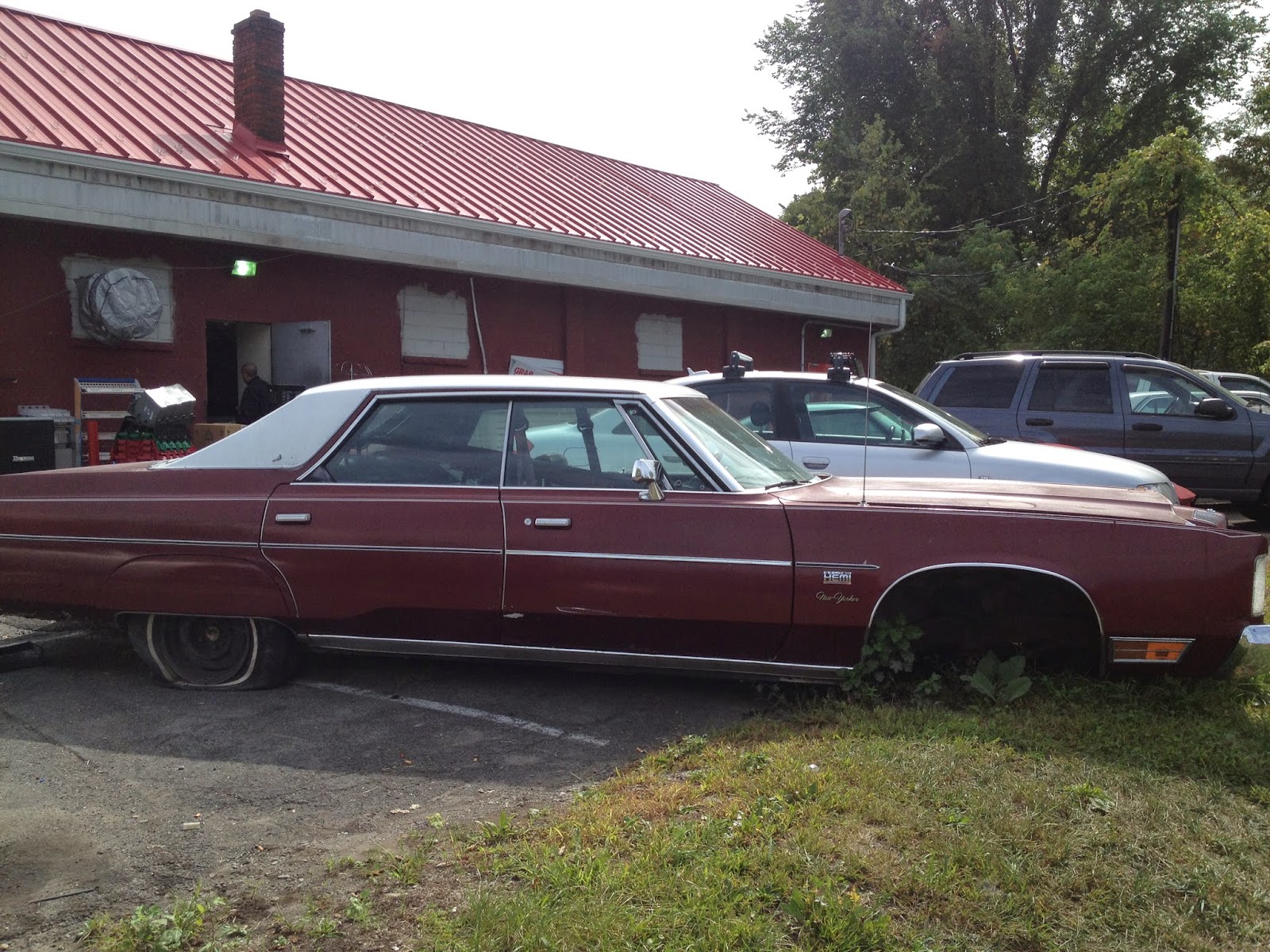
This great burgundy behemoth greeted us when we first pulled in:
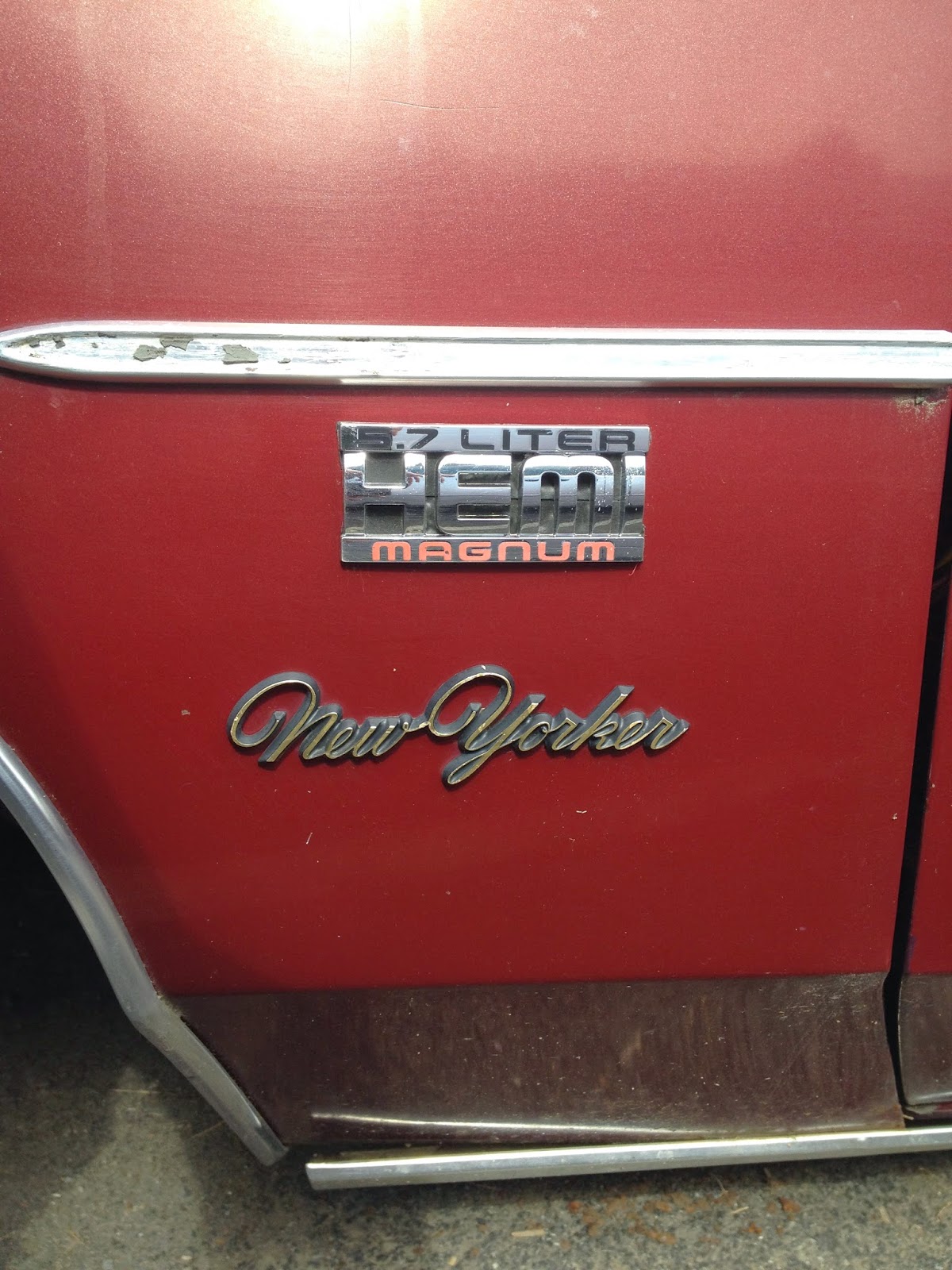
This is a 1976-1977 Chrysler New Yorker Brougham in Claret Red. Everything about this car screams excess.
This is basically the last dinosaur wandering the cooling Earth wondering where all its friends have gone, not realizing it was as good as extinct already. A full 4 years after the gas crisis that shocked the American public into mileage consciousness this beast lumbered off the assembly line. How Chrysler could feign surprise when on the brink of bankruptcy in '79 is beyond me.
Behold the sign of puffy leather sofa seating and leisure suit style!
Apparently this has a Hemi in it (which I seriously doubt). Most likely there is a wheezing and emissions-strangled 400 V8 lying dormant beneath its massive hood.
*It is a bit of irony that this car, while escorting its parent corporation to insolvency, was named New Yorker just a year after the famous "Ford to City: Drop Dead" headline regarding the presidents aversion to helping stave off NYCs own bankruptcy. 
This is a sad image indeed. We were told that this thing runs like a charm and was driven to this spot just so the owner could remove the front end. Here it sits beached with a perfect drivetrain, dead.
The New Yorker was the higher-end version of the Newport. However in this year the New Yorker inherited the front and rear treatment of the mighty Imperial which had just been discontinued. Somehow this registered with the general public, making the '76 model a minor hit. This probably added to Chryslers delusion that they ought to continue building 5,000 lb cars that got 8-12mpg.
Too bad the front end of this yacht was in demand as the body looks cherry.
With all the windows down cruising along in total cushy silence I bet this would be the ultimate cruiser. Fred from the B-52s probably had this ride when he was about to set sail in Love Shack.
Now let's do some exploring around the property . . .
Righteous! This is a 1966 Plymouth Belvedere II 2 door hardtop in Dark Blue Poly. This is a wonderful car identical to one that a close friend of mine drove in high school.
Engine offerings in the brochure went from the 225 Slant 6 all the way up to a high performance 383 V8. However 24 were known to leave the factory with the mighty 426 Hemi under the hood. If you didn't mind special ordering such a thing, almost doubling the price of the car, and agreeing to forgo any warranty they would build one for you in those days.
Beneath the junk and dirt this car seems straight and restorable. The squared-off lines of the '66 model year always looked great to me, especially with this roofline and that circle of brushed metal on the rear edge of the side trim. Cool car but there's more to explore!
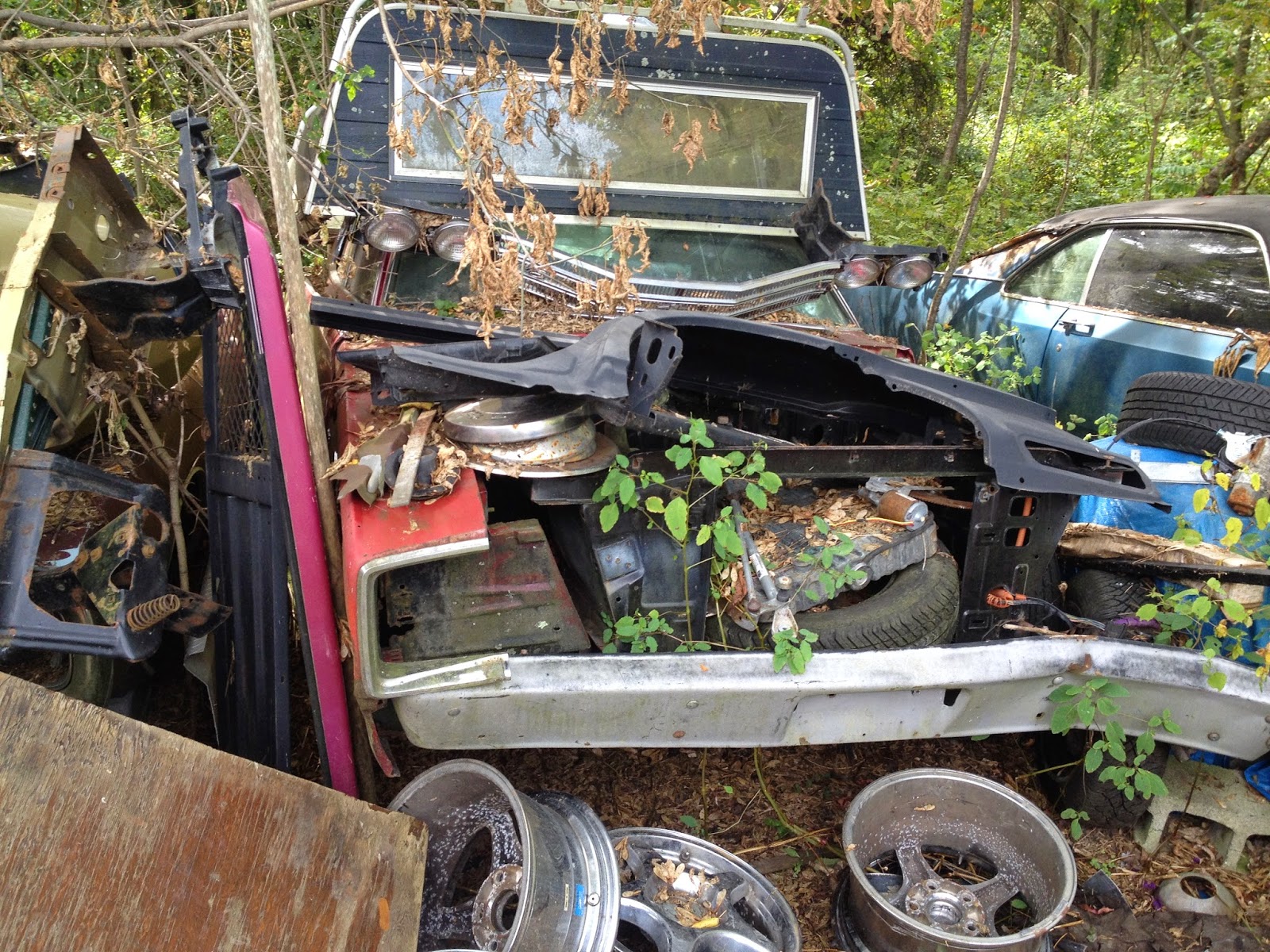
I know this is getting a bit ridiculous but that is a 1974 Dodge Charger peeking out from beneath a massive pile of parts (which includes that white grill bar to a '55 Ford Truck). This model year is identical to the 1973, but the Frosty Green Poly color choice identifies it. This was the final year for Charger which went from the General Lee in 1969 to a personal luxury coupe here. The Cordoba took over in '75.
It wasn't just Mopars in the yard; here lies a 1962 Mercury Comet in Jamaica Yellow. The '62 differs from the '60 and '61 by having a chrome spear running along the top of that concave body line. The chrome is missing but the holes where it was attached remain.
Another Chrysler from the "Fuselage Styling" era is on hand without its front clip. This one is a 1971 Newport in Honeydew (though if I ever saw a honeydew melon that color I'd probably pass it up).
Two more '71 Newports are lurking in the back, one in Evening Blue Poly and the other in April Green Poly.
Finally, another '71 Newport being reclaimed by nature, this one in Glacial Blue. *That piece of rusty cocoa on top just past that tire is actually a front fender for a 1971 Plymouth 'cuda with the front gills or louvers. This is a '71-only part for the high performance 'cuda, not available on the base Barracuda. Even in this condition it's worth more that the car it's resting on!
Finally this tragedy is a barely-discernible 1966 Dodge Coronet in Bright Red. Obviously the grill, hood, and drivers side fender are all missing but I'm 95% sure that's what this is. We're deep into automotive junkyard fetishism here but this sort of archeology is right up my alley. I used to clamber around the hills and woods near my house in high school taking pictures of junk cars in the woods so nothing's changed really.
Next post will include real, drivable finds I'm sure.