Showing posts with label rally. Show all posts

Monday, October 16, 2017

The weirdest, greatest supercar you'll ever see

C'EST MAGNIFIQUE!
Robin of Omaha recently sent these pics of a true oddity. Even in stellar condition its not surprising to see this ride hunkered down at the mechanic as it is fearsomely complicated. Behold!
This is a 1972-1973 Citroën SM in Jaune Bouton d'Or (also known as Buttercup Yellow). This thing was so ahead of its time that it shouldn't even be gauged against other automotive makes.
While we're staring this thing in the face let's talk about the main visual difference between the European and U.S. models. In France the SM had 6 square headlights placed behind angled glass like the middle panel above. Also in France the headlights turned with the front wheels! The glass cover and turning ability of the lights were both illegal in the U.S. which is why we can't have nice things. 
Just look at this strange creature. It could be from outer space or the depths of the ocean. The body is extremely aerodynamic which helped take advantage of perhaps the most incredible feature of the SM: it came from the factory with a Maserati V6 motor under the hood!
Those wheels are steel with stainless trim. If you preferred a lighter weight rim they offered a first-ever carbon fiber resin wheel option. As long as this thing is it won all kinds of rallies and races when introduced. When it hit these shores it won the Motor Trend Car of the Year award, a rarity for a non-domestic model at the time.
Top speed from the factory was listed at 140mph; no small feat for an early '70s luxury touring car. It is fitted with the self leveling hydro-pneumatic suspension that was made famous by the earlier DS. Four wheel disc brakes provided for the shortest stopping distance of any car tested up to that point. The suspension system was set up so that under hard braking the car would lower evenly.
The styling is so awesomely French!
Supposedly you could drive this car for hours at 120mph with no discomfort, achieving 19 mpg the whole time. The steering took some serious getting used to however. It is a unique variable powered assist that allowed for no road feel at all. Citroën recommended 50 miles of careful driving to get used to the steering as it was so sensitive. I've never driven (or ridden) in one of these but accounts are that once you get over the learning curve other cars feel archaic and old fashioned to steer.
To add to the futurism the windshield wipers detect rain when set to the lowest setting and will turn on and off as needed. This is a feature just becoming more common now. If we could pop the hood you would see a bizarre sight; a pair of honeydew melon sized spheres painted forest green are on the top sides of the motor, attached to two green tanks. They are the hydro-pneumatic suspension components but they look crazy to the uninitiated.
This car came about because Citroën bought Maserati in 1968 and they decided to marry the high performance motor to this design which was already years in the making. Unfortunately that means maintaining one of these involves a Maserati specialist and a Citroën mechanic.
The lovely sensualists of France underestimated the immovable and indifferent federal safety regulators of the U.S. and assumed they would get an exemption to the 5mph crash safety bumper regulations coming due in 1974. They did not and as a result the SM stopped being imported overnight. It is a shame as this car represented a bright future in automotive design where speed, efficiency, and pure style could work in harmony. Instead we kept producing bloated dinosaurs until the industry almost totally collapsed at the end of the decade.
Viva la France (and Italy)!

Saturday, August 12, 2017

SAAB STORY. There I said it

FUNKY SWEDISH FISH GASPING ON THE PAVEMENT
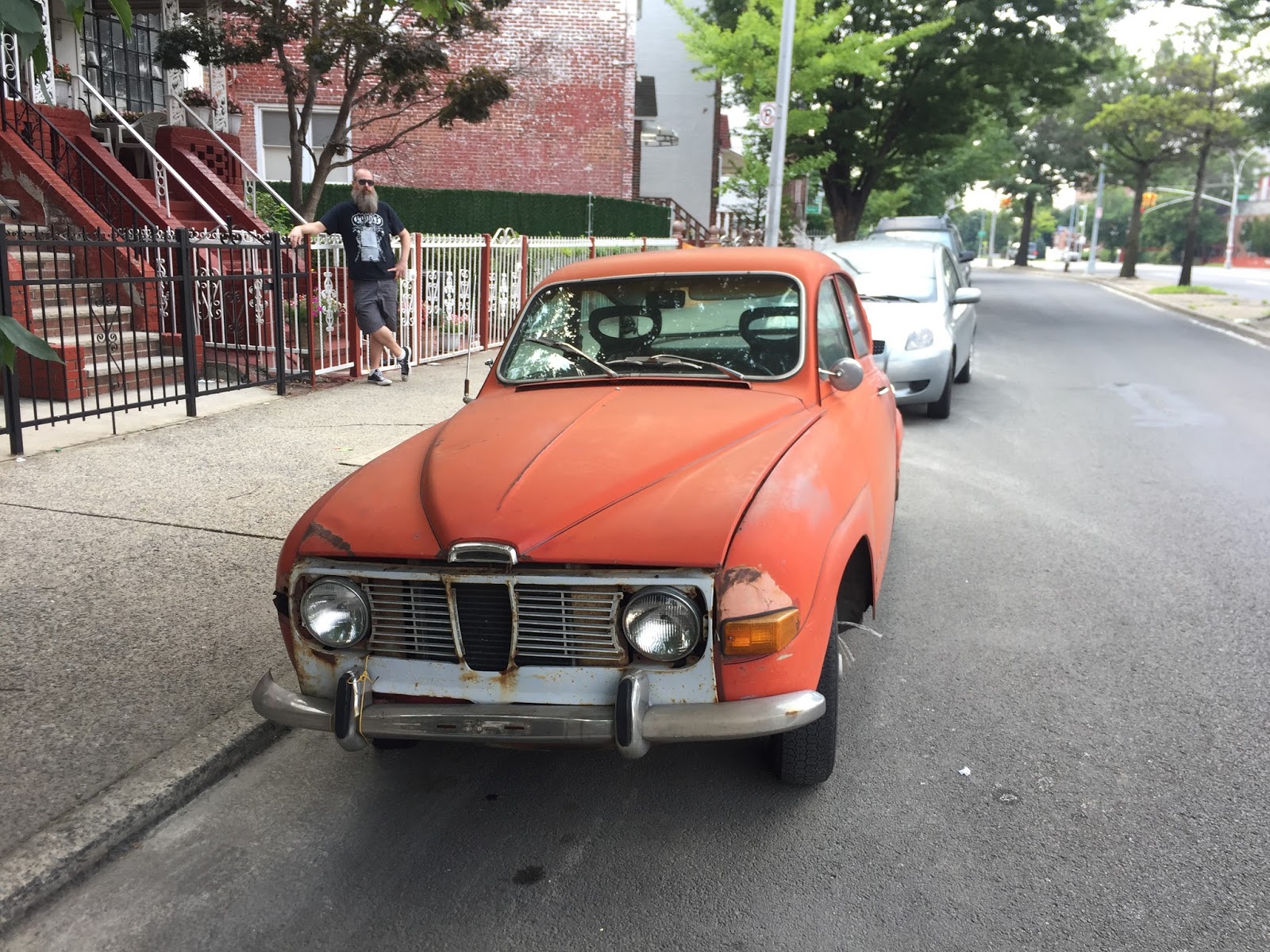
NYC is truly huge. 6 months ago I was driving out on the Kings Highway around the Flatlands neighborhood when I spotted this little frumper. It was facing the opposite direction across 5 lanes of rowdy traffic so I yelled out to myself but kept on my merry way. Recently I was in the same neck of the woods with my eyes peeled and there she was!
This is a 1973 Saab 96 in Burnt Orange (with a Silbermink or Silver Mink fascia around the grill). Most people don't realize that older Saabs looked like a cross between a spaceship and a VW Beetle.
Look into the grubby mouth of this well worn little punk! It looks like the "before" picture on a subway dental advertisement. The replacement fascia and bit of Bondo tell me that someone cares at least a little for this ride. That poor diminutive bumper is the veteran of many a parallel parking mishap. 
The 96 was introduced in 1960 and remained in production through the 1980 model year (though they stopped coming into the States after '73). My guess is that the tiny front bumper was the reason the '74 never made it to our shores because that year ushered in the federal crash safety regulations.
The line running along the lower body was where a piece of chrome trim once lived. I'm not certain but I think it denotes the trim level; the high end DeLuxe had 2 chrome strips, this had one, and some had none at all. In the DeLuxe the rear quarter windows were hinged and would pop open but these are probably fixed.
Saab was originally an aeronautical company and aircraft design elements made it into their cars. The very first Saab automobiles were straight-up bizarre! The engines were 2 stroke meaning that oil had to be added to the gas. The radiators in those first models were behind the engine just under the windshield. The door glass didn't roll down conventionally, just the rear edge would go down so that the front edge would remain above the sill. There are foreign cars and there are truly foreign cars!
By the time this ride was built the 2 stroke motor was replaced with a Ford V4. It was a great little engine in a tiny car and as a result the Saab 96 had a major presence in the rally world. All 96s were front wheel drive as well.
I love the slippery lines on this ride.
This old sticker confirms that the paint is original. It's hard to read in this pic but I believe this particular Swedish Motors was in Pennsylvania. The overall condition is great for a 44 year old car. 
No plates? No problem on King's Highway!
These awesome wheels are more commonly seen on the Saab Sonett; a very low to the ground fiberglass sports car built around the same time. They're referred to as Soccerball wheels.
Even beat down and tired this thing looks amazing!
This steering wheel was introduced in '73 which helps to confirm that this is a final year U.S. spec 96. The interior is straightforward and functional with toggle switches and knobs as opposed to flashy electronics.
The replacement for this ride was the Saab 99 which debuted in 1968. Instead of replacing the 96 they were both produced alongside each other until the last 96 left the factory in 1980. The 99 was remarkably modern in '68 when it hit the scene. It looked very much like the 900 that was built through the '80s and into the '90s. I've owned 3 different 900s including the only car I've ever had stolen from me! Oakland represent! 
This little punk isn't going anywhere any time soon.
These round headlights were only on the U.S. models at this point. From 1969 onward the rest of the world had rectangular headlights on the 96.
Well there we have it; an odd little import from the era when nobody in the States knew what a Saab was. There can't have been many of these sold back in '73 and very few remain on the streets today. Back in college a motorhead acquaintance bought a pair of these pretty cheap. He drove one around school and I think the other one was meant for parts even though they both ran. His plan was to set one up for rally racing. To this day I've never even sat in one of these. Hopefully someday I'll get the opportunity to drive one a bit just to see what it's like. 


Thursday, December 1, 2016

Rally Sunny hidden in plain sight

RALLY SUNNY HIDDEN IN PLAIN SIGHT
On a bright and sunny summer day in Park Slope I walked by this rugged little punk. It was looking a little out of place all covered in tattoos and generally scruffy. The more I looked the more I dug it!
This is a 1991 Nissan Sentra SE-R Coupe in Super Black. Laugh all you want; this is a little rally car.
At first I thought some kid threw a bunch of racing stickers all over his crap ride but it quickly became apparent that this thing actually races.
The SE-R Coupe was a hopped-up version of the thrifty subcompact Sentra (known in Japan as the Sunny). It introduced the now-legendary SR20DE motor which stands for 2.0 liter Dual overhead cam Electronic fuel injection. This car set speed records for subcompacts and has been a darling of the small car racing scene since.
Triple mounted rally lights perhaps? I can't think of what else would cause these crude cuts. I'd like to point out that there are no less than 4 plastic ties in this pic: the white on on the right of the grill is joined by 3 black ones seemingly holding the grill to the car. She's been around!
I'm guessing the arrow points to the towing point where you should attach a winch if pulling this little tough guy out of a ravine.
These little numbers are hood pins. Most cars that have them don't need them (I'm looking at you new Mustangs that will never crest 90mph). However if you intend to throw your car around washboard dirt roads, over jumps and bumps, and cross little streams then they are a practical assurance that your hood won't pop up on you while driving. You can own a car for 30 years and the hood will stay closed, but if you go off road the factory latch can give up at the worst time.
The SE-R came stock with 4 wheel disc brakes and MacPherson struts.
The clean spot on the door is where this has worn a number for some race. You can just glimpse that this thing is fitted with a full roll cage inside.
Yes! 2 racing seats and a full roll cage replace most of the interior. For those of you who might not know rally racing requires 2 people to do. The job of the driver is to go as fast as possible while listening to constant instructions from his passenger; the navigator. The navigator has the entire course or route broken down to each and every corner, bump, obstacle, etc. I found this rather ridiculous example of a rally team in action but it still gives you the idea.
A sunroof is nice when you're cruising along on a sunny day but in serious rallying you need rigidity more than a big hole in the roof. This problem has been crudely but effectively solved!
This is the most homemade heavy-duty mudflap ever just bolted right into the car. I imagine this thing has been on some wet, muddy races where you want the window open for ventilation but don't want a face full of earth slopping up at you.
Those '90s wings don't do a damn thing but at least it's on a real race car for a change.
You never know which direction your car will be facing after you break through a fence and slide down into a creek or something, so here's another tow point on the rear.
Well there we have it; a true race car registered and parked on the streets of a highbrow neighborhood. It's truly refreshing to see a car that was built for performance actually living the dream. So many high dollar muscle car cream puffs sat coddled in a garage being polished more than driven.
My favorite examples of race cars being raced despite their value are the huge Bentleys of the 1920s and '30s. These cars are worth so much and are so heavily insured that many of their owners do race them hard. The thought is that racing is what they were meant to do, and if you wreck it the value is so great you can rebuild it no matter how extensive the damage is.
Hats off little racer!