Showing posts with label 1973. Show all posts

Saturday, August 12, 2017

SAAB STORY. There I said it

FUNKY SWEDISH FISH GASPING ON THE PAVEMENT
NYC is truly huge. 6 months ago I was driving out on the Kings Highway around the Flatlands neighborhood when I spotted this little frumper. It was facing the opposite direction across 5 lanes of rowdy traffic so I yelled out to myself but kept on my merry way. Recently I was in the same neck of the woods with my eyes peeled and there she was!
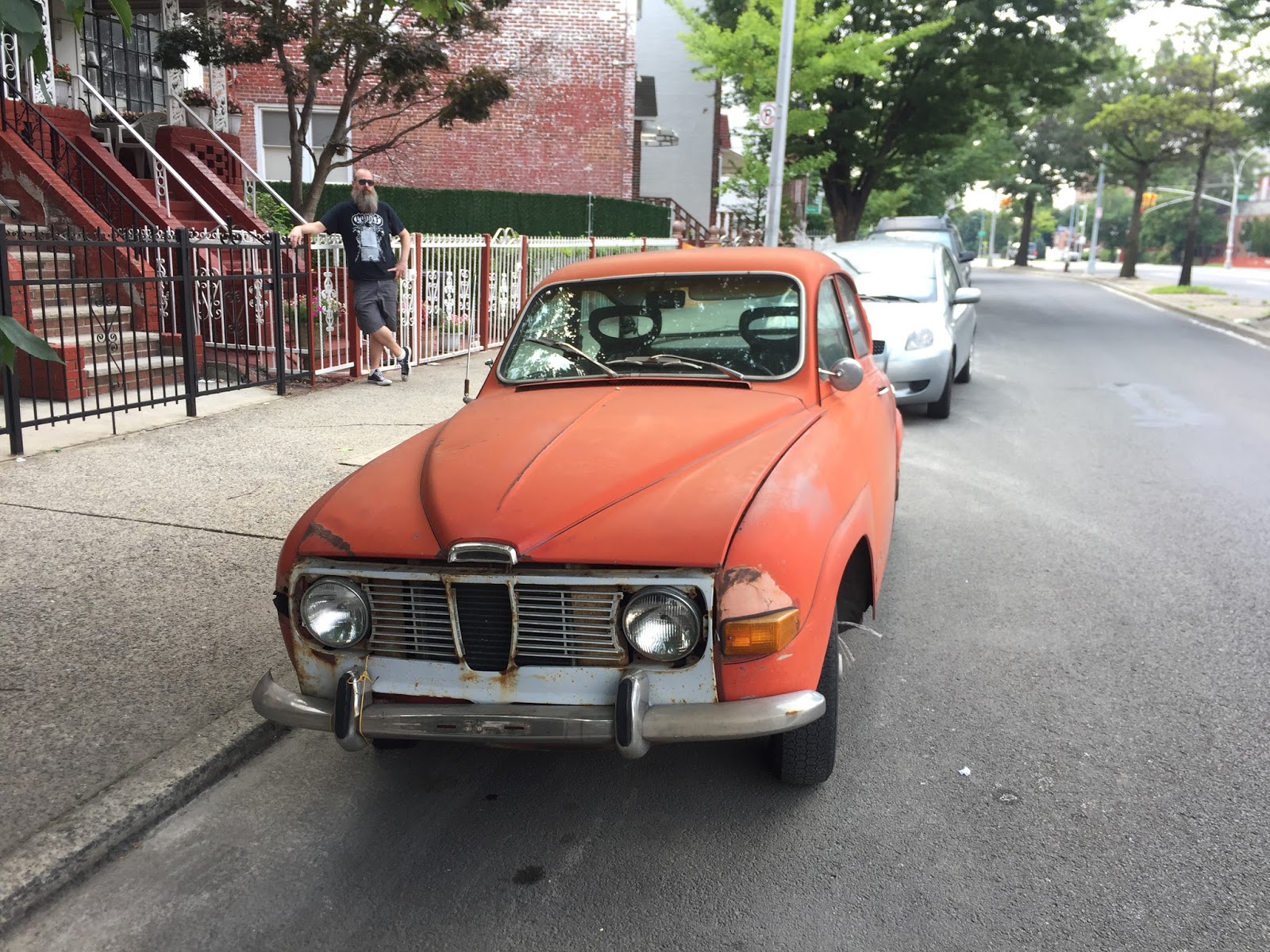
This is a 1973 Saab 96 in Burnt Orange (with a Silbermink or Silver Mink fascia around the grill). Most people don't realize that older Saabs looked like a cross between a spaceship and a VW Beetle.
Look into the grubby mouth of this well worn little punk! It looks like the "before" picture on a subway dental advertisement. The replacement fascia and bit of Bondo tell me that someone cares at least a little for this ride. That poor diminutive bumper is the veteran of many a parallel parking mishap. 
The 96 was introduced in 1960 and remained in production through the 1980 model year (though they stopped coming into the States after '73). My guess is that the tiny front bumper was the reason the '74 never made it to our shores because that year ushered in the federal crash safety regulations.
The line running along the lower body was where a piece of chrome trim once lived. I'm not certain but I think it denotes the trim level; the high end DeLuxe had 2 chrome strips, this had one, and some had none at all. In the DeLuxe the rear quarter windows were hinged and would pop open but these are probably fixed.
Saab was originally an aeronautical company and aircraft design elements made it into their cars. The very first Saab automobiles were straight-up bizarre! The engines were 2 stroke meaning that oil had to be added to the gas. The radiators in those first models were behind the engine just under the windshield. The door glass didn't roll down conventionally, just the rear edge would go down so that the front edge would remain above the sill. There are foreign cars and there are truly foreign cars!
By the time this ride was built the 2 stroke motor was replaced with a Ford V4. It was a great little engine in a tiny car and as a result the Saab 96 had a major presence in the rally world. All 96s were front wheel drive as well.
I love the slippery lines on this ride.
This old sticker confirms that the paint is original. It's hard to read in this pic but I believe this particular Swedish Motors was in Pennsylvania. The overall condition is great for a 44 year old car. 
No plates? No problem on King's Highway!
These awesome wheels are more commonly seen on the Saab Sonett; a very low to the ground fiberglass sports car built around the same time. They're referred to as Soccerball wheels.
Even beat down and tired this thing looks amazing!
This steering wheel was introduced in '73 which helps to confirm that this is a final year U.S. spec 96. The interior is straightforward and functional with toggle switches and knobs as opposed to flashy electronics.
The replacement for this ride was the Saab 99 which debuted in 1968. Instead of replacing the 96 they were both produced alongside each other until the last 96 left the factory in 1980. The 99 was remarkably modern in '68 when it hit the scene. It looked very much like the 900 that was built through the '80s and into the '90s. I've owned 3 different 900s including the only car I've ever had stolen from me! Oakland represent! 
This little punk isn't going anywhere any time soon.
These round headlights were only on the U.S. models at this point. From 1969 onward the rest of the world had rectangular headlights on the 96.
Well there we have it; an odd little import from the era when nobody in the States knew what a Saab was. There can't have been many of these sold back in '73 and very few remain on the streets today. Back in college a motorhead acquaintance bought a pair of these pretty cheap. He drove one around school and I think the other one was meant for parts even though they both ran. His plan was to set one up for rally racing. To this day I've never even sat in one of these. Hopefully someday I'll get the opportunity to drive one a bit just to see what it's like. 


Saturday, May 6, 2017

The German troll under the bridge

THE GERMAN TROLL UNDER THE BRIDGE
In a fit of insomnia I rode my bike down to Brighton Beach recently at dawn. The sun rising over the wreckage of inner Coney Island was beautiful, and the breeze off the Atlantic fresh and invigorating. Then I turned back under an elevated block of the subway and found this:
Yeesh. I felt like I needed to say "sorry" and close the bathroom door because this thing looks like I walked in on it. How a beautiful car can get to looking so creepy is beyond me.
This is a 1973 Volkswagen Karmann Ghia in what looks to be a repaint of Bright Orange. It also looks like a bum that's getting a bit too close while trying to ask for something.
What happened here is a mystery to me as the engine is in the back. Was it parked facing something that burned? Is this a horrifically done dent repair? Who knows but the effect is icky.
Those nostrils originally had delicate chrome vents in them with 3 horizontal bars. That circle above the damage had the VW emblem at one point and shows the original Amber factory color. 
This car is 100% Beetle under the skin which makes parts and maintenance extremely easy. Basically the Beetle was the people's car and so VW decided to hire coach builder Karmann to design a foxy, sporty iteration to lure customers. Karmann decided to bring Italian design firm Ghia into the mix and thus the name was born.
The first Karmann Ghia was introduced in 1955 and looked very similar to this one. The body panels were hand formed which certainly justified the extra cost. Upon release the Karmann Ghia was a total success, surpassing even the most optimistic projections with 10,000 sold.
Unfortunately someone decided a generic tough guy steering wheel was better than the original. By '73 the factory steering wheel was made of black plastic and wasn't the nicest in VW history but it managed some class for the era. The early wheels are lovely with a thin ceramic rim and chrome horn ring. I can't blame them for the radio replacement or the under dash gauges (no water temp gauge of course). That button between the clock and radio is a cheap horn replacement. I had one just like it in a car where the previous owner replaced the steering wheel with a bro faux job.
These are the flat style hubcaps with castle Wolfsburg in the middle. I've heard these called Porsche caps as well and don't know if they were ever on a VW from the factory.
In front of the rear wheel there is a dark circle. That is the point where you should place the factory jack for lifting the car. So many older VWs are damaged because someone rolls a big floor jack under the car indiscriminately. The thin floors and rockers will buckle easily.
1973 was the first year for these large federally mandated bumpers. Unlike some larger American cars there's just no hiding these and they really take away from the delicate curves.
Herein lies the air cooled 1600 flat 4 hooked up to dual carbs. By '73 there was a decent amount of power for such a light car. They bragged that it was good for 93 mph which is PLENTY for this!
That guy in the distance had a fierce trudge going.
These taillights look pretty good to me, especially when contrasted against the Beetle version of the same vintage. They are larger than the earlier Ghias but they maintain a lovely feminine shape to go with such a voluptuous car. The earliest Ghias are known as Low Lights due to their tiny art deco style lights low on the fenders.
Well that's where I backed away to rejoin the Dawn's Early Light. I would suggest that few cars from 1973 have aged as well as the Karmann Ghia though this is a munchy example. Convertibles were available from 1957 through the end of production in 1974 and they really look great. However finding any VW from this era without debilitating rust is difficult let alone one where the roof is made of cloth. As with any VW if you're curious to shop for one I suggest checking the battery tray, spare tire well, and rocker panels for rust. Don't panic if you see some, but those areas are a good barometer for the overall condition.

Thursday, May 4, 2017

Woulda shoulda Barracuda

WOULDA SHOULDA BARRACUDA 
My heart skipped a beat when I saw this ride. A 'cuda sitting on the sidewalk next to the BQE? Not any of your Williamsburg BQE either; this is the Gowanus Expressway section where they still have porn shops and XXX video rental places. WHAT IS IT DOING HERE???
I asked the dudes hanging in the open shop if it was a '70 but they said it was a 1973.
From the top: this is a 1973 Plymouth Barracuda with a slight misting of what could be Blue Sky on the corner closest to us. This looks like a truly legendary muscle car. Looks like one.
If you ever see one of these with 4 headlights it's a 1971.
*Special shout-out to the inspection sticker sitting int he windshield.
By 1973 the mightiest engines of yore had been plucked from availability leaving only the 318 and 340 V8s as the engine choices. To be fair the 340 is a great power plant with some racing cred. However as recently as 1971 the 383, 440, and 426 Hemi V8s were options.
The body shell itself is a holdover from 1970 when Plymouth finally divorced the Barracuda from the Valiant line. It certainly looks fun and athletic with its tall haunches big wheel wells. Funny enough in the early days of this generation you could order the reliable but unexciting 225 Slant 6 cylinder. To go even further in a miserly direction you could order a diminutive 198 Slant 6 in 1971 only. If you really hated yourself and wanted to be sad you could've ordered the A93 Barracuda Coupe which had an especially cheap interior and fixed rear quarter windows! To have a hardtop body style and deny the ability to roll down the rear windows is just cruel and odd. Very few were ordered and you can bet almost none exist today.
Those round taillights are '72-'74 only and I think they're the best looking example.
Beginning in '73 there were large federally mandated bumpers added front and rear. They actually looked alright on the Barracuda as they weren't quite as huge as they could've been. I'm assuming that our hero here is stripped for bodywork and that the components are inside.
Not that you can tell but the grill has an aggressive split example with a pronounced vented pointy center. On each side were individual rectangular cutouts outlined in red. The hood is original with its dual mock scoops. They look great when the "scoops" are painted black.
The 1970-1974 Barracuda is so popular that even later models like this are worth real money. I was once taken on a hairy test drive of a 'cuda that had either the 360 or 383 in it. The seller wanted to show it off so a friend of mine and myself climbed in and the guy slammed the gas to the floor! It was by FAR the most absurd test drive I've ever witnessed; donuts, drifting through corners, burnouts, and more donuts! The tires were screaming the entire time and I was flabbergasted and exhilarated. The 1992 asking price was super low, like $1,200 or something yet neither of us bought it. Then again we knew a local teenager with a yellow and white convertible 'cuda he was thinking of selling for $2,000! Woulda shoulda Barracuda.

Saturday, April 9, 2016

Multi Colored Mopar with Badges of Steel!

DUSTED
Way up north in the hinterlands of Queens I ran across this multi colored beast:


This is a 1973 Plymouth Duster that seems to have originally been Autumn Bronze Metallic. Primer has started taking over, no doubt following creeping rust. This car is absolutely identical to the 1974 model with 1 exception; the front turn signal lenses on this car are clear as opposed to amber. 
 If you look closely you can see a small attachment to the top of the fender on this side only. This is a turn signal indicator that consisted of a fiber optic cable going from the inside of the turn signal to a little porthole lens on the fender. It was a visual reminder if you left it on, or if you needed to change the bulb. In this instance it tells us that this fender was a replacement from a car built on or after 1975 when they became standard.
Alright, why not remove the original badge and replace it with a much larger version fashioned out of steel? The look is spot on to the original that would've been mounted below this placement.
One quirk that was lost when this fender was replaced is a metal Chrysler/Plymouth pentastar logo. They were placed on the passenger side of all Mopar cars from the early '60s through the early '70s. The reason they were only on the passenger side was that people walking by on the sidewalk would see it when it was parked!
This car looks huge from this angle but it's remarkably well-proportioned in real life. They were considered compact when new!
The storage capacity of these rides is great; the backseat folds forward leaving a cargo area from the back of the trunk up to the front seats. Surfboards fit nicely.
The other side had those dog dish cop hubcaps, but this side has the sporty Rallye Wheels. With very few exceptions these came with the venerable Slant-6 or the 318 V8 under the hood. If you wanted a manual it was three-on-the-tree, or a floor mounted unit for an additional $14.

These cars are favorites of mine ever since I purchased a '72 Gold Duster in Providence for $60. The for sale sign on the car stated "No other car in R.I. but this one is chep! $100 OBO. Chep! Chep! Chep!" I went into the Store 24 where it was parked to see if there was a zero left off and the guy said "80 bucks, 60 bucks, whatever you got!"
I drove that car to Baltimore once, NYC dozens of times, and delivered pizzas in it for 6 months. Somebody ran a stop sign and smashed it up and I was paid $700 for it!

This particular ride looks a lot like the car I drove in California in 2006-2007. Mine was a '74 Dodge Dart Sport, with "Sport" indicating the fastback Duster body style. They are quick enough even with the 6 cylinder, quiet, pretty darn economical, and as reliable as a Swiss watch. I would love to have one again some day, so maybe I'll have to take a trip to Queens to check its status!

Thursday, August 27, 2015

Long winded breakdown of full size GM offerings from '66 through '75

FIVE OF A KIND
The dog days of summer have me relaxing as opposed to posting so I figured I'd drop a whole handful of rides that are close siblings. Without further ado;
What we have here is a 1967 Chevrolet Caprice in what might be Madeira Maroon Poly. While this is a sweet classic now it was one of the most popular cars of its day when built. Over 124,000 left the assembly line in this year alone!
Here she is parked on busy Bedford in Williamsburg. The forward-leaning style of the front end was a one year only design. The year previous didn't have those running lights on the outer edge of the grill (the turn signals are actually located down in the bumper), and the top of the grill was lower than the tops of the headlights in the following year.
The venerable 327 V8 powers this beast but it could have just as easily been a 283, 350, 396, or 427 (a mere 50 of the 427 equipped Caprices were built though so if you see one rotting away somewhere let me know!). Transmission options were also many, with 3 and 4 speed manuals and 2 different automatics all available.
This was the first year for the Caprice as a stand alone model and it represented the top of the heap for the full-size lineup.
I love the old dealership emblems they used to produce for cars. A decal is usually present now (or the phoning-it-in license plate frame) but the ones where they gave some effort to ape the chrome script of the factory emblems really stand out now. As is often the case this one has a couple of screws going directly through it to hold it in place.
Fit and finish is slightly wonky and scrapes and scuffs abound, but this is a solid and really good looking driver. If it were a show car you probably wouldn't want to park it on a busy street.
Look at all that trunk hanging out past the rear axle! In the '70s the trunk would shrink and the hood would grow to enormous lengths. This car is pretty huge by todays standards but it is somewhat balanced in its proportions. 
Well we'll leave this eager punk where it sits looking ready to pounce. Now on to a more sedate, later example:
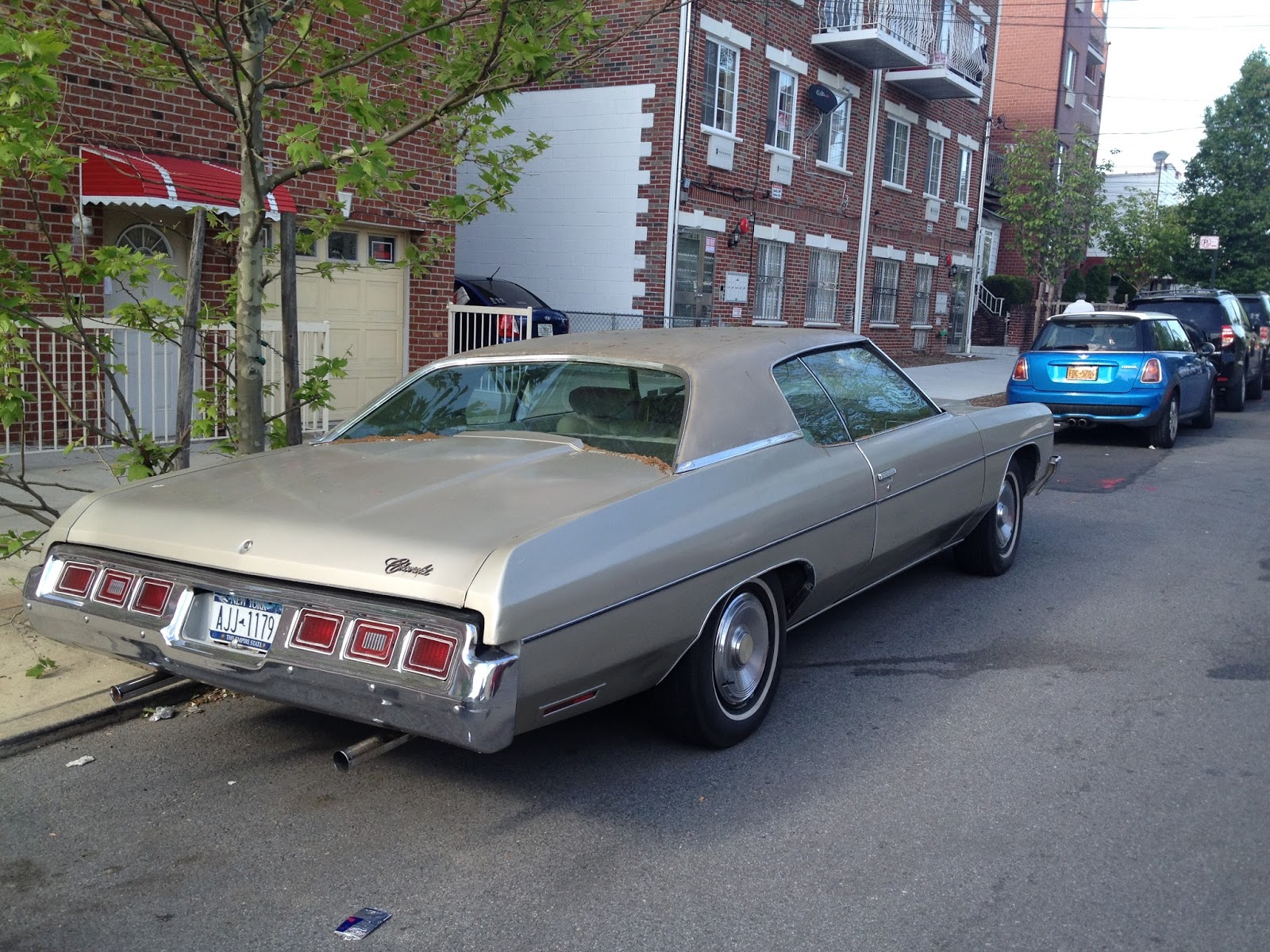
Ahhh yes, here is the serene 1973 Chevy Impala in yawn-inducing BEIGE. This color looks so gentle that it looks like it came from a hospital. If your psychologist is suddenly unavailable they could let you sit on the big bench seat inside this ride and you would feel calm.
*By the way, the only way I know of discerning an Impala from a Caprice in '73 is the grill. The Impala has twice as many horizontal and vertical lines in it as the Caprice.
This is pretty darn close to immaculate which is shocking for two reasons; first of all it's a 42 year old car in New York with no rust! Second of all this was the car of choice for lowriders everywhere. So many of these got used up with 100 spoke Dayton wheels, upholstered steering wheels, and hydraulics that encountering a stock version is almost impossible.
There's some faint rust at the lower edge of the concave rear window but that seems to be the extent of the damage. The trunk lid has what seems to be a mock hood scoop which is something I haven't seen on any other car.
The federally mandated bumpers were introduced in stages. This year is on the cusp where the huge front bumpers ready to withstand a 5mph crash are already in place. This is the last gasp for rear bumpers that incorporate the taillights before the regulations for the rear came due in '74.
The stock hubcaps are nice enough, and the lower body crease helps temper the dimensions of this beast. The 350 V8 was standard in '73 but you could also order a 400 and 454. Now lets lose the roof:
Here we have an EVIL 1972 Impala convertible in Tuxedo Black. This is the last year for an Impala drop-top as it would move to the upscale Caprice the following year.
The grill has been spray painted black (for extra toughness I suppose). Those cheeseball plastic mirrors are not original and I'm calling the owner out on it! The originals were square brushed stainless steel examples that fit a large car.
You can see the lineup I was presented with on this block! We'll see those other rides in a minute.
The hubcaps on this beast are Chevy, but they come from an early-'80s Suburban.
A white roof on a convertible is a stroke of genius since it helps keep the interior cool in the sun. I had a convertible with a black top and interior once and even though it looked great the seats were 1,000 degrees no matter what.
Next we'll flip-flop color schemes:
This is a 1974 Caprice convertible in Antique White. It's very easy to date this car because it's the last year for the headlights being tucked in behind the leading edge of the fenders and the first year for the huge rear bumpers. This basic design would continue through '76 but the final two years had the a flat grill out front with the headlight pods on an angle leaning back. The overall impression of that look is a fainthearted attempt at making a square slab aerodynamic. 
Here's that ridiculously huge rear bumper hanging off like a park bench. It also gives the impression of squinting or lazy rear taillights to me. Why you would need those additional little bumper guards on there is a mystery to me.
This was the first year for a Caprice convertible. The name on the hardtop was located on the sail panel behind the rear side window. For the convertible you can see the emblem located on the leading top edge of the quarter panel.
Now on to an interloper:
Here we have a 1975 Buick Electra 225 Limited in Arctic White with a Maroon vinyl landau roof. We can pinpoint the date because this is Buicks first year for square headlights and the following years would see the turn signals directly under the headlights instead of down in the bumper.
Buick was above Chevy, Pontiac, and Oldsmobile in the GM hierarchy but still below Cadillac in luxury. Some of those extra touches exist here though like the stand up hood ornament and the cornering lamps on the sides. Under the skin however this car is the same as the Impalas and Caprices from the same year (along with the Olds 98, Caddillac Coupe de Ville, and Pontiac Grandville for that matter).
The plastic bumper extensions missing here are easily the weakest link for all GM cars of the era. Most Buicks and Cadillacs need them replaced at some point. This car is a true hooptie with the trunk lock missing and dents, scrapes, and rust all over it.
Well there you have it for GM full size beasts from '66 and '72-'75. I've ridden in at least one example of each of these yachts and they all ride nicely with plenty of power and cushy comfort. Parts for them are readily available too since all were made in vast quantities. These days one can still be had at a reasonable rate and would be a breeze to maintain.