Showing posts with label 1972. Show all posts

Thursday, June 8, 2017

Brawny Bay Ridge Bumblebee

BRAWNY BAY RIDGE BUMBLEBEE
I strolled around the block from my house recently and this striking brute was waiting for me:
This is a 1972 Chevrolet Chevelle SS in Cream Yellow. This thing dead lifts more than you and has a tribal tattoo around it's bicep.
There are 2 simple ways to discern a '72 from the almost-identical '71. Those turn signals consist of a single lens on each side whereas they were split into 2 stacked rectangles previously. In addition there are 2 horizontal bars in this grill where the '71 had one. In the interest of overall toughness the owner has blacked out the chrome bars on this grill* (which is nothing compared to having a black hood and trunk I suppose).
*For the record there was a blacked out version of this grill as a part of the Heavy Chevy package. That was more of a base model Chevelle with the big engine than a true SS.
The Super Sport package had been available in some form on various Chevys since it was an option for the 1961 Impala (my favorite Impala for what it's worth). It has varied from a simple dress up package that adds stripes and badges to a legitimate performance upgrade. This year is thankfully the latter with front and rear sway bars joining that fire breathing V8 under the hood.
This ride is just beautiful in that delicate Cream Yellow. Chrome trim is very understated with thin moldings around the wheel wells, front and rear glass, and the drip rail above the doors only.
This was the final year for the Cowl Induction hood that brought fresh air directly into the thirsty 4 barrel carburetor. When it's hooked up properly it remains closed until you stomp your foot on the gas when a vacuum actuator pulls it open. When there is no vacuum in the system or it's not hooked up it stays open like this. As bad ass as this sweet detail is it added no horsepower to the car but who cares? COWL INDUCTION bro yes!
*Those functional hood pins are a part of the Cowl Induction hood package by the way.
This car is outfitted with the mightiest of the mighty for Chevrolet; the 7.4 liter Turbo-Jet 454 V8. The way horsepower had been rated had changed to net as opposed to gross in 1971 so the 454 was rated at "only" 270 HP (those are air quotes for effect you grammar nazis). The net HP was supposed to approximate the power at the wheels and the gross would be what the engine produced on its own. The gross HP for this engine was probably more like 365 but there is no disputing the torque rating which was a whopping 390lbs.
This ride is outfitted with the optional Strato-Bucket seats and a console mounted slap shifter for the automatic transmission. There's also a color coordinated Yellow Little Tree hanging off the dash which is Jasmin (I looked it up). Points for consistency.
This is the last year for the second generation Chevelle which debuted in 1968. While the body dimensions are the same the '68-'69 version looked very different in the front with a forward leaning grill containing quad headlights. For 1970 only there were quad lights with body color surrounds before switching to single headlights such as this ride.
I love the continuity across lines within Chevrolet for 1972. The Camaro had similar taillights as did the Corvette. Each taillight is actually different but they look identical to the layman. A single Michigan plate? Normally I would launch into a diatribe about how you'll never get a ticket in Brooklyn with one out of state plate on any car but this one is too nice so I think it's legit.
This is the mid size GM muscle car body which was shared by the Buick Skylark/Gran Sport, Oldsmobile Cutlass/442, and Pontiac LeMans/GTO. These cars sold spectacularly well overall, with the Chevelle being the 2nd best selling American car of 1972. Many consider 1970 to be the ultimate moment in the Muscle Car craze due to a combination of unbridled horsepower and lack of regulation. This generation Chevelle was square in the middle of the craze.
If I were smarter, more patient, or better prepared I would've saved this for my 454th post but too bad. My desires usually move away from such common cars as illustrated by my 1st gen Mustang takedown but I'm giving this one a pass. Why is that? The car above represents the final moments of the muscle car era with few exceptions (the Super Duty Trans Am from 1974 is, in my opinion, the very last remnant of the original MC era). The 454 wasn't even listed in most of the Chevelle brochures of the day. 1973 would introduce a new, larger era for Chevelle the likes of which can be seen in the movie Drive*. While those cars are cool enough it's a major departure from these more athletic rides.
*Heads-up music will play the moment that clip starts!
 

Friday, April 21, 2017

Sweet old 'bird by Owl's Head Park

SWEET OLD 'BIRD BY OWL'S HEAD PARK
I was walking around my future neighborhood of Bay Ridge (though I didn't know it then) when I stumbled upon this sweet rig:
Right on! I love these old rides and they're getting scarcer by the year.
This is a 1972 Pontiac Firebird in what I think is an aftermarket color. There was a Cardinal Red and Sundance Orange but neither are close to this one. Nice job though and an interesting choice.
The front of these cars is called the Endura nose and it serves double duty as the bumper. They are made of urethane rubber over a steel core. Pontiac bragged about it taking a good beating while still looking good and never rusting. Here is an amazing commercial from the era where they they show off how durable it is. Just because I couldn't decide between the two here's another.
There were almost no differences between the '72 and '73 Firebird but the grill holds the clue. This honeycomb pattern was replaced with a straight ahead crosshatch pattern in '73.
This well loved example is the standard Firebird. In addition you could've ordered a luxury version called the Esprit. If high performance was your bag they came in Formula and Trans Am as well. One particularly rare option was a high output 455 V8 in both 325 and 335 horsepower guise.
This body is essentially identical to the Camaro with the exception of the front and rear fascias.
Ha ha ha I've had that same window crank! Gotta love having a vice grip in an old car. Next to duct tape it's about as useful as it gets.
Even in this somewhat grubby condition I love white interiors in cars. This ride has the gauge package as illustrated by the 3 smaller lenses above the heater controls. The steering wheel is somewhat plain Jane for a Firebird with most of them coming with 3 spoke, sportier versions.
This slippery body looks great with no spoiler or wing mucking it up. Those pre-safety standard bumpers are delicate enough to not look overloaded and ridiculous. By '74 big bumpers were added but they managed to incorporate them better than most.
The famous Flaming Chicken changed slightly over the years. The Trans-Am was the ride with the sweet decal on the hood.
This is the 2nd generation of the Firebird. Introduced in '70, this design had a remarkable 11 year run before the Knight Rider version showed up in '82. When you factor in the amount of change from the very beginning of the '70s into the beginning of the '80s it is an astonishing achievement. Firebird managed to hold on to its muscle car cred too with The Rockford Files and Smokey and the Bandit building their legend.
It's amazing to think about now but the Firebird and its sibling Camaro were almost scrapped entirely due to a labor strike in '72. The workers at the Lordstown plant in Ohio held a 22 day long strike which cost GM a cool 150 million (in 1972 dollars!). A similar but much longer strike was the nail in the coffin for the IH Scout II as the company finally forfeited and just halted production outright. The legacy of the Lordstown strike was that 1972 was the smallest production year for Firebird with just under 30,000 built. For contrast the year before saw 53,000 produced and the following year 46,000.
Nothing wrong with some Cragar Super Sport wheels on any '70s ride!
Well that's where we'll leave this rare 'bird. I've always preferred Pontiac to Chevy due to the slightly aggressive and unique styling. Pontiac was the only division of GM to have the Endura front ends which look beautiful to me. Prices are climbing on these so if one catches your eye at a decent price I highly recommend snapping it up quick!


Friday, April 7, 2017

ORV? MPV? SUV? Yes to all three!

ORV? MPV? SUV? YES TO ALL THREE
I was wandering the final wintry moments in Red Hook recently when I stumbled upon one of my favorite trucks of all time. Behold!
This is a 1972 Ford Bronco in the outstanding color Sea Pine Green Metallic. This is in the running for the cutest damn truck to have ever been built. Something about these old Broncos in their stock trim without being all jacked up is so freaking charming I can't stand it. This is my equivalent of a little fuzzy bunny.
The Bronco was introduced in 1966 looking almost exactly like this one (this 1st generation design would remain essentially intact all the way through 1977). A man named Donald Frey was the man who conceived the Ford Mustang. He was also the project manager for this little truck. Those are 2 serious feathers in his cap and I'm surprised he's a relatively unknown figure today.
This poor little donkey has run afoul of some immovable object, displaying the weakness of the bumper in the process. As capable as these are the factory bumpers are flimsy.
To engage the 4 wheel drive you need to exit the cab and lock the front hubs by turning that dial emerging from the hubcap. Shifting into 4WD on the fly was still a ways away.
The Bronco was meant to compete with the Jeep CJ and IH Scout which helps to explain the dimensions. Marketed as both an ORV and MPV (Off-Road Vehicle and Multi-Purpose Vehicle) they were built to scramble over rugged terrain and be unstoppable in all seasons and climates. The ride height and wheel placement at the edges of the body make for excellent approach and departure angles when climbing over rocks or passing through a steep ditch.
You can see from this view that this ride has dual gas tanks to assist in your days-long excursion into the mountains or desert. This used to be a common option for trucks when gas mileage was crummy and rural gas stations were infrequent. Pre-cell phones there was a real danger of running out of gas going for a country drive without first mapping the closest stations.
This spare tire placement is straight out of the Jeep playbook. It swings away to the right revealing a traditional tailgate. Broncos sold well from their introduction but couldn't topple the CJ sales figures.
Like its competitors the roof is removable making this an instant beach cruiser. In addition to this body style there was a short roof pickup version as well. 
For the first 3 years there was the Bronco Roadster too. This model came from the factory without a roof or doors! Molded fiberglass door openings without any lock or hinge hardware made for a pure beach vehicle. Only a couple thousand were ever produced and something like 100 remain.
By 1972 creature comforts were being touted in the sales literature in addition to its off road capabilities. Chevrolet released the K-5 Blazer in '69 while the IH Scout II came out in '71. Both of these newcomers were full size ORVs as opposed to these little guys. The similar IH Scout 800 was discontinued in '71. The Toyota Land Cruiser kept its small dimensions through the '70s but for the domestic market it was the Bronco and Jeep CJ.
The interior is as beautiful as the exterior on thsi sweet ride. A factory radio is present to allow AM to burble through a single dashboard speaker. 
That chrome shifter handle just under the dash is actually the floor mounted transfer case for selecting 4WD high and low. Due to the column shifter position I think this is actually a 3-on-the-tree manual transmission truck.
The engine choices were a thrifty inline 6 cylinder or an optional 302 V8. Even the small 6 had several upgrades for durability such as a larger 6 quart oil pan, heavy-duty fuel pump, oil-bath air cleaner, and a carb with a float bowl designed to function while tilting on steep terrain.
Wear marks like those above allude to original paint that has been washed too many times and baked in the sun. This must have come from the Southwest or something.
The vents on the hood bring fresh air into the cabin. The placement is not an accident for a vehicle that might be crossing rivers or trudging through deep snow.
Well there you have it; one of the cutest little vehicles this country's ever produced. When you consider the capability and simplicity this is the perfect classic to use as a daily driver. Unfortunately most were used as intended which means they were chewed up and spat out. Any examples not used to death have love rusted away in most of the country. Plenty of examples remain but the prices is climbing. My suggestion would be to find the least rusty Bronco you can find as all the running gear is standard '60s & '70s Ford. 
Rugged but usable ones are currently just under 10 grand. The sky's the limit for nice restorations or survivors.

Tuesday, March 28, 2017

2 cool cars with an identity crisis

NOTICEABLE VERSUS OUTLANDISH
I'm bringing us back to the halcyon days of Summer when I found the following 2 rides roosting in Moosic, Pennsylvania. That's Moosic like "moo-zic" as opposed to moose, ick.
Get a load of this color! What we have here is a 1971-1972 Pontiac Ventura II in Buccaneer Red. This is basically a Pontiac Nova in an early case of badge engineering. The Chevy Nova was so popular that GM introduced almost identical versions in each of their divisions. The Ventura was first, followed by the Buick Apollo and Oldsmobile Omega in '73.
With the quad split grill this is my favorite of the faux Novas. This grill only lasted for the first 2 years. 1973 brought a split grill in 2 larger segments.
The rear side windows come to a point in the rear which means this is a standard coupe with a trunk. Beginning in '73 these were available as a hatchback. You can identify hatchbacks by the rear window being squared off. They even offered a tent that attached to the open hatchback for camping! Those are so rare it's almost like they never existed.
This hood is Ventura-specific and helps to make the trademark Pontiac pointy schnoz look like it belongs on the car. The Nova, Apollo, and Omega all had a single raised line going down the center. Under the hood lurks either the 250 inline 6 or 350 V8. There was a sporty Sprint option that allowed for the 307 V8 as well.
The "II" suffix alluded to the fact that there was an earlier, full size Ventura in the '60s. was dropped after 1972 even though this compact version soldiered on through '77.
Enough with that flashy but correct ride, let's get goofy!
Yeesh!
This sickly looking tough guy is a 1967 Dodge Dart in the unmistakable 1970-only color Sublime Green. The color was one of the High Impact range offered from '69-'72. The High Impact line included Panther Pink, Plum Crazy, Go Mango, and Top Banana as well as others.
I think a 1967 Dart 2 door is a great car on its own. This person obviously wanted a Hemi Dart which was only offered in 1968. However the turn signals are round on the '68 and slightly inset from the location of those above. Who could blame the owner for making a tribute? There were only 80 total Hemi Darts produced and they were reportedly the fastest muscle car of all time. Hemi Darts had the hood with massive scoop as seen above. The hood and fenders were fiberglass, bumpers aluminum, and doors acid dipped to save weight.
Other weight saving details included the omission of a back seat, no arm rests, no window cranking mechanism, and thinner glass. They were sold with no warranty specifically for "supervised acceleration trials" (that's drag racing to you rubes). From the factory the Hemi Dart was good for a 10 second quarter mile at 130 mph!
If you want to be noticed this is a great way to go I suppose. You're setting the bar high though as you'd better have an earth shattering beast of an engine under the hood to back up the look. I have to say the black wheels and blackwall tires look pretty great on this beast.
Well that's that. Summer's coming people just hold on a bit longer!

Monday, March 6, 2017

A brand new ride disguised as the most common car in the world

A BRAND NEW RIDE DISGUISED AS THE MOST COMMON CAR IN THE WORLD
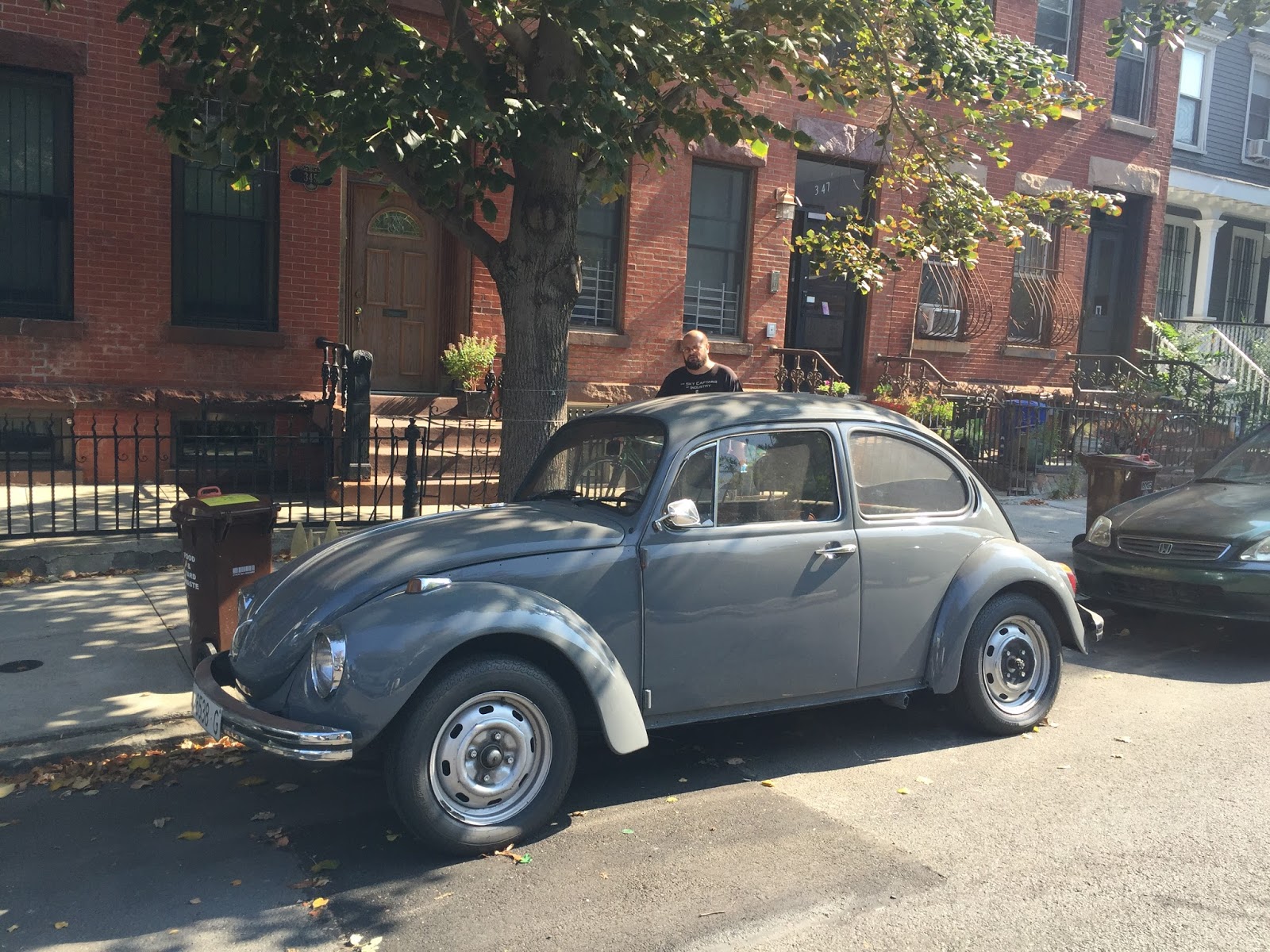
How many Beetles can you pass before you notice one that's special? Sure they're getting more scarce in the rusty Northeast but even here there are several in daily use. I was mid yawn walking by this ride before a strange emblem caught my eye:

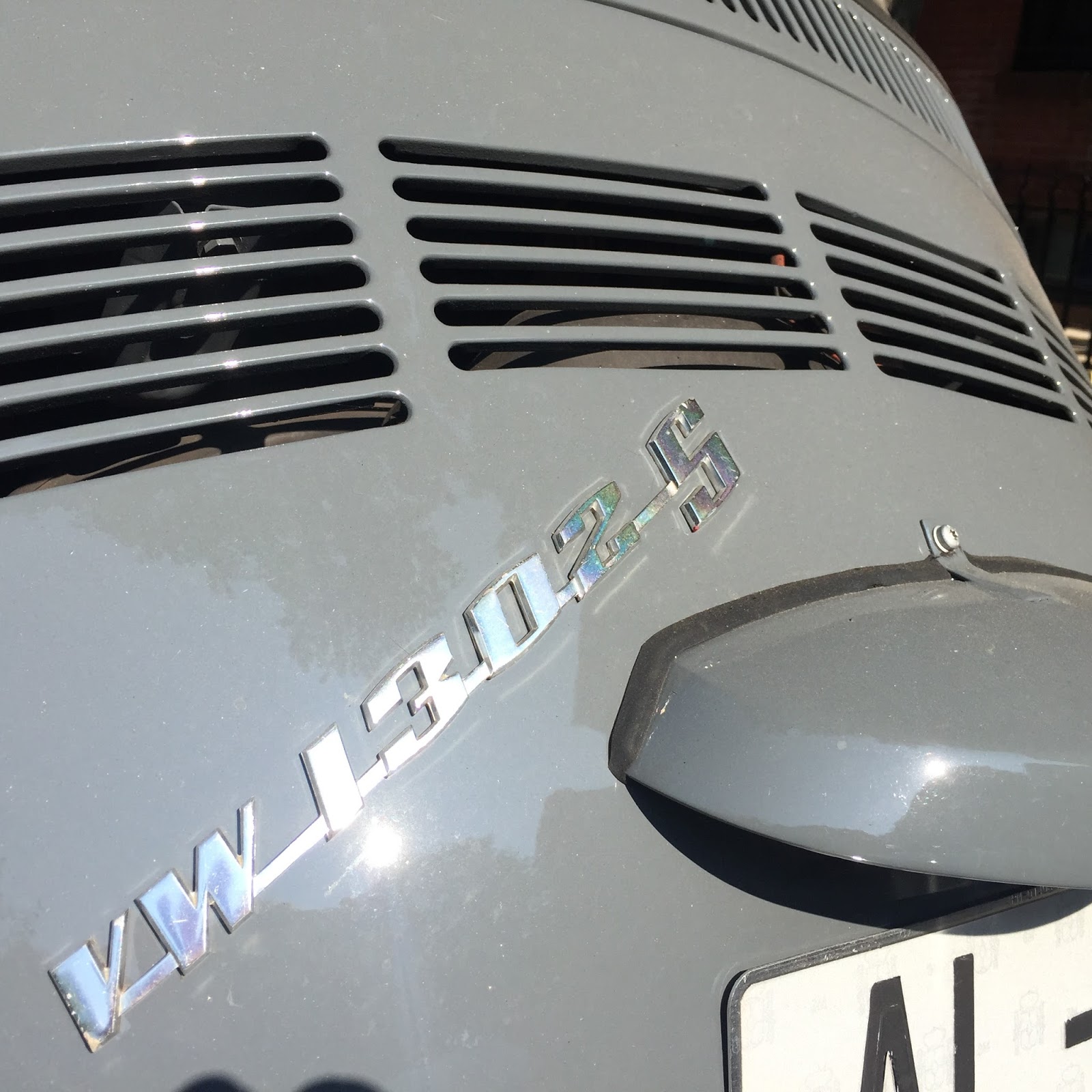
VW1302-S? I've seen 1300 and 1500 emblems before which corresponded to the engine size, but what was this?
What it is is a 1972 Volkswagen 1302-S in either Silver Grey Poly or Chinchilla. The awkward 1302-S name was only used for 2 years but it was actually the first Super Beetle.
There are so many differences between the 3202-S/Super Beetle and the standard Beetle that it's hard to believe they look almost identical. The hood is longer, increasing the luggage capacity greatly. In addition the spare tire sat horizontally on the trunk floor for the first time. The front suspension on these larger Beetles was upgraded to independent struts as well. Handling was more like a regular car than a Beetle.
This one is missing the hubcaps and running boards but is in otherwise stellar condition.
Everything you need to know to pinpoint the year on this ride can be found on the back. The previous year 1302-S had 2 banks of 5 horizontal vents on the hood where this has 4 banks. The year after this sported massive taillights and a larger rear window (and is actually known as the 1303).
Confoundingly the 1302 was only available with the 1600 engine in the States.
That little crescent moon shape behind the rear side window is the outgoing vent for the new fresh air flow-through system introduced with the Super Beetle. Air conditioning was a new option.
For the first time in '72 there was a plug-in dock under the hood which can be hooked up to the VW diagnostic computer at the dealership. These early computers can be expensive to replace these days. I had a 1970 VW Type 3 Squareback with fuel injection. In the stack of receipts that came with the car was one invoice for the computer "brain" for the fuel injection. In the mid to late '90s it cost over $1,000 to fix!
The interior has been tastefully redone in cloth and vinyl. The steering wheel looks to be an earlier replacement due to that chrome horn ring.
In various forms the VW Beetle had been in existence since the late '30s. Official sales figures start around 1947 but it was the 1972 model year when the Beetle surpassed the Ford Model T as the greatest selling automobile in history. It has since been dwarfed by the Toyota Corolla.
Well there we have it; a cool little transition car hidden in plain sight. VW history changed dramatically with this ride. The old technology that carried the company from its inception until this car was built was bowing out. The engine was still air cooled and placed in the rear. The gas tank was still up front. The car still looked like a round classic from the 1930s. In the years following this the baton would be passed to the Rabbit (known as the Golf everywhere besides the States), the Dasher, and Scirocco. Engines would change to being water cooled. Creature comforts would take priority. For anyone who remembers the warbling buzz of a Beetle driving by this ride will still make you nostalgic.