Showing posts with label Beetle. Show all posts

Monday, March 6, 2017

A brand new ride disguised as the most common car in the world

A BRAND NEW RIDE DISGUISED AS THE MOST COMMON CAR IN THE WORLD
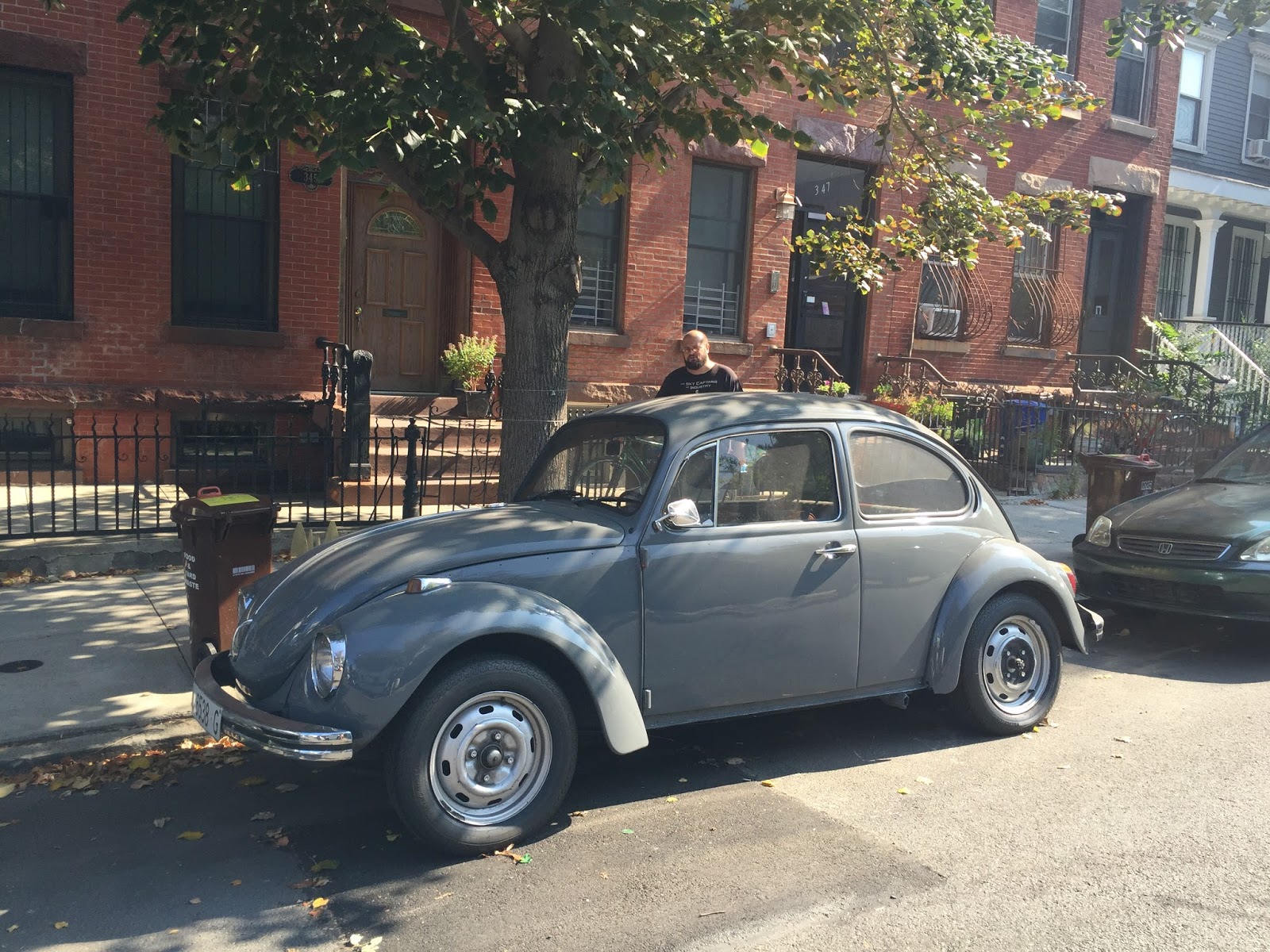
How many Beetles can you pass before you notice one that's special? Sure they're getting more scarce in the rusty Northeast but even here there are several in daily use. I was mid yawn walking by this ride before a strange emblem caught my eye:

VW1302-S? I've seen 1300 and 1500 emblems before which corresponded to the engine size, but what was this?
What it is is a 1972 Volkswagen 1302-S in either Silver Grey Poly or Chinchilla. The awkward 1302-S name was only used for 2 years but it was actually the first Super Beetle.
There are so many differences between the 3202-S/Super Beetle and the standard Beetle that it's hard to believe they look almost identical. The hood is longer, increasing the luggage capacity greatly. In addition the spare tire sat horizontally on the trunk floor for the first time. The front suspension on these larger Beetles was upgraded to independent struts as well. Handling was more like a regular car than a Beetle.
This one is missing the hubcaps and running boards but is in otherwise stellar condition.
Everything you need to know to pinpoint the year on this ride can be found on the back. The previous year 1302-S had 2 banks of 5 horizontal vents on the hood where this has 4 banks. The year after this sported massive taillights and a larger rear window (and is actually known as the 1303).
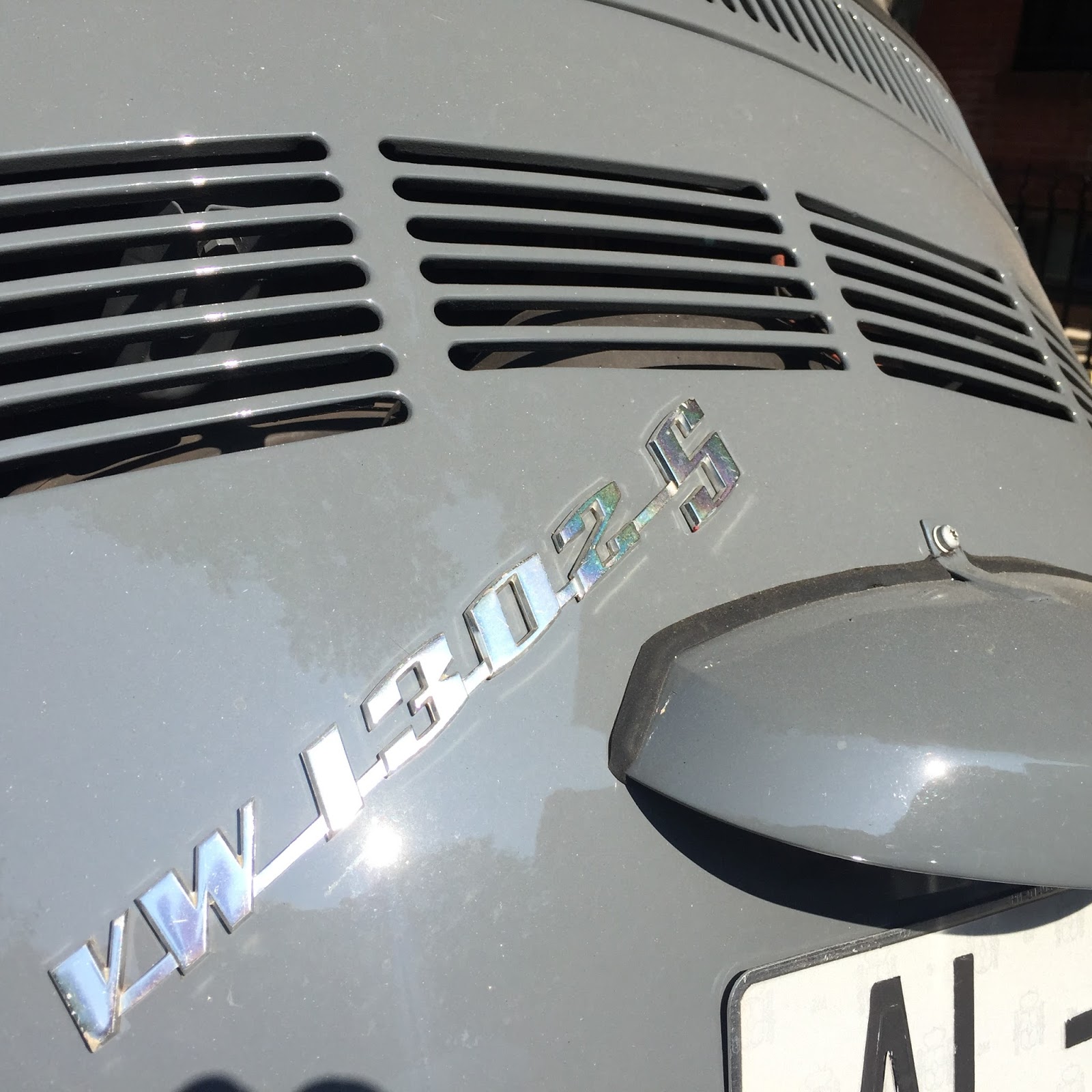
Confoundingly the 1302 was only available with the 1600 engine in the States.
That little crescent moon shape behind the rear side window is the outgoing vent for the new fresh air flow-through system introduced with the Super Beetle. Air conditioning was a new option.
For the first time in '72 there was a plug-in dock under the hood which can be hooked up to the VW diagnostic computer at the dealership. These early computers can be expensive to replace these days. I had a 1970 VW Type 3 Squareback with fuel injection. In the stack of receipts that came with the car was one invoice for the computer "brain" for the fuel injection. In the mid to late '90s it cost over $1,000 to fix!
The interior has been tastefully redone in cloth and vinyl. The steering wheel looks to be an earlier replacement due to that chrome horn ring.
In various forms the VW Beetle had been in existence since the late '30s. Official sales figures start around 1947 but it was the 1972 model year when the Beetle surpassed the Ford Model T as the greatest selling automobile in history. It has since been dwarfed by the Toyota Corolla.
Well there we have it; a cool little transition car hidden in plain sight. VW history changed dramatically with this ride. The old technology that carried the company from its inception until this car was built was bowing out. The engine was still air cooled and placed in the rear. The gas tank was still up front. The car still looked like a round classic from the 1930s. In the years following this the baton would be passed to the Rabbit (known as the Golf everywhere besides the States), the Dasher, and Scirocco. Engines would change to being water cooled. Creature comforts would take priority. For anyone who remembers the warbling buzz of a Beetle driving by this ride will still make you nostalgic.

Wednesday, September 7, 2016

If a car could be a smile this would be it

THE SMILING CAR
Boy is this thing late to the party! Here she is wearing all white after Labor Day and dressed up for summer just as it's leaving us behind. Regardless I ran across this little crumpet at the terminus of Ocean Parkway where the road gives way to the boardwalk between Coney Island and Brighton Beach. You know it, I know it, so without further ado . . .
this is obviously a Volkswagen Super Beetle convertible in Alpine White. While pinpointing the years on these cars takes a maniacal eye for detail we can call this a 1975 for 2 reasons: the words FUEL INJECTION were added to the trunklid in '75, and the rear window defogger (which this does not have) was added in '76.
What can you say about the Beetle that hasn't been said before?
The larger Super Beetle was introduced in 1971 to accommodate a larger, better front suspension among other things. This necessitated completely different body panels from the windshield forward for the new Super Beetle. I used to bemoan the chubbier look of these larger Bugs but now I can appreciate how much better they handle than the charming earlier Standard Beetles.
Those large taillights are affectionately known as the Elephants Foot were introduced in '73.
Here is another departure from every VW Beetle since the '50s; a single tailpipe as opposed to the familiar double. While the warbling whistle it produced was pretty much the same, the fuel injected engines can be identified by that single pipe.
Look this is the deal with this ragtop; it is FUN FUN FUN! If you want to feel like you're driving around in a little boat or amusement park ride, aren't in a terrible hurry to get anywhere, and aren't concerned about the lack of airbags or much protection whatsoever in an accident it is easy to love this car. Beetles are basically smiley face emoticons as cars and the convertible even more so.
If and when you're in the market for any Beetle the first thing to inquire about is rust. They all rust easily and like a house with no insulation the outside wall is the inside wall so small holes can quickly become tragic. The first thing to go is the battery tray. This is located under the passenger side of the backseat! Lift up the backseat and look for holes under the battery on the floor. If there aren't any you're in great shape. If there are it's still not the end of the world. The sides under the doors and bottom of the front door jam are areas need major welding when rotted out.
Behold the "modern" Super Beetle dashboard! First of all there's an actual dashboard with padding and everything as opposed to the classic Beetle speedometer mounted on a metal wall. Faux woodgrain compliments a plastic radio looking very 1975 with its big black knobs. A windshield wiper stalk is a departure from the nondescript dash mounted switch of yore. 
Somethings never change though; see that tiny wood tipped lever next to the inside of the seat? Lifting that opens the heater channel tube to allow barely warm air to leak out into the cabin. Using that to heat a convertible Bug in winter? Better bring a blanket!
I wanted to highlight the tiniest of fancy moments on this car; that three-stripe chrome piece between the hood and the door has no purpose other than to beautify. Why is it here? It doesn't match any other part of this ride. It's almost like noticing an original ornate brass banister in a far corner of the underground Penn Station that somehow escaped demolition from the original structure (those do exist by the way).
This is the quintessential mid-to-late '70s Super Beetle wheel. It's funky and quirky, kinda mag like kinda tractorish, and the hub cap is literally a tiny cap on the hub itself. I dig these wheels, and in the words of the immortal Q-Tip; "the wet look's complete when the tires say Pirelli".
Well we'll leave this old dog sniffing its German brethren out by the mighty Atlantic. If what you see is what you get with this ride it's in spectacular condition. At this very moment it's a light sanding and paint job away from looking perfect for years to come. As you might imagine every part is available for this thing without exception (the VW Beetle was the worlds best selling car in history from 1972 (when it surpassed the Ford Model T) to 2013 when the Toyota Corolla took the crown. 
I've had several Beetles and highly recommend them as great little cars for those who don't mind tinkering and think discomfort can be charming. Driving with a blanket over my knees and a cloth in my hand to wipe the windshield all winter was just what you had to do you know? If that doesn't sound good to you stay away!

Wednesday, May 18, 2016

Hilariously out of place Baja

BAJA!
I truly have no recollection of where this car was located. It is definitely in NYC somewhere, most likely deep in Brooklyn where free standing homes with big lawns exist (Midwood? Marine Park?). Regardless somewhere amidst this beatific Americana setting was this misplaced lump:
In California? Sure. Way out on Long Island? Possibly. But a Baja Beetle on the city streets? Unprecedented!
For those of you who don't know this is a Volkswagen Beetle with an aftermarket dune buggy conversion kit called the Baja. These were super popular for decades but like the classic custom vans of the '70s they are fading fast.
With the modern cars around it this thing looks positively prehistoric! The look is enhanced by the fact that it seems to have no color at all. With the exception of the front wheels and turn signals it looks like a black and white photograph.
Pinpointing the year of a Beetle can be tough regardless, and this one has had half of its body replaced with components from the kit. My best guess is that this started life as a 1971 or so Super Beetle due to the slightly longer hood, crescent shaped vent behind the rear quarter windows, and front turn signal size.
The Baja conversion consisted of replacement hood, fenders, engine cover, and that front valance below the hood. While there were many kits to choose from there were really only 2 distinct styles; Wide Eye (pictured here with the headlights on the fenders), or Narrow Eye (where both headlights would be bunched together on the front between the fenders).
This car looks like you just woke it up.
Beetles were remarkably capable off-roaders from the factory due to the high ground clearance, flat floor, and engine located over the drive wheels. The Baja kit was named after the Mexican Baja 1,000 race which pitted all sorts of trucks, Jeeps, and motorcycles on a brutally rugged rock and dirt course to the Southern tip of the Peninsula. Beetles have always competed in it, with success. Perhaps the most astonishing thing about the Baja race is known as Class 11. To enter the Baja in Class 11 you must race a stock VW Type 1 Beetle with no modifications except for adding a roll bar and adding ground clearance. No Super Beetles are allowed. You must use the stock drum brakes! The engine and transmission have to be the equivalent of a standard 1968 Beetle too. No wonder they named these kits after the race.
At some point a visor was added over the windshield of this beast. On display here is one of the greatest advances in VW Beetle history; the exterior fuel filler door! From the early split windows of the '40s all the way through the late '60s you had to pop the hood to fill 'er up. It's the small things folks.
Those wheels are vintage Wagon Wheels from the '70s.
Lowe's emblem on the left fender? Really dude?
The taillights have been replaced with pointy rocket lenses from a '59 Cadillac which, if original, means this conversion happened a long time ago. The engine looks to be a standard air cooled Beetle unit, with what looks to be modified Cherry Bomb mufflers welded to a stock exhaust. The bumper is appropriately homemade looking, as is the trailer hitch. I suppose towing a very small boat isn't out of the question even for a Beetle.
Well there you have it; a funky looking hybrid kit car ready for the dunes. The best thing about a Beetle is that absolutely every single component is still available for it and probably will be forever. If you find something like this in a barn where it's been sitting for 30 years you can get it running in a day or 2. Complete engines are not only available, but take about an hour to install. Seeing this one made me realize how long it had been since I last encountered one and I have to say it's a pretty cool summer ride.

Monday, July 20, 2015

Let's just stick with the whole Volkswagen/Porsche thing I've got going

THE PEOPLES CAR
It's rare to find a Hooptie in winter but this next little ride was indeed holding it down in snowy Ditmas Park early this year:
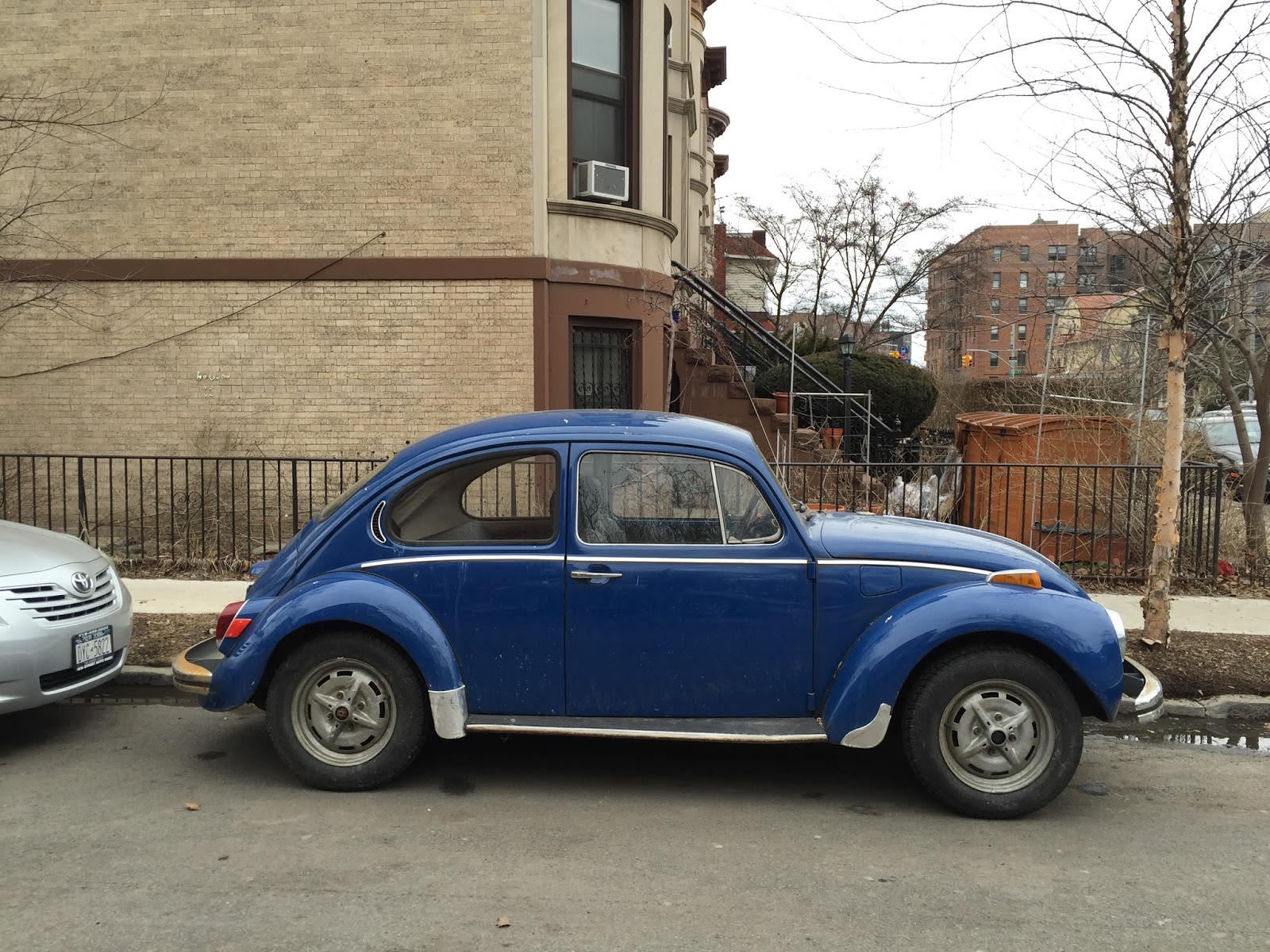
This is a 1972 Volkswagen Super Beetle in Adriatic Blue. The original (Standard) Beetle was the Type 1. However, once the larger Super Beetle was introduced it became known as the Type 1302.


Obviously every single person on earth knows this car (at least over the age of 20). A good percentage of the people walking around out there have had one at some point in there lives. I've had 2 that ran well, one free and complete parts car that could've run, and a very old classic that I never got going. Those that I had were standard Beetles, all from 1963 or earlier. These bigger Beetles from the '70s drove more like a normal car.
After a major redesign in 1968 the Beetle grew in every direction. In the years following the windows, bumpers, and turn signals/brake lights all increased in size to this iteration. The Super Beetle was even bigger, with an extended front end allowing for the spare tire to lay flat on the trunk floor as opposed to standing in the front in a well. The main improvements for the Super were in the handling department though as McPherson Struts replaced the old shock absorbers up front. A rack & pinon steering set up was introduced in 1975 and is an easy conversion for these older ones.
Here we can see the extended schnoz on the Super; the hood remains almost level to the middle of the front wheel. The Standard Beetle angled downward almost from the base of the windshield. 
Very faintly in the above pic you can see the fuel filler door located above the rear of the front fender. Before 1968 you had to open the trunk to fill the gas tank!
These are the stock wheels but they've always seemed a bit busy to me. I much prefer the old school round chrome hubcaps from the '60s and earlier Beetles.
Here we've got the bulbous and heavily vented hood over the air-cooled rear engine. It would be the 1600 dual port 4 cylinder at this point, which is a great engine. I've had an engine just like this one in each of  my '63 Beetles and the difference in power was incredible.
These taillights are still somewhat restrained compared to what was to come. By the mid '70s the taillights were enormous, incorporating orange into the lenses as well.
That crescent vent behind the rear side window first arrived in 1971 to improve the famously inadequate heating system. Air is drawn into the cabin through heater boxes that hug the exhaust pipes leaving the engine. Since Beetles are just about air tight with the doors and windows closed (they can easily float when driven into a lake) the air needs a way to exit the cabin to allow for newer, warmer air to make it in. These crescents are meant to exhale the inside cabin air.
This was the final year for a flat windshield on the Super, which went to a curved unit in '73.
From it's ominous beginnings as a joint Adolf Hitler/Ferdinand Porsche design for the Peoples Car the Beetle went on to become the largest selling automobile in history (beating out the previous record holder the Ford Model T. In the 1990s the Toyota Corolla toppled the Beetle). By 1972 this was the only thing on the road that looked like it was designed in the '30s with its fenders separate from the body and overall rounded look. Safety and emissions regulations and performance demands all combined to finally make the Beetle extinct. It is a remarkable testament to their simplicity and quality that so many are still on the road today.