Showing posts with label German. Show all posts

Wednesday, August 2, 2017

The perfect metaphor for Volkswagen 2017

FROM ROLLIN' JOINTS TO ROLLIN' COAL
Scott from South Jersey sent the following pics from a vacation up in Maine and they gave me an ironic chuckle. Behold opposites ends of the same coin:
This is a 1981-1984 Volkswagen Rabbit pickup in a cool color I can't be sure of (Assuan Brown perhaps?). The Rabbit Pickup was a plot twist because it is a VW that was first introduced in North America. In fact it was built in Pennsylvania and was sold only in the U.S. from 1978-1982. When it was made available in Europe it was given the name Caddy.
Look at that ridiculous smokestack sticking up out of the bed! 
We can see from the emblem on the side of the tailgate that this is a diesel model. Diesel Volkswagens have been the darling of the biofuel set as they are very environmentally friendly. From the factory these would offer up to 50mpg when mated to a 5 speed stick shift (incidentally the 5th gear was labeled E for Economy!). However that smokestack is a part of the recent Rollin' Coal movement. When you're Rollin' Coal you are blowing the maximum amount of black smoke from your diesel exhaust to thumb your nose at wimpy Prius drivers (and increasingly "protesters"). I'm totally serious folks! I suppose it is the perfect metaphor for VW now that it famously got caught cheating on the diesel emissions software of their rides.
So here you have the beacon of hippie environmental consciousness transformed into a pinko hating vehicle for the Right. Who knew?
Thanks to Scott for this schizophrenic vision!

Sunday, June 18, 2017

Representing Father's Day with the Car With Two Trunks!

THE MOST PRACTICAL CAR OF THE LATE '60S?
My little sister from another mister Neen spotted this little Kraut roosting in the Empire Region and sent me some snaps. I'm glad she did because I love these rides so much!
This is a 1965-1969 Volkswagen Type III Fastback in Savannah Beige. This is the "car with 2 trunks" and it is in lovely condition!
*One amazing detail is the windshield washer fluid dispenser which is that little dot between the cowl vents. It is powered by an air hose connecting the spare tire to the fluid reservoir. That means that if you use the windshield washer with abandon and forget to inflate the spare you'll have a flat tire in the trunk!
The Type III was named as such because the Beetle was 1st and the bus 2nd in production dates. These came in Fastback and Squareback (known in Europe as the Variant) body styles in the States. Europe also had a 2 door coupe version with a proper little trunk lid called the Notchback. The Fastback was introduced to replace the Notchback but both turned out to be so popular that they sold them alongside each other (in the rest of the world anyway).
Those vents along the quarter panel bring fresh air into the engine compartment which was truly essential as this is an air cooled car. Unlike the Beetle this is a flatter "pancake" engine that fits underneath the rear floor. If you lift up the hood here you'll see a flat floor leading up the rear seat (that folds forward for extra storage). To access the engine you would move the rubber mat to expose a removable panel beneath. The front hood is the main trunk with the spare tire and gas tank too.
We know this is a '60s version because of these delicate chrome ringed lights and smaller signals. Starting in 1970 much larger lights incorporating both brakes and turn signals arrived.
In 1968 the Type III became the first car to have fuel injection as standard equipment. They ran very smooth, always started easily, and offered great gas milage. This may or may not have that setup but regardless I would love to roll around town in this little beauty.

Friday, May 19, 2017

Lovely little Variant in Oakland

LOVELY LITTLE VARIANT IN OAKLAND
Some cars have languishing in my computer for no particular reason. I snapped these pics in Oakland at least 2 years ago. Look at this sweet freaking face!
This is a 1970-1973 Volkswagen Type 3 Squareback in Yukon Yellow (with the exception of a door and quarter panel that are in the color Amber). I can tell you from experience that this is a great car.
The Beetle was the Type 1 and the Bus Type 2. These were known as Type 3 or Volkswagen 1600 depending on the market. The Type 3 was launched in 1961 and initially consisted of the 1500 Notchback; a 2 door coupe with a front and rear trunk. These were never imported to the U.S. and as a result are very collectible today. The U.S. market first saw the Type 3 in 1966 when both a Fastback and Squareback 1600 were offered.   
These rides have a pancake motor which is essentially a flattened version of the 1600cc VW air-cooled 4 cylinder. It was compact enough that it set underneath the rear cargo floor. You open the rear hatch, lift up the black rubber mat, and there is a metal trapdoor that unlocks and opens to expose the motor.
The '60s Type 3s had smaller front turn signals, taillights, and bumpers as well as a slightly smaller body overall. Of all the myriad cars whose lights and bumpers grew to meet regulations I think the Squareback wears them exceptionally well.
The Squareback was known as the Variant in the rest of the world.
While there was a fully automatic transmission available for these the manual is the way to go. They are outfitted with the Freeway Flyer transmission which benefitted greatly by having taller gears for highway cruising. I once drove 4 people 4 hours at 70mph without issue in one of these.
The louvers along the top of the quarter panel feed air into the engine cooling system which worked very well even in hot climates. By 1969 these rides came with Bosch fuel injection standard. A major percentage of the VW community believes converting those old injection systems to dual carbs is the way to go. I had a 1970 Squareback with F.I. and it was fantastic; always starting in any weather, smoothly accelerating with plenty of power, and never needing adjustment for the 5 years I drove it. The caveat is that our car came with a manila binder full of records and someone had replaced the computer "brain" for the system years earlier for $1,200. In 1990s money that was a lot but it worked a treat!
Well that does it for this charming little daisy.
I was out at Ocean Beach in S.F. with my girlfriend at the time and we saw one of these in Baby Blue with a for sale sign in the window. After admiring it we walked into the Surf Coffee Shop talking about how cool it was. The guy sitting by the door said "wanna test drive it?" and handed us the keys! We didn't know that guy at all but we took him up on it. 5 minutes later we were back negotiating a deal for the car (I think $2,200 down from his asking price of $2,500). The clock didn't work but it was set to 4:20. The ashtray was full of roaches to boot.
We drove that car for 2 years in while living on California St. in S.F., and then trailered it back East to Western Massachusetts. There we continued driving it for another 3 years, parking it only for the few worst winter months. Each Spring she would start right up. After that the Squareback made the move to New York with us and she stayed with my ex as it was always really her car. I heard it was sold to someone in Pennsylvania and hopefully she's driving as I write this.
If you see one in good shape and running condition don't hesitate. These are spectacular, hilariously fun cars to use every day.

Thursday, May 18, 2017

"Ich bin eine Furt! Warum magst du mich nicht?!"

"Ich bin eine Furt! Warum magst du mich nicht?!"
Poor little Sierra. Handbuilt, quick, sporty, and modern all sound like the sorts of traits that make a car popular. That's not the way it went down with this little punk though . . .

This is a 1988-1989 Merkur XR4Ti in Diamond White. To the rest of the world this is a Ford Sierra XR4Ti. The name breakdown is as follows: eXperimental, Racing, 4th generation, Turbocharged, fuel Injected.
These cars were each hand built by the Karmann Coachworks GmbH (kind of German for LLC) in Rheine, Germany. This is the same firm that collaborated with Ghia on the Volkswagen Karmann Ghia. Merkur as a company was founded to try and woo back buyers of American luxury brands that were heading towards BMW and Audi. However with only the above hatchback and a luxury sedan called the Scorpio brought over from Europe there was never much excitement or sales. The plug was pulled on Merkur just 4 years in. 
 The Sierra was popular in Europe and ran from 1982-1993. Several body styles were available in 3, 4, and 5 door configurations. There was even a van! The U.S. only got this 3 door hatch.
I blame this person even more than Debbie Wasserman Schultz for putting a Bernie 2016 sticker under the bad omen of a Merkur emblem. Go back to Maine!
This example is in shockingly good condition. The earlier 1985-1987 XR4Ti had a double wing in the back with the higher one about 5 inches above the lower.
 The U.S. spec cars had a turbocharged 2.3 Liter 4 cylinder in the as opposed to the 2.8 Liter V6 in the European Cosworth version. The Cosworth Sierra was fast, boasting a top speed of 150 mph! There was also a 1.6 Liter engine available in Europe only that boasted 51 miles to the gallon. That's getting into Prius territory.
This one is fitted with the 5 speed manual transmission which means it's probably a lot of fun to drive. Behold the manual Lumbar Support adjustment dial on the side of the seat; 1980s!
Well that's where I'll leave this little oddity. Like many automotive footnotes this ride found itself the butt of jokes. However unlike other punchline rides there's no real tragedy to pin its failure on. It never blew up like the Pinto, wasn't horribly made like the Yugo, or had a spectacular and criminal scandal like the DeLorean. No, this little car is more like the Edsel; introduced to great fanfare and quieted shown the door within a few years. To see one now is like seeing the future, 1980s style.

Saturday, May 6, 2017

The German troll under the bridge

THE GERMAN TROLL UNDER THE BRIDGE
In a fit of insomnia I rode my bike down to Brighton Beach recently at dawn. The sun rising over the wreckage of inner Coney Island was beautiful, and the breeze off the Atlantic fresh and invigorating. Then I turned back under an elevated block of the subway and found this:
Yeesh. I felt like I needed to say "sorry" and close the bathroom door because this thing looks like I walked in on it. How a beautiful car can get to looking so creepy is beyond me.
This is a 1973 Volkswagen Karmann Ghia in what looks to be a repaint of Bright Orange. It also looks like a bum that's getting a bit too close while trying to ask for something.
What happened here is a mystery to me as the engine is in the back. Was it parked facing something that burned? Is this a horrifically done dent repair? Who knows but the effect is icky.
Those nostrils originally had delicate chrome vents in them with 3 horizontal bars. That circle above the damage had the VW emblem at one point and shows the original Amber factory color. 
This car is 100% Beetle under the skin which makes parts and maintenance extremely easy. Basically the Beetle was the people's car and so VW decided to hire coach builder Karmann to design a foxy, sporty iteration to lure customers. Karmann decided to bring Italian design firm Ghia into the mix and thus the name was born.
The first Karmann Ghia was introduced in 1955 and looked very similar to this one. The body panels were hand formed which certainly justified the extra cost. Upon release the Karmann Ghia was a total success, surpassing even the most optimistic projections with 10,000 sold.
Unfortunately someone decided a generic tough guy steering wheel was better than the original. By '73 the factory steering wheel was made of black plastic and wasn't the nicest in VW history but it managed some class for the era. The early wheels are lovely with a thin ceramic rim and chrome horn ring. I can't blame them for the radio replacement or the under dash gauges (no water temp gauge of course). That button between the clock and radio is a cheap horn replacement. I had one just like it in a car where the previous owner replaced the steering wheel with a bro faux job.
These are the flat style hubcaps with castle Wolfsburg in the middle. I've heard these called Porsche caps as well and don't know if they were ever on a VW from the factory.
In front of the rear wheel there is a dark circle. That is the point where you should place the factory jack for lifting the car. So many older VWs are damaged because someone rolls a big floor jack under the car indiscriminately. The thin floors and rockers will buckle easily.
1973 was the first year for these large federally mandated bumpers. Unlike some larger American cars there's just no hiding these and they really take away from the delicate curves.
Herein lies the air cooled 1600 flat 4 hooked up to dual carbs. By '73 there was a decent amount of power for such a light car. They bragged that it was good for 93 mph which is PLENTY for this!
That guy in the distance had a fierce trudge going.
These taillights look pretty good to me, especially when contrasted against the Beetle version of the same vintage. They are larger than the earlier Ghias but they maintain a lovely feminine shape to go with such a voluptuous car. The earliest Ghias are known as Low Lights due to their tiny art deco style lights low on the fenders.
Well that's where I backed away to rejoin the Dawn's Early Light. I would suggest that few cars from 1973 have aged as well as the Karmann Ghia though this is a munchy example. Convertibles were available from 1957 through the end of production in 1974 and they really look great. However finding any VW from this era without debilitating rust is difficult let alone one where the roof is made of cloth. As with any VW if you're curious to shop for one I suggest checking the battery tray, spare tire well, and rocker panels for rust. Don't panic if you see some, but those areas are a good barometer for the overall condition.

Wednesday, March 29, 2017

The most affordable Porsche

THE MOST AFFORDABLE PORSCHE
I recently went up to Bear Mountain for some late winter nature time. Who knew I'd run across a cocaine edition '80s sports car? Behold!
This is a 1984 Porsche 944 in Black (I was hoping for a more interesting color name but no!). Everybody knows the flagship Porsche 911. The larger 928 had a starring role in Risky Business. The 944 is the forlorn and forgotten Porsche.
The flared fenders are from the factory, giving this ride a voluptuous look.
Way back in the 1970s Volkswagen and Porsche teamed up to develop a car that would be sold by Audi. This complicated alliance began to unravel while the car was being developed. At one point VW declared that they would be the only ones to sell the car. Then they decided to drop it altogether! Porsche bought everybody out, finished the car, and called it the 924. This small hatchback Porsche had an Audi engine which caused enthusiasts to turn their back on it.
This ride was introduced in 1982 as a replacement for the 924, this time with all Porsche parts. To me it has aged very well. We know this is pre-1985 because the power antenna is visible on the front fender. In addition these are the stock '82-'84 wheels. In 1985 new wheels were introduced that looked like rotary phone dials.
This sporty German has been around.
From this angle the evolution of the 924 is on full display. Both models have this large rear window.
The 944 uses a rear transaxle that helped even out the front and rear weight ratio almost perfectly. As a result handling is very good.
This was an unexpected state park find to say the least! 
The way Porsche values have been skyrocketing lately this is really the time to pick one of these up if you're so inclined. At the moment these are seriously cheap wheels. A 1983 example is currently on Ebay with a Buy it Now price of $3,000 that needs nothing but a paint job and speedo cable (supposedly). Even the most well documented mint condition examples seem to be under 10 grand. It wasn't long ago that a 911 could be had for that kind of money so act now!

Monday, March 6, 2017

A brand new ride disguised as the most common car in the world

A BRAND NEW RIDE DISGUISED AS THE MOST COMMON CAR IN THE WORLD
How many Beetles can you pass before you notice one that's special? Sure they're getting more scarce in the rusty Northeast but even here there are several in daily use. I was mid yawn walking by this ride before a strange emblem caught my eye:

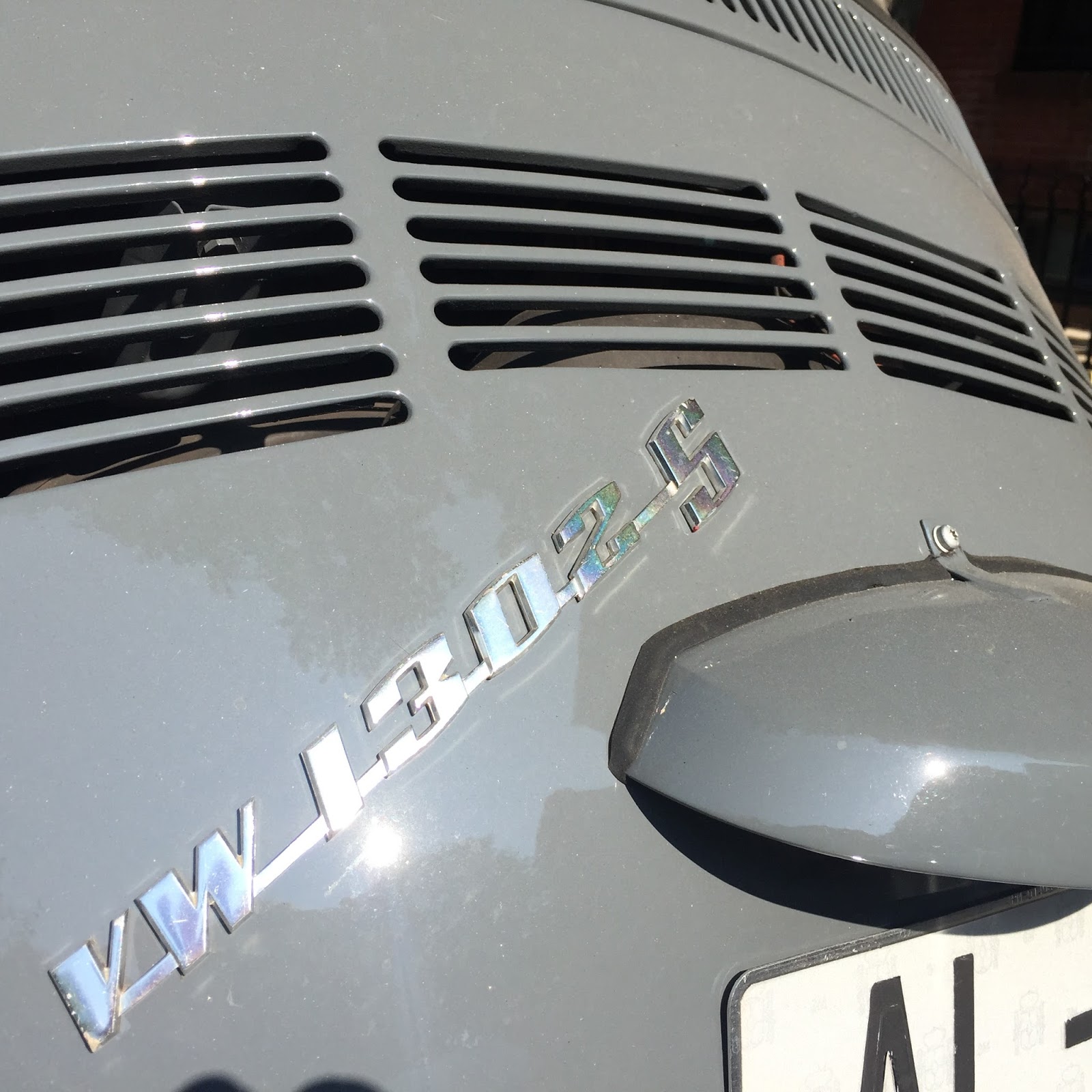
VW1302-S? I've seen 1300 and 1500 emblems before which corresponded to the engine size, but what was this?
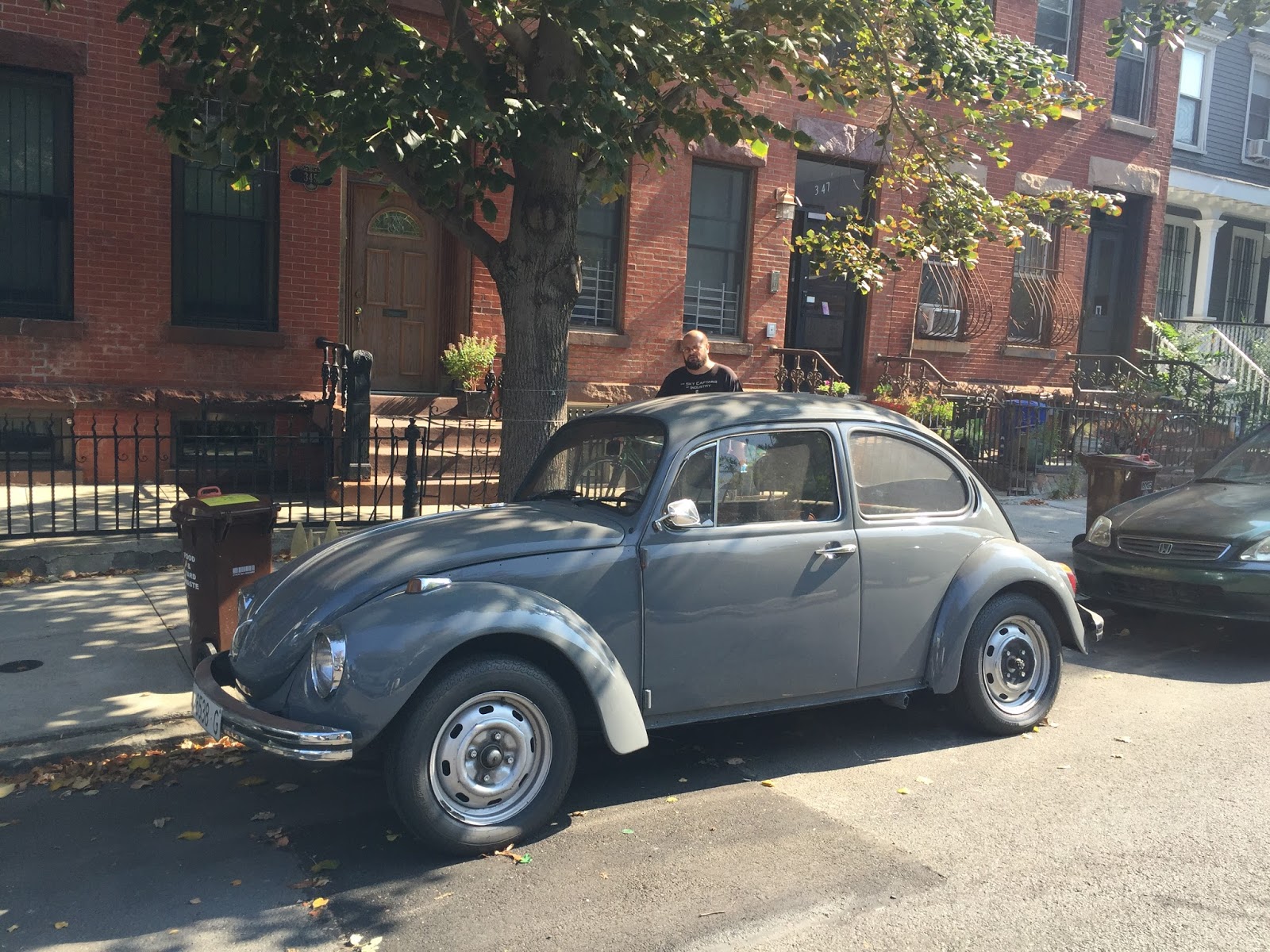
What it is is a 1972 Volkswagen 1302-S in either Silver Grey Poly or Chinchilla. The awkward 1302-S name was only used for 2 years but it was actually the first Super Beetle.
There are so many differences between the 3202-S/Super Beetle and the standard Beetle that it's hard to believe they look almost identical. The hood is longer, increasing the luggage capacity greatly. In addition the spare tire sat horizontally on the trunk floor for the first time. The front suspension on these larger Beetles was upgraded to independent struts as well. Handling was more like a regular car than a Beetle.
This one is missing the hubcaps and running boards but is in otherwise stellar condition.
Everything you need to know to pinpoint the year on this ride can be found on the back. The previous year 1302-S had 2 banks of 5 horizontal vents on the hood where this has 4 banks. The year after this sported massive taillights and a larger rear window (and is actually known as the 1303).
Confoundingly the 1302 was only available with the 1600 engine in the States.
That little crescent moon shape behind the rear side window is the outgoing vent for the new fresh air flow-through system introduced with the Super Beetle. Air conditioning was a new option.
For the first time in '72 there was a plug-in dock under the hood which can be hooked up to the VW diagnostic computer at the dealership. These early computers can be expensive to replace these days. I had a 1970 VW Type 3 Squareback with fuel injection. In the stack of receipts that came with the car was one invoice for the computer "brain" for the fuel injection. In the mid to late '90s it cost over $1,000 to fix!
The interior has been tastefully redone in cloth and vinyl. The steering wheel looks to be an earlier replacement due to that chrome horn ring.
In various forms the VW Beetle had been in existence since the late '30s. Official sales figures start around 1947 but it was the 1972 model year when the Beetle surpassed the Ford Model T as the greatest selling automobile in history. It has since been dwarfed by the Toyota Corolla.
Well there we have it; a cool little transition car hidden in plain sight. VW history changed dramatically with this ride. The old technology that carried the company from its inception until this car was built was bowing out. The engine was still air cooled and placed in the rear. The gas tank was still up front. The car still looked like a round classic from the 1930s. In the years following this the baton would be passed to the Rabbit (known as the Golf everywhere besides the States), the Dasher, and Scirocco. Engines would change to being water cooled. Creature comforts would take priority. For anyone who remembers the warbling buzz of a Beetle driving by this ride will still make you nostalgic.

Thursday, March 2, 2017

Classy little Heckflosse in Hellblau

CLASSY LITTLE HECKFLOSSE IN HELLBLAU
Under the elevated BQE near Greenpoint sat this lovely little saloon. Over the years I have found some unbelievable cars in this stretch of parking spaces. I know from experience that you can basically park a car under the highway forever with little chance of a ticket or a tow.
This dapper ride is a 1963-1965 Mercedes-Benz 190D in Hellblau (that's Light Blue to you heathens). Even crouched in the grimy shadows and covered in dust it is classy as hell.
The 190 was really a shortened version of the 220 series. As a result of the smaller outside dimensions combined with the same generous interior these were enormously popular as taxicabs around the world.
I love this detail of the chrome outlined fresh air intake and the outward swinging wipers. The roof is tall enough to wear a Mad Men style hat comfortably.
These are hardy well built beasts meant to soldier on indefinitely with regular maintenance. Quality of construction was excellent from the body panels to the drivetrain. When you consider that German auto production at the time consisted of the no frills Volkswagen and still primitive Porsche it's irrefutable that Mercedes produced the countrys most luxurious vehicles.
Those turn signals are the key in discerning the vintage on these rides. In 1961 there were none on the front panel at all; only the top fender mounted units did the job (you often see large free standing fog lights mounted from the bumper between the headlights and the grill on '61s which look like turn signals but aren't). In 1962 small round turn signals were located where these larger units are.
Look how freaking classy these fender mounted turn signals are! Before 1963 the mirrors were mounted directly on top of them. This antenna placement is curious as most seem to be located on the other side of the car. This ride has an antenna mounting point on the passenger side too. Perhaps this is an aftermarket addition? Was one of the fenders replaced so that it ended up with two? Who knows.
The body colored hubcaps really complete the tailored outfit this thing is wearing. M-B would continue this on through the 1980s. The tires look to be in great condition and fully inflated. I got the impression that you could jump in this ride and drive away on the spot.
Look at that fat glazed donut!
The steering wheel and gearshift end are made of an ivory colored plastic material. I can see one small crack at the 4:30 mark but that's it which is remarkable for a car of this vintage. I'm guessing this car wasn't driven a ton.
You can just glimpse the 3 pedals that means this is a 3 on the tree manual shift car. The speedometer is vertical which continued on into the 1970s. M-B didn't offer air conditioning in this era but many dealers installed units in new cars before selling them. When equipped there is a large a/c unit hanging under the dash.
The wrap-around rear window provides excellent visibility. There is only the slightest evidence of rust bubbling under a piece of trim in the front. These mint quarter panels are amazing. The rear bumper looks to either be a replacement or re-chromed as it outshines the front 2 to 1.
The D stands for diesel. In this case we're talking about a 2 liter inline 4 cylinder engine. These cars are famously underpowered even with the manual. However with the amazing fuel efficiency of the diesel and the popularity with taxi drivers the D outsold the gas powered 190C by about 100,000 cars.
There's a trailer hitch on this ride!
This era Mercedes is known throughout the world as the Heckflosse or Finback due to its small pointed fins. Reverse lights are built into the taillights even though they weren't legally required when production began. Check out that stylish accent line that starts at the front of the rear wheel well and trails straight back to the rear of the quarter panel. Classy classy classy!
Well that's where I'll leave this well dressed beauty sitting politely among the younger rides. These cars are about as timeless as it gets and thousands are still used as daily drivers today. They are very straightforward and easy to work on and dead reliable when given basic maintenance. This is the sort of ride you might pick up from somebody in running condition for under $10,000. Tune it up, lube up the chassis,give it a polish, and you would be welcome anywhere. Pulling up to the fanciest restaurant or poshest estate in this ride would get you smiles and nods every time.