Showing posts with label 1974. Show all posts

Saturday, June 24, 2017

Motor Trend Car of the Year for 1974

MOTOR TREND CAR OF THE YEAR FOR 1974
Some cars live strange lives. When we were getting ready to open our shop in Gowanus 5 years ago this was parked with a for sale sign in the window at a local gas station. I even had a friend who was considering buying it for $5,000 years ago (I told him it hadn't moved from the lot in years). The gas station where it lived is now gone and so here we find this little ride, 10 blocks to the north:
This is a 1974 Ford Mustang II in Bright Red. *This is a rare case of perfect timing with an all new design. Somehow the folks at Ford knew to start planning on a tiny version of their Mustang even as the trend was still bigger is better.
*All the more astonishing from the folks who brought you the Edsel!
From what I can tell these turn signals are the one clue that this is a 1974. That horizontal bar in the middle of the lens was a first year only detail for the II.
The sky was falling in 1974 for the domestic automobile market. From October '73 through March of '74 the gas crisis caught the public by surprise. In a land where plentiful cheap gas was taken for granted the cars were enormous and thirsty. In a cruel bit of timing this same year ushered in new efficiency and safety regulations that had automakers scrambling to make their dinosaurs compliant. Here comes the Mustang II in drastically scaled down fashion with a design that accommodated the larger bumpers nicely. It was an instant hit.
There isn't a single bolt on this car that was carried over from the previous generation. In fact the Mustang II shared a platform with the compact Pinto.
The wheels on this ride are from an '80s Mustang 5.0 a la Vanilla Ice. They look a bit oversized for my taste but whatever. Styling cues harken back to the original 1964.5 Mustang such as that simulated scoop on the door. This thing is very tidy overall.
They also produced a fastback/hatchback version of this car which looks plenty cool, but I like this notchback model. My babysitter had one of these when I was a wee sprite in the '70s. I can still clearly remember sitting in the backseat admiring the steering wheel with its circular openings on the spokes.
After all this time these have aged really well. The big taillight clusters look cool with their angled edges conforming to the body shape. Even the huge mid-'70s bumpers look justified with their red cladding.
Who needs plates? Park a car in Brooklyn with nothing on it and the cops will roll right on by for weeks or months (this has already been where I took these pics for at least a month).
As much as this looks like a hardtop there is a thin B pillar between the door and rear quarter glass. In addition the rear quarter is fixed in place and doesn't have a roll down mechanism. There was never a convertible either making this the only generation Mustang to lack one.
In this first year of production there was no V8 available giving it the dubious honor of being the only year Mustang without an 8 cylinder option in its entire 53 year (and counting) run. The base engine was a 140 Inline 4 cylinder. The sole upgrade was the German built Cologne V6.
I love white interiors and this one with the red dash and carpet is fantastic! This ride seems decently appointed as it has an am/fm Stereo (possibly with an 8 Track but I can't be sure from this view). Being an automatic means this ride is S L O W. Those 3 round gauges are all the basics with Fuel being on the left, ALT in the center, and the temp on the right. That little white nub on the door panel is the remote side mirror adjustment. If there was a/c there would be large vents hanging under the dash. This has the basic wheel but the sporty GT wheel was what I remember.
Where there we have it; the perfect mini placeholder for a marque while the 1970s sorted itself out. Lee Iacocca was responsible for the II and insisted that the overall fit and finish were of the highest order. He specified that the Mustang II ought to be "a little jewel" and as a result they're very stout little rides. 4 of the 5 years the II was produced are in the top 10 of all time for Mustang sales. There were stylish Ghia and sporty King Cobra editions too. If you like the looks of this beast just go get one as there are a ton of them out there!

Friday, June 23, 2017

Malaise Era Bow Tie in Revlon Pink

MALAISE ERA BOW TIE IN REVLON PINK
I was walking up towards Carrol Gardens from the mighty Gowanus when I spotted this little punk:
This is a 1974 Chevrolet Nova in some sort of aftermarket pink. Few cars are more difficult to pinpoint than the '73 to '74 Nova. From what I can gather the only differences are very slight alterations to the bumpers (though the most telling aspect is hidden from view; one year has shock absorbers connecting the bumper to the frame) and the painted extension between the front bumper and grill is plastic one year and metal the next. I've read that the Chevy Bow Tie grill emblem was introduced in '74 but it seems that not all were so equipped so who knows?
These are the ridiculously oversized bumpers that were tacked onto cars to satisfy the new federal crash mandate for '74. This body style is clean and compact if it weren't for these guardrails hanging off the edges.
This ride is wearing a set of Oldsmobile rims from the '70s/'80s.
These were available as hatchbacks as well as traditional trunk backs like this one. The option cost an additional $150 and were popular enough that I've seen a few. The hatch looked pretty much exactly like this if you can imagine the entire rear front the bottom of the trunk to above the window opening. The rear seat folded forward which made for a huge increase in storage for the hatch. There was even a factory tent option that would convert your open hatchback to a mini camper. I've only seen pictures of them as they are seriously rare.
Too bad that original material is feeling the full force of the CLUB Basic. This split bench was the bare bones standard.
Well there we have it; a somewhat neutered remnant of the muscle car era that was wading through waist deep federal emissions and safety regulations on its way out of the factory. I've gone full circle on Novas. I used to think they were cheesy and not very desirable but these days I find them great. They are nicely sized rides when compared to the smaller cars of today and parts are 100% available. If you want a classic you can work on yourself that won't break the bank a Nova is a good bet. Find one from the mid-'70s and they're genuinely cheap wheels. Who cares if they left the factory with smog equipment and a straight 6 cylinder? The engine bay was designed to accept the ubiquitous 350 which will move this car around with alacrity.

Tuesday, October 18, 2016

Hodge Podge Poncho

FRANKENSTEIN'S PONTIAC
I was driving aimlessly through the furthest reaches of Queens recently when I found myself revisiting the oft-ignored neighborhood of Broad Channel. This out of the way little 'hood is located on an isthmus in Jamaica Bay that connects Howard Beach to the Rockaways. I pulled an egregious u-turn when this beast appeared:
Whoa! This is most likely a 1974 Pontiac Luxury LeMans in various shades of primer. The grill we see here was only for 1 year; in '73 the grill wasn't deeply inset like this one, and in '75 it had the addition of a single horizontal bar in the middle. Upon further inspection however we can see that this car contains bits and pieces from other years and models.
The hood scoop confounded me at first glance. There was an optional hood for this year that had dual scoops set into the hood but there was a space between them of about a foot. Finally after scratching my head and searching I realized this is a 1965-'67 GTO scoop grafted on to a '70s hood. Why not?
This era is known as Colonnade styling from GM (the word means a row of columns supporting a roof). Most of the 2 door Colonnade cars had a large 3/4 window and very thin roof pillars. The Luxury LeMans of '74 and Grand LeMans of '75 had these smaller rear quarter windows. Some models like the GTO and Grand Am had louvered 3/4 windows that are awesome!
The first year of this body style had a pointy rear end. The trunk lid and lower quarter were at steep angles and there was no noticeable bulge for the trunk at all. That pointy styling was polarizing and after '73 Pontiac went to this more conventional look.
*Big shout out to the '75-'79 Chevy Nova 4 door in the driveway.
The trunk lid looks to be the factory color Lakemist Green. The taillight surrounds and rear valance not only look to be the introduced-in-1975 color Arctic Blue, but also from a Grand Am as opposed to Luxury LeMans. The Grand Am taillights from '74-'75 consisted of these 2 vertical lenses on each side in a waterfall design whereas the LeMans had a solid lens on each side. 
That little Pontiac Arrowhead emblem was only on the right side of the trunk for '75. There must be a couple of 1975 parts cars laying around here somewhere!
The wheels are Rally IIs that were standard on the Firebird and Trans Am but optional for other models. Those little metal side mirrors are bogus as all Colonnade Pontiac coupes had body colored aerodynamic versions.
When I'm way off the beaten path I get a bit more nervous about actually placing my phone against the window for an interior shot so this isn't the best. The steering wheel looks more like an Oldsmobile version from this distance though.
This car has so many different donor parts that it could almost be anything really. Maybe it's a '75 with a newer front attached?Looks like a Cameo White front fender made its way home on this side.
That unapologetically massive bumper is '74 or newer.The '73 was big but had turn signals on the sides, not in the middle.
Well that'll about do it for Frankenstein's Pontiac. I love Pontiac styling and feel that GM in general weathered this unfortunate malaise-era better than the other Big 2. Even though it's massive and has guardrail bumpers this car still has a hungry aggression to it. When and if it becomes a single color I'm sure it will turn heads again. Good luck Pontiac!

Monday, April 18, 2016

Show Car Sunday/Monday returns with 2 natty Brits!

BRITAINS FAVOURITE SONS
Last year I was spending a week out in Riverhead when I encountered this smart looking pair:
A couple of serious British sports cars in the purest sense! Both are honest 2 seater roadsters that are more about driving fun then super high speeds.
The lighter car is a 1969 MGB Tourer in Pale Ivory. 
From this angle you can just see that there are 3 windshield wipers, which denotes it as a Tourer.
The MGB was introduced in 1962 and ran with only a few changes through 1980. One of the major defining changes over the years that helps to identify when one was built is this chrome grill. In 1974 the entire grill and front bumper were incorporated into a massive black rubber unit.
The engines in these little cruisers were small inline-4 cylinder in the 1,622cc to 1,798cc range, never producing more than 95 horsepower. The small engine made for a pretty even weight distribution between the front and back which is just what you want in a sports car.
I've never seen red line tires on anything but American muscle cars, but whatever. The wheels are real-deal spokes that require lots of cleaning and occasional maintenance. You need a large wrench to undo the center cap when removing them.
The luggage rack is another Tourer touch. Those cheap reflectors on the sides represent the beginning of MG trying to sneak through US safety regulations. One disastrous attempt at compliance happened in 1975 when the new US headlight height regulations went into effect. As opposed to redesigning the front of the car, the MG's parent company decided to raise the suspension height by 1". It doesn't sound like much, but the higher center of gravity (especially with larger, heavier bumpers of the '70s) ruined the handling that MG was famous for.
This example is just clean as a whistle. Perfect paint and convertible top fit on a small quirky sports car are rarities.
The the taillights had an amber flasher on the  bottom would mean the car was a '68.
This next ride is more aggressive in its demeanor. What we have here is a 1974 Triumph TR6 in Dark Red. We know it's a '74 because that's the last year for the large amber turn signals to be placed between the grill and the bumper, but the first year for those unfortunate large rubber guards on the bumpers.
This is dubbed as the "last of the true sports cars" due to its very traditional construction. The body is bolted onto a frame as opposed to being a unibody. The dashboard on every TR6 is made of real wood! They were meant to be thrashed about and driven hard.
The 6 stands for the 2,500cc inline-6 cylinder engine. Look how proudly British this little punk is!
You've got to love the gas cap placement; right behind your head! Not spilling a drop on your paint seems impossible. The license plate housing is wide enough for euro tags.
I love the looks of the TR6 with its low stance and huge wheel openings.
Both of these cars shared a common evil and that is Lucas Electric. This was the company responsible for more automotive misery than any other in the UK. Their electrical systems would short out as a matter of course. I should know this; my father had a late '70s MGB that burned to the ground! He said it overheated but I still feel like Lucas is somehow to blame.
We'll close it out with a good look at this eager little tough guys mug.

Thursday, August 27, 2015

Long winded breakdown of full size GM offerings from '66 through '75

FIVE OF A KIND
The dog days of summer have me relaxing as opposed to posting so I figured I'd drop a whole handful of rides that are close siblings. Without further ado;
What we have here is a 1967 Chevrolet Caprice in what might be Madeira Maroon Poly. While this is a sweet classic now it was one of the most popular cars of its day when built. Over 124,000 left the assembly line in this year alone!
Here she is parked on busy Bedford in Williamsburg. The forward-leaning style of the front end was a one year only design. The year previous didn't have those running lights on the outer edge of the grill (the turn signals are actually located down in the bumper), and the top of the grill was lower than the tops of the headlights in the following year.
The venerable 327 V8 powers this beast but it could have just as easily been a 283, 350, 396, or 427 (a mere 50 of the 427 equipped Caprices were built though so if you see one rotting away somewhere let me know!). Transmission options were also many, with 3 and 4 speed manuals and 2 different automatics all available.
This was the first year for the Caprice as a stand alone model and it represented the top of the heap for the full-size lineup.
I love the old dealership emblems they used to produce for cars. A decal is usually present now (or the phoning-it-in license plate frame) but the ones where they gave some effort to ape the chrome script of the factory emblems really stand out now. As is often the case this one has a couple of screws going directly through it to hold it in place.
Fit and finish is slightly wonky and scrapes and scuffs abound, but this is a solid and really good looking driver. If it were a show car you probably wouldn't want to park it on a busy street.
Look at all that trunk hanging out past the rear axle! In the '70s the trunk would shrink and the hood would grow to enormous lengths. This car is pretty huge by todays standards but it is somewhat balanced in its proportions. 
Well we'll leave this eager punk where it sits looking ready to pounce. Now on to a more sedate, later example:
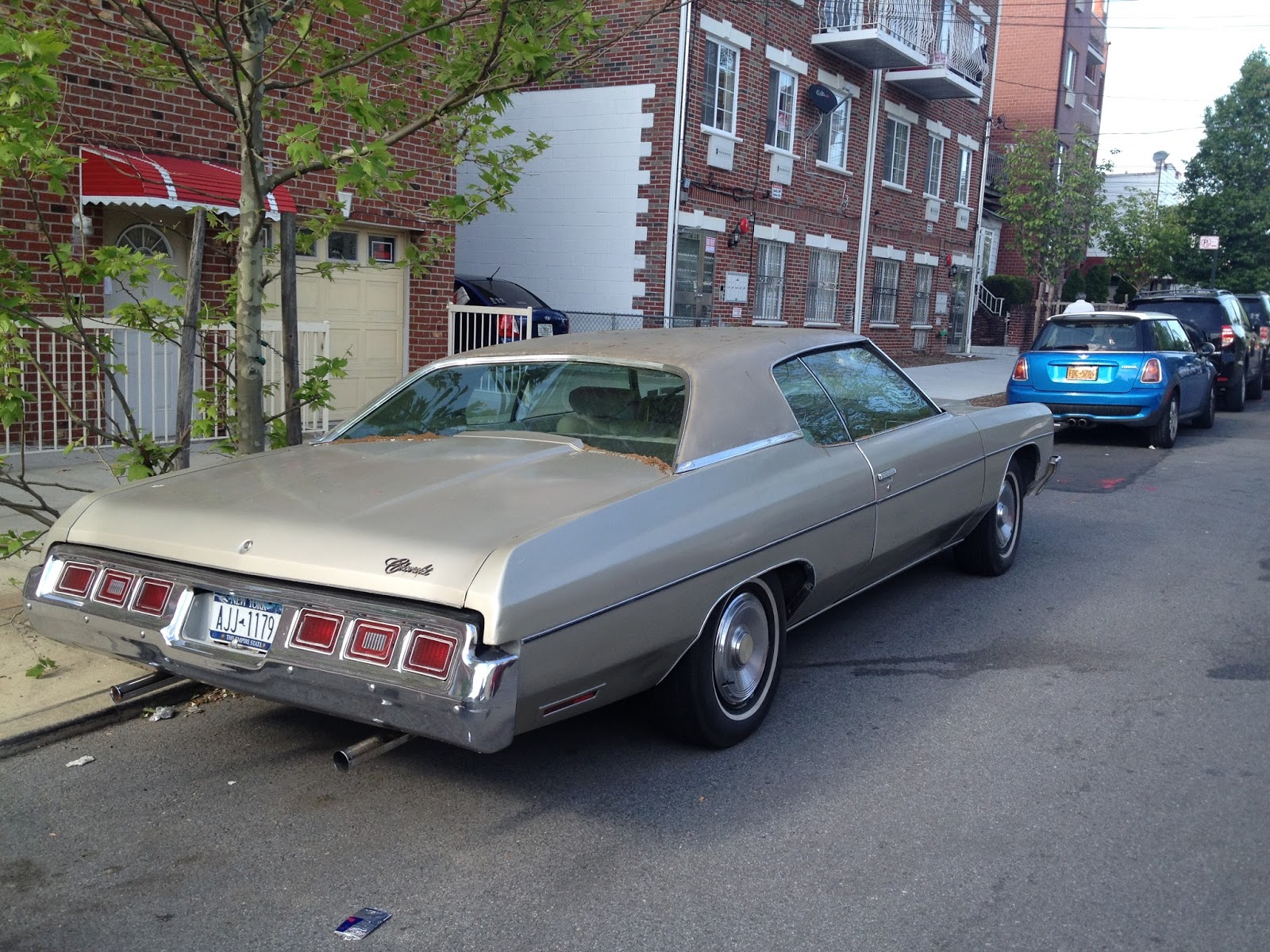
Ahhh yes, here is the serene 1973 Chevy Impala in yawn-inducing BEIGE. This color looks so gentle that it looks like it came from a hospital. If your psychologist is suddenly unavailable they could let you sit on the big bench seat inside this ride and you would feel calm.
*By the way, the only way I know of discerning an Impala from a Caprice in '73 is the grill. The Impala has twice as many horizontal and vertical lines in it as the Caprice.
This is pretty darn close to immaculate which is shocking for two reasons; first of all it's a 42 year old car in New York with no rust! Second of all this was the car of choice for lowriders everywhere. So many of these got used up with 100 spoke Dayton wheels, upholstered steering wheels, and hydraulics that encountering a stock version is almost impossible.
There's some faint rust at the lower edge of the concave rear window but that seems to be the extent of the damage. The trunk lid has what seems to be a mock hood scoop which is something I haven't seen on any other car.
The federally mandated bumpers were introduced in stages. This year is on the cusp where the huge front bumpers ready to withstand a 5mph crash are already in place. This is the last gasp for rear bumpers that incorporate the taillights before the regulations for the rear came due in '74.
The stock hubcaps are nice enough, and the lower body crease helps temper the dimensions of this beast. The 350 V8 was standard in '73 but you could also order a 400 and 454. Now lets lose the roof:
Here we have an EVIL 1972 Impala convertible in Tuxedo Black. This is the last year for an Impala drop-top as it would move to the upscale Caprice the following year.
The grill has been spray painted black (for extra toughness I suppose). Those cheeseball plastic mirrors are not original and I'm calling the owner out on it! The originals were square brushed stainless steel examples that fit a large car.
You can see the lineup I was presented with on this block! We'll see those other rides in a minute.
The hubcaps on this beast are Chevy, but they come from an early-'80s Suburban.
A white roof on a convertible is a stroke of genius since it helps keep the interior cool in the sun. I had a convertible with a black top and interior once and even though it looked great the seats were 1,000 degrees no matter what.
Next we'll flip-flop color schemes:
This is a 1974 Caprice convertible in Antique White. It's very easy to date this car because it's the last year for the headlights being tucked in behind the leading edge of the fenders and the first year for the huge rear bumpers. This basic design would continue through '76 but the final two years had the a flat grill out front with the headlight pods on an angle leaning back. The overall impression of that look is a fainthearted attempt at making a square slab aerodynamic. 
Here's that ridiculously huge rear bumper hanging off like a park bench. It also gives the impression of squinting or lazy rear taillights to me. Why you would need those additional little bumper guards on there is a mystery to me.
This was the first year for a Caprice convertible. The name on the hardtop was located on the sail panel behind the rear side window. For the convertible you can see the emblem located on the leading top edge of the quarter panel.
Now on to an interloper:
Here we have a 1975 Buick Electra 225 Limited in Arctic White with a Maroon vinyl landau roof. We can pinpoint the date because this is Buicks first year for square headlights and the following years would see the turn signals directly under the headlights instead of down in the bumper.
Buick was above Chevy, Pontiac, and Oldsmobile in the GM hierarchy but still below Cadillac in luxury. Some of those extra touches exist here though like the stand up hood ornament and the cornering lamps on the sides. Under the skin however this car is the same as the Impalas and Caprices from the same year (along with the Olds 98, Caddillac Coupe de Ville, and Pontiac Grandville for that matter).
The plastic bumper extensions missing here are easily the weakest link for all GM cars of the era. Most Buicks and Cadillacs need them replaced at some point. This car is a true hooptie with the trunk lock missing and dents, scrapes, and rust all over it.
Well there you have it for GM full size beasts from '66 and '72-'75. I've ridden in at least one example of each of these yachts and they all ride nicely with plenty of power and cushy comfort. Parts for them are readily available too since all were made in vast quantities. These days one can still be had at a reasonable rate and would be a breeze to maintain.