Showing posts with label rat. Show all posts

Wednesday, November 8, 2017

First of its kind but last call before World War II

FIRST OF ITS KIND BUT LAST CALL BEFORE WWII
As the green leaves suggest these pics were snapped in Summer. I was driving upstate when I passed what looks to be an abandoned project. I had to turn around and pull over!
This is a 1941 Chevrolet Fleetline that may have once been painted Volunteer Green Poly. This car doesn't show up in any of the Chevy literature for 1941 as the Fleetline was a late addition to the model year. This simple 4 door was the only version available initially.
Despite looking truly abandoned this ride has many (if not all) of its components either installed or roosting in the backseat. A full set of original hubcaps still bearing a hint of the red accent swoops is present. One look at the dry rot on this tire and you know its only function will be to roll this on and off of a trailer. I was kind of shocked they held air at all.
Calamity!
This is what happens when you drop your car off for a full restoration and stop paying your bills. All of the trim has been carefully removed and most of the paint has been sanded off. Evidence of smoothed out Bondo where dents or rust repair were are visible all over. This beast looks like it was almost ready for paint when the clock stopped.
Yeah I know this is a terrible pic. I only include it to show off that upholstery.
This roofline is unique to the Fleetline as every other 4 door Chevy had rear quarter windows behind the rear doors. The worst of the body seems to be the rocker panels and lower door edges. OG paint remains only around the door glass.
The rockers on this side have been cut out completely. I'm guessing this was the straw that broke the camel's back.
"Runs & Drives!" meant slowly even when new. Under this mighty hood sits the 216 Blue Flame inline 6 cylinder engine good for a mere 90 horsepower. A three on the tree transmission and drum brakes all around complete the chilled expectations. This engine was later bored out to 235cc and it was a higher performance version of that block that powered the original Corvettes from 1953-1955. Variations of this motor were produced from 1937-1963. 
The lines for this are pretty sweet in my opinion. Production of all passenger automobiles ceased in 1942 so the factories could be used for the war effort. When production resumed in 1945 there was a pent up demand for new cars so they built what they could which meant that this car was produced with very little change through 1948. However back in '41 this was up to date.
Unfortunately these rides aren't worth much even in pristine condition. I can almost imagine the series of phone calls reaching the end of the line for this thing pretty quickly.
Someone probably drove this to the shop proudly figuring it didn't need much. They removed the paint and found damage which they started to repair. Then the rocker panel bad news came along with estimates for the interior and re-chroming. At that point you realize that you can go to the classic market and buy a perfectly preserved example for what you've already put into it.
Another scenario is that the elderly owner wants to restore his first car. The project starts and the owner dies or can't drive anymore. The relatives either try to sell it or look into finishing the restoration and see that the cost far outweighs the reward. Unless you have a deep emotional connection to a car like this it is akin to restoring a 1983 Ford Escort from the ground up.
*Notice the tiny opening at the bottom of the grill above the ER in New Jersey on the license plate. That's where you would put the crank if your starter failed! A true holdover detail.
**I also have no idea what that round thing is under the right turn signal.
I include two pics of the interior to show different aspects. Here you can see a perfectly round hole in the floor under the driver's feet. In my '47 Dodge this was an access panel for the master cylinder so I'm guessing it's the same.

The interior is actually pretty nice with the optional clock on the passenger side and speedometer in lovely condition. The horn ring is in place and the Bakelite gearshift knob is intact. My '47 Dodge had a massive under dash heater that would be clearly visible. Who knows if this came with one or not? If this ride was delivered to a Southern state there's a good chance it was never built with one. If you were a serious penny pincher you could order your Chevy without one all the way up through the mid-'60s but who would order a clock before a heater?
Well that will do it for this well worn example of a mass produced, very old car that few people want. Best bet for this beast would be for a father/son project or for someone to rat rod it out. I know it's sacrilege to say that about a running 76 year old car, but a truly stunning '46 fastback Fleetline sold recently for $3,800 so you know the cards are stacked against this thing.
Good luck faded trooper!

Friday, June 16, 2017

The most historically significant car EVER

THE MOST HISTORICALLY SIGNIFICANT AUTOMOBILE SINCE AUTOMOBILES WERE INVENTED
It's hard to heap too many superlatives onto the following ride no matter how altered it is from its original state. Behold this super rat rod parked right in front of my building:
This started life as a 1927 Ford Model T Tudor in (what else?) Black. More specifically Double Deep Black. When the Model T was introduced in 1908 it was available in Gray, Green, Blue, and Red. The famous policy that stemmed from Henry Ford stating that "the customer can have any color they want as long as it's Black" didn't actually start until 1914.
Yes that says FARMALL on the grill. This grill originally came from a late 1930s International Harvester Farmall tractor. All Farmalls were bright red in color when built. In addition this grill has been cut down a bit; there would have been a 4th bank of 4 horizontal openings on the bottom.
Rat rods stemmed from people cobbling together working hot rods from mismatched pieces of various cars that were wrecked, abandoned, or thrown away. However like a pair of $1,000 distressed jeans they are now high dollar, high concept approximations of true rats. Maybe this body shell was found in a Texas field but it's definitely had several dozens of thousands of dollars sunk into it since.
I have no idea which V8 engine powers this thing but those open headers must be extremely loud when it's running. This thing is a catchall of rat rod styling cues: German iron cross on the visor, aggressively chopped roof, channeled body where it's sunken down between the frame rails, keg fuel tank where the back seat used to be, exposed engine with unique grill, metal spider web details in the door openings, and a matte faux patina color body.
Those big Ford spoke wheels with the V8 symbol on the caps are great.
This is the last year for the fabled Model T which concluded a spectacular 18 year run. This is the car that put America behind the wheel. Henry Ford invented the modern assembly line to crank these Tin Lizzies out at an unheard of rate of 1 every 3 minutes. By the time this one rolled out of the Highland Park facility in Detroit Ford had built 15,000,000 of them.
Besides the roof height the body shell maintains most of its 1927 look. The Model T had these flat doors unlike the rounded ones of its replacement. That trim line that runs under the windows would curve up around the rear of the rear side window on the later Model A. This rat still boasts the original insanely charming taillights too.
"The Golden Rat" is the name of this beast (the quotations marks are theirs). With the body aggressively channeled and lowered and the fenders removed the wheels look pretty amazing.
Originally the roof was canvas stretched over a wooden frame. Most early bodies had wood frames as well with metal affixed over it for the shell. This roof has been replaced with a massive sheet of metal that has hundreds of louvers stamped into it. There is no window glass except for the windshield so having that many holes in the roof is moot.
This shot gives you an idea of how low this thing actually is. The highest point of the roof sits below the level of the hood of the truck behind it!
Ford produced 8 different models from their first Model A in 1903 until the T was introduced in 1908. Supposedly the Model T was so new in every way that they decided to start all over again with the Model A as its 1927 replacement. These final Model Ts had standard features that were impressive for such an everyman car at the time including a sun visor, windshield wiper, rearview mirror, and a dash light. Remember this was pre Great Depression when most of the roads were unpaved and in disastrous condition so niceties like a rearview mirror weren't taken for granted. The front seats even slid forward and backward to adjust for legroom!
The price for the cheapest Model T (the Runabout) in 1927 was a mere $360! That was less than half the cost of the first examples from 1908. Until 1972 when the VW Beetle usurped it the Model T was the best selling car in history (the Beetle topped out at 21.5 million while the Toyota Corolla is currently in the lead with 40+ million and counting). While it is true that the 1901 Oldsmobile Curved Dash automobile was the first car built on an assembly line the production was nothing compared to the Model T (a total of 19,000 of those Curved Dash models were sold between 1901-1907). This car changed the way Americans lived, where they worked, how they planned communities, and how most products were assembled in the future. Because there were so many produced they are still available in every level of condition. Within the past year I saw one advertised locally that was registered, inspected, and ready for daily use in its original factory specs for under $10,000. I've never driven one and only sat in a few that were parked but I'd love to one day. In the meantime hats off to "The Golden Rat"!

Tuesday, November 29, 2016

Diabolical Rat!

    '48 RAT!   
Gotta love walking your normal routine and encountering a ride that blows your mind. Behold this bucket of bolts crouching like a tiger with braces ready to pounce!
Hells yes! This is a 1948 Dodge Business Coupe wearing at least a few panels of Windward Green. This thing has been transformed 6 ways to Sunday in true rat rod fashion.
Like the other domestic automakers Dodge had to cease automobile production in 1942 to help with the war effort. When the war stopped demand for new cars was at an all time high while automotive design had been ground to a halt for years. In a panic the Big Three released cars that were basically the 1942 models that they still had all the tooling for. The first all-new cars didn't roll off the assembly line until 1949 or so.
First of all this beast has been thoroughly chopped, and a nice job too. With such a curved roof and rounded window openings lowering the roof by several inches takes serious skill.
In true rat rod fashion there are no wipers and just a scraggly bit of wire for an antenna. The hood is a 2 piece hinged in the middle. With both sides up it looks like a V from the front.
The wheels are an interesting choice. They look like they came off of a semi truck (only in design as they're definitely car wheels). It does lend a sense of power and capability to this crouched puma.
The Business Coupe body style was prevalent from the early days of the automobile through the 1950s. It meant the car was a 2 seater with either a removable or no backseat. Most such as this sled had a small roof only suitable for a front seat. Traveling salesmen would use all the additional room for their products and demonstration items.  
Looks like there's a spot for either a frenched exhaust or taillight on the bottom of the rear fenders. When something is frenched it's inset into a recess.
The patina is great on the hood and trunk. It reminds me of this ride I featured over a year ago. Since this is also a Dodge from just 2 years previous I can't help but wonder if they share an owner or at least have knowledge of each other.
I had a '47 Dodge way back when. I drove by the car sitting by the side of an East Providence road with "$850 - runs" written on the door glass. I owned it briefly and drove it only a handful of times before acquiescing that I was in over my head. I lost the brakes once (pedal fell to the floor like I dropped it off a table) and gently coasted through a red light and up the hill to the friends driveway where I was keeping it. Sold it immediately to a grateful local guy for the same money I'd paid.
I have nothing good to say about this at all. In fact with such a cool car I find this flat-out offensive! WHY would you replace your awesome 1948 door handles with these sad rounded-rectangular ones that look like they came off an '80s Corvette? I didn't pull that out of a hat; I'm 99% sure these are from an '84-'96 C4 Corvette. My guess is that they lifted the drivetrain from a 'vette and just started grabbing other things they might need, but THESE awful door handles? For shame!
Indeed the steering wheel, gearshift, and seats all look like they were pulled from a C4 Corvette. The C4 ran the gamut in its lifetime from anemic and terribly underpowered to powerful and quick. Who knows what iteration drivetrain this has? Regardless the inside door handle is from the same 'vette.
Originally that large chrome expanse in the dash center was a speaker for the tube radio hidden behind it. 
This is a rat detail I dig; steel mesh in place of a vent window! Chances are excellent that modifying the glass during the chopping of the roof was simply too much so they did this. No matter though I think it's pretty tough.
On display here are a couple of the welded seams where the chop took place; the windshield pillar and vent window both show their wounds. Of course the chrome trim had to be snipped too.
Not only has this been chopped but it's been seriously dropped too. My '47 was a very tall car that climbed up into. Overall the roof has to stand a foot and a half to 2 feet lower than factory.
I've always loved this grill. The square turn signals were originally covered with beautifully pattered heavy glass lenses. The headlights on mine were super dim but I'm guessing the electric has been upgraded to '80s Corvette status.
Well there we have it; the twin to the only car I've ever owned that had a starter button. To start the car you would turn the key to "run", pull the choke, pump the gas a few times, and press the starter button. Mine always started and idled smoothly. There wasn't really an E brake as much as a parking brake; when you pulled the under dash trigger-shaped handle for the brake it grabbed the driveshaft! Very effective in holding the car on a hill but nothing that helped me when the brakes went out.
As of the last days of November this is still parked on the street in Brooklyn. Who knows if it will remain once the snow falls?

Thursday, May 19, 2016

Rare muscle car hiding in plain sight!

GTS
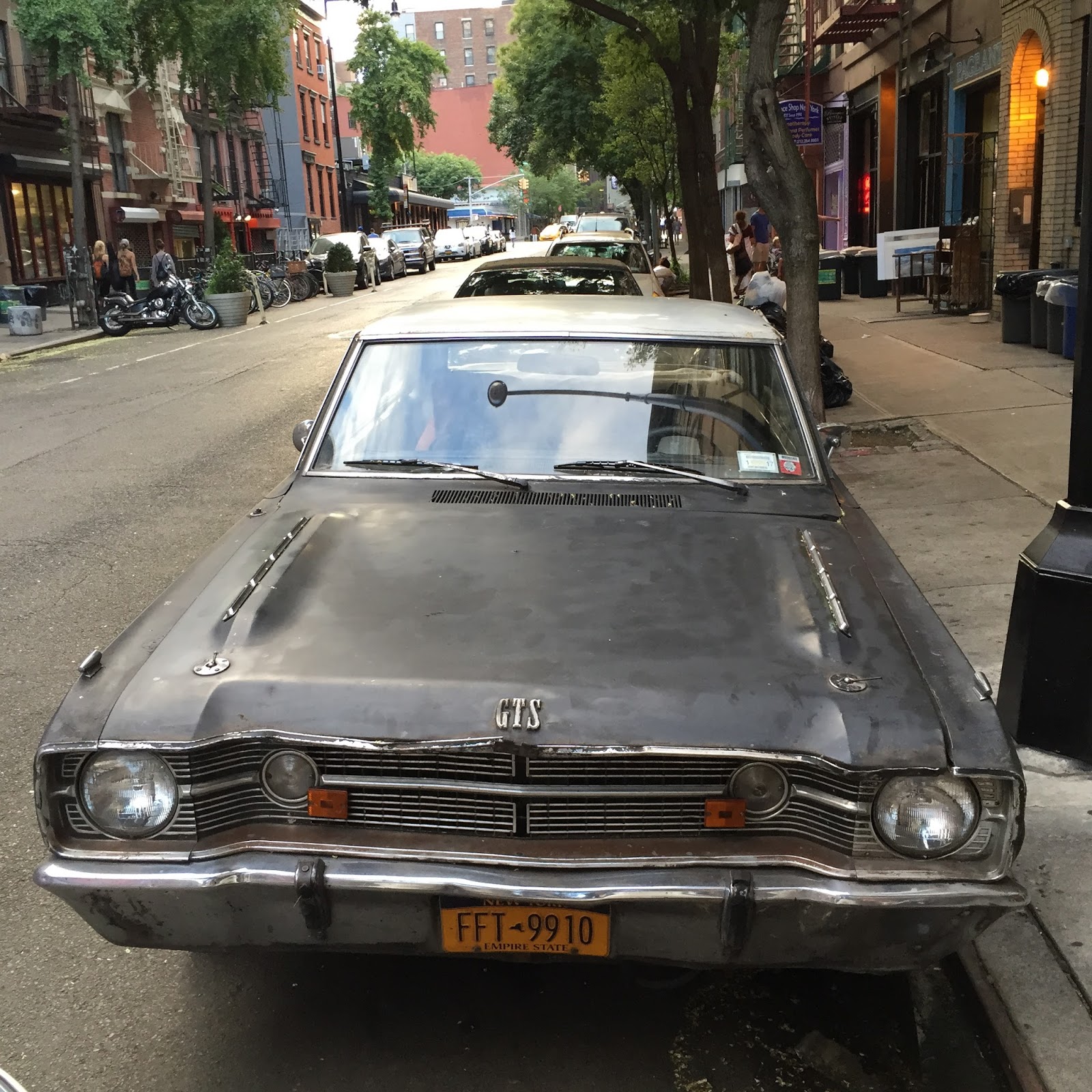
I was walking through the heart of the East Village recently when this awesome beater presented itself:
Damn! Don't be fooled people; this is a legitimate and very rare high performance muscle car built for the drag strip. What we have here is a 1968 Dodge Dart GTS in Black with White "Bumblebee" stripes. Incidentally because I know it's very important to everyone those stripes are tape, not paint.
We know it's a '68 because those clear turn signal lenses are round. In '67 and '69 they were rectangular. Occasionally there is a '68 GTS with a vertical chrome bar in the middle of the grill, but nobody agrees on why some have it and some don't.
The GTS was a high performance option package built for only 3 years.
Those hood bulges were new for '68, complete with faux vents. The side marker lights were only this tiny in '68. That little chrome bullet on top of the fender has a fiber optic cable in it going to the turn signal so you can see if the bulb has gone out.
This thing is a crumpled as a re-used brown paper bag. Still, the stance is correct as it sits evenly. We might have one of those (restored where you can't see it) rides that remain fast but theft proof while parked on the mean streets of NYC.
These are period correct Dodge Rallye wheels. That center piece is a literal hubcap covering only the hub. Tires are suspiciously new for a full on hooptie.
One look at that door lock is all you need to know. The finish is so disastrous on this bucket that they seem to just spray flay black over any rust or dusts that emerge.
Most GTS Darts had this stripe treatment. Occasionally you will see one without which invariably causes people to claim it as fake or incorrect. However, for those who wanted to fly a bit below the radar option code 319 was stripe delete.
The base engine for the GTS was the now-famous 340 V8. Even though it is smaller than the optional 383 it could rev much higher without damage. Its combined weight and super high 6,000 rpm abilities made it perfect for the drag strip.
This is not a big car, in fact considered compact for the year. In 1970 the larger and heavier AAR (All American Racing) 'cuda came with the 340 and it was a racing hit.
It looks like the trunk is open but this is just something red jammed into a piece of trim. Only 8,745 GTS were made that year starting at $3,163.
Along the bottom edge of the roof between the side rear windows is a chrome strip. This means that originally this ride sported a vinyl roof. This could be ordered on its own or as a part of the White Hat Special option package. The advertisements of the era are pretty great with beautiful hippie chicks draped all over the cars, hugging the seats, laying flat across the hood, etc. Everything was worded towards capturing Dodge Fever.
*The print copy on the brochure reassures the buyer that He (presumably) can "keep mum about the price and be known as a big shooter".

In shadow this thing looks great!
Alright there are a bunch of things to address in this shot. The first and most obvious is that the steering wheel has been replaced with a K-Car unit from the '80s (it also happens to be chained to the floor somehow). We can see the optional TorqueFlight automatic trans with console (standard was 3 on the tree). The huge tach and additional gauges let us know this thing is still built to run hard. The tape on the dashboard means it's a beat up pig of a rat rod, ans the ankles reflected on the left let us know this thing is STILL dishing out Dodge Fever.
This is the most anti-theft thing I've ever seen. They look like they're just trying to keep it together at a traffic stop.
Nothing like a mailbox reflector just screwed into the fender. And how exactly did the chrome trim stop at the halfway point in the wheel arch? I only ask because the other side is exactly the same.
This is one of my favorite rides I've encountered on the streets of NYC. Everything about it shows that it's parked on the streets nightly ready for vandalism and parking misadventures. Despite all that though this is a muscle car hiding in plain sight! As crummy as it looks I bet this is a fun car to get in and mash the pedal to the floor. Fixed up these go for around $30,000 but I'm sure this would be much cheaper if you could find one.
Hats off, Road Warrior! Keep on fighting the fight!
*If you happen to find one of the few lightweight Hemi Darts built in '68 you're talking $300,000+!