Friday, September 9, 2016

Vehicle as rugged appliance

VEHICLE AS RUGGED APPLIANCE
When I was visiting my sister in Oregon I snapped so many cool old rides that I've been doling them out slowly so as not to have an Oregon Month (not that that's a bad thing but I'll let some proud Oregonian take that on). Today we'll focus on this beasty:

This is a 1960 or newer Willys Station Wagon (officially listed as model 6-226) in what I believe to be the faded factory color Redwood. 
One look tells you everything you need to know about this rig. Your first impressions probably go something like this: "dirty, big, old, sturdy, truck". Exactly!
This beast is actually the first all steel station wagon ever produced with all previous wagons having rear bodies made at least partially, and many times entirely, of wood. Today we would think of this as an SUV but 70 years ago when first introduced it was closer to a car than a truck. This really is the first crossover as well.
Pinpointing the date on utilitarian rigs like this can be tough to do. Sometimes a change will be made mid-year with no real announcement. Other times a change might be made for one market but not the other. Things I'm going by when declaring this as a 1960-1965 model ('65 was the end of production) are the 3 horizontal grill bars (down from 5 in 1954), single windshield (from a split unit in '59) and the large back window which definitely wasn't around in the '50s yet seemed to remain optional for a bit while 2 smaller rear windows remained available.
I can tell you that this is not a Deluxe model as there would've been a fat chrome stripe following that horizontal belt line that bisects the door. *I want to point out that shelf located just behind the front fender which is replicated on the other side. These are for spare gas cans. The owner of this rig is ready to head off on epic adventures away from society and it looks like they already have!
This design is a stroke of genius by industrial designer Brooks Stevens. His landmark design achievements are numerous but let's just highlight the fact that he is responsible for the Oscar Meyer Weinermobile!
Everything about this says rugged and capable. It has big wheels but not huge and the tread is pretty well worn from use. The back window is long gone, being somewhat replaced by wire fencing material. I don't know what that grate would protect against besides a bird or racoon invasion (though it looks like something got in on the left side).
The true genius behind this design is the body itself, what it consists of, and who made it. In 1946 when the first Willys Station Wagon was released automobile bodies were in very high demand. WWII halted auto production in the States from 1942-1945 and the pent up demand for vehicles combined with the glorious national mood of victory meant everybody wanted a new ride now. Brooks Stevens with his background in Industrial as opposed to Automotive design came up with a matter-of-fact solution: the body would consist of metal typically used for household appliances that could be fashioned and assembled by sheet metal fabricators. This truck is therefore more of an appliance than a passenger vehicle which is fitting for such a no nonsense ride.
Let's give a shout-out for how beautiful an Oregon summer day can be! It was almost exactly 100 degrees this entire week though which was blowing the minds of the locals.
We can see from this angle that the quaint original taillights have been replaced with small red lights screwed directly into the body. Small mailbox reflectors have been added to the tailgate and rear quarter panels.
Even though this is the first steel bodied station wagon the design of the body mimics that of a wooden bodied car. The dark painted panels in the door illustrate this well; if you were to paint the recessed rectangles brown and the raised portions more of a blond tan color it really would look like wood. Painting the roof a dark color would also approximate the cloth tops of the wood frame wagons. In a more practical sense those ribbed portions add rigidity to the body side which would otherwise be vast sheets of metal prone to warping.
You've gotta love the interior of this simple beast!
A centrally mounted gauge contains only the speedometer, temperature, and fuel level. Below that you have an ashtray (of course!), and knobs for choke, lights, and the wipers. That fan mounted over the right shoulder of the driver tells you all you need to know about climate control.
*Dashboards with central gauge clusters are a stroke of genius for vehicles meant for the worldwide market. All you have to do for this to be registered in New Zealand is move the steering wheel and pedals to the other side as everything else is the same.
Here we have either a charming lie or a thorough owner who is updating their emblems as the vehicle evolves. When first built this truck had a 4 or 6 cylinder in either flathead or overhead cam design. The 327 is a Chevy small block V8 engine introduced in 1962. With the trailer hitch and signs of modern use I'm guessing there is a 327 under the hood.
Well that's where we'll leave this eager mongrel. The Willys station wagons are some of the most widely available "ran when parked" classics out there, usually advertised with caveats like "haven't tried to start it" or more threateningly "please understand that this is a classic project and if you think you'll just buy it and drive across the country don't waste my time!". To see one on the move is extremely rare which is a shame as their basic makeup and legendary capability make it a cool cruiser. The ultimate version of this is the late '40s Willys Jeepster which is a 2 door convertible with the same front end as this ride. Regardless that fact that this thing could be 40 miles off road in the woods somewhere even as I type this makes me smile.


Thursday, September 8, 2016

50 year old Ford Fairlane 500

50 YEAR OLD FORD FAIRLANE 500
This blog was launched with an absurd Cadillac that looked like it hadn't left its East Village block much during its difficult lifetime. I recently found myself in the same area and was greeted with this very serious looking executive:
What a confident looking car! 
This is a 1966 Ford Fairlane 500 in what I think is Sauternes Gold Poly. Somewhere along the way the bumpers seem to have been painted which is normally a fireable offense in my book. However in this case with the remaining trim left shiny I like it.
The Fairlane was introduced in 1955 and continued on as either a full size or mid size car all the way through the 1970 model year. This iteration is the 5th generation which was launched in '66. The lines are clean and balanced with just the right amount of styling cues to keep it from being boring.
Like most Fords the Fairlane could be had with any number of engine and transmission combinations from the lowly 200 inline 6 with a three-on-the-tree manual up to an exceedingly rare 427 V8 set up for Nascar racing. This ride has the 289 V8 that also found its way into the original Shelby Cobra.
*I went to high school with a motorhead who had a 2 door Fairlane of this vintage that supposedly had an engine that somebody offered him $10,000 for. The only setup I can imagine being that valuable back in 1990 would be the mighty 427 which I believe was 1 of 57 total built. Even the rarest of muscle cars were widely available when I was a teenager!
This era was considered mid size but the scale of the trunk is pretty generous today.
These taillights are clean and strong with the reverse lights placed in the middle of the red lens. You can see the faintest memory of a fin on top of the quarter panels now vestigal like the leg bones of a whale skeleton.
Too bad this beauty has a proper rub/scrape along the quarter. What it does show is a lack of Bondo though; it looks like this beast has made it five decades without rusting out.
This car is as basic as can be; bench seats, no air conditioning, and no radio! To the right of the speedometer is a wide Ford logo. That is the radio delete which is a factory cover over the opening when you choose not to get a radio. You'll now notice that there is no antenna on this car nor evidence that there ever was one. The rarest of these non-options is the heater delete! In the '60s you could still order a car specifically with no heater at all for which you would get a small amount off of the total price. I've only seen one and it was a stripped down Chevy from about '65.
The 5th generation Fairlane lasted only from '66-'67. The easiest way to discern the two years is the grill; 1967 had 4 vertical bars in addition to this horizontal one.
This treatment for the stacked headlights with the lower pair being set back makes for a nicely aggressive look. I really love the front of this generation Fairlane. Its sibling the Mercury Comet looks slightly different but fantastic nonetheless.
Well there we have it; someones seriously cool cruiser parked among the boring vehicles of today. With the roominess of a 4 door and the power of the 289 this would be a great car to go on a long drive with friends. The fact that it's the least desirable body style just makes it more affordable. All of the mechanicals are widely available even today as well which makes this an eminently usable classic.

Wednesday, September 7, 2016

If a car could be a smile this would be it

THE SMILING CAR
Boy is this thing late to the party! Here she is wearing all white after Labor Day and dressed up for summer just as it's leaving us behind. Regardless I ran across this little crumpet at the terminus of Ocean Parkway where the road gives way to the boardwalk between Coney Island and Brighton Beach. You know it, I know it, so without further ado . . .
this is obviously a Volkswagen Super Beetle convertible in Alpine White. While pinpointing the years on these cars takes a maniacal eye for detail we can call this a 1975 for 2 reasons: the words FUEL INJECTION were added to the trunklid in '75, and the rear window defogger (which this does not have) was added in '76.
What can you say about the Beetle that hasn't been said before?
The larger Super Beetle was introduced in 1971 to accommodate a larger, better front suspension among other things. This necessitated completely different body panels from the windshield forward for the new Super Beetle. I used to bemoan the chubbier look of these larger Bugs but now I can appreciate how much better they handle than the charming earlier Standard Beetles.
Those large taillights are affectionately known as the Elephants Foot were introduced in '73.
Here is another departure from every VW Beetle since the '50s; a single tailpipe as opposed to the familiar double. While the warbling whistle it produced was pretty much the same, the fuel injected engines can be identified by that single pipe.
Look this is the deal with this ragtop; it is FUN FUN FUN! If you want to feel like you're driving around in a little boat or amusement park ride, aren't in a terrible hurry to get anywhere, and aren't concerned about the lack of airbags or much protection whatsoever in an accident it is easy to love this car. Beetles are basically smiley face emoticons as cars and the convertible even more so.
If and when you're in the market for any Beetle the first thing to inquire about is rust. They all rust easily and like a house with no insulation the outside wall is the inside wall so small holes can quickly become tragic. The first thing to go is the battery tray. This is located under the passenger side of the backseat! Lift up the backseat and look for holes under the battery on the floor. If there aren't any you're in great shape. If there are it's still not the end of the world. The sides under the doors and bottom of the front door jam are areas need major welding when rotted out.
Behold the "modern" Super Beetle dashboard! First of all there's an actual dashboard with padding and everything as opposed to the classic Beetle speedometer mounted on a metal wall. Faux woodgrain compliments a plastic radio looking very 1975 with its big black knobs. A windshield wiper stalk is a departure from the nondescript dash mounted switch of yore. 
Somethings never change though; see that tiny wood tipped lever next to the inside of the seat? Lifting that opens the heater channel tube to allow barely warm air to leak out into the cabin. Using that to heat a convertible Bug in winter? Better bring a blanket!
I wanted to highlight the tiniest of fancy moments on this car; that three-stripe chrome piece between the hood and the door has no purpose other than to beautify. Why is it here? It doesn't match any other part of this ride. It's almost like noticing an original ornate brass banister in a far corner of the underground Penn Station that somehow escaped demolition from the original structure (those do exist by the way).
This is the quintessential mid-to-late '70s Super Beetle wheel. It's funky and quirky, kinda mag like kinda tractorish, and the hub cap is literally a tiny cap on the hub itself. I dig these wheels, and in the words of the immortal Q-Tip; "the wet look's complete when the tires say Pirelli".
Well we'll leave this old dog sniffing its German brethren out by the mighty Atlantic. If what you see is what you get with this ride it's in spectacular condition. At this very moment it's a light sanding and paint job away from looking perfect for years to come. As you might imagine every part is available for this thing without exception (the VW Beetle was the worlds best selling car in history from 1972 (when it surpassed the Ford Model T) to 2013 when the Toyota Corolla took the crown. 
I've had several Beetles and highly recommend them as great little cars for those who don't mind tinkering and think discomfort can be charming. Driving with a blanket over my knees and a cloth in my hand to wipe the windshield all winter was just what you had to do you know? If that doesn't sound good to you stay away!

Friday, September 2, 2016

Convertible Week continues with a beach ready cruiser!

MALIBU BLUE
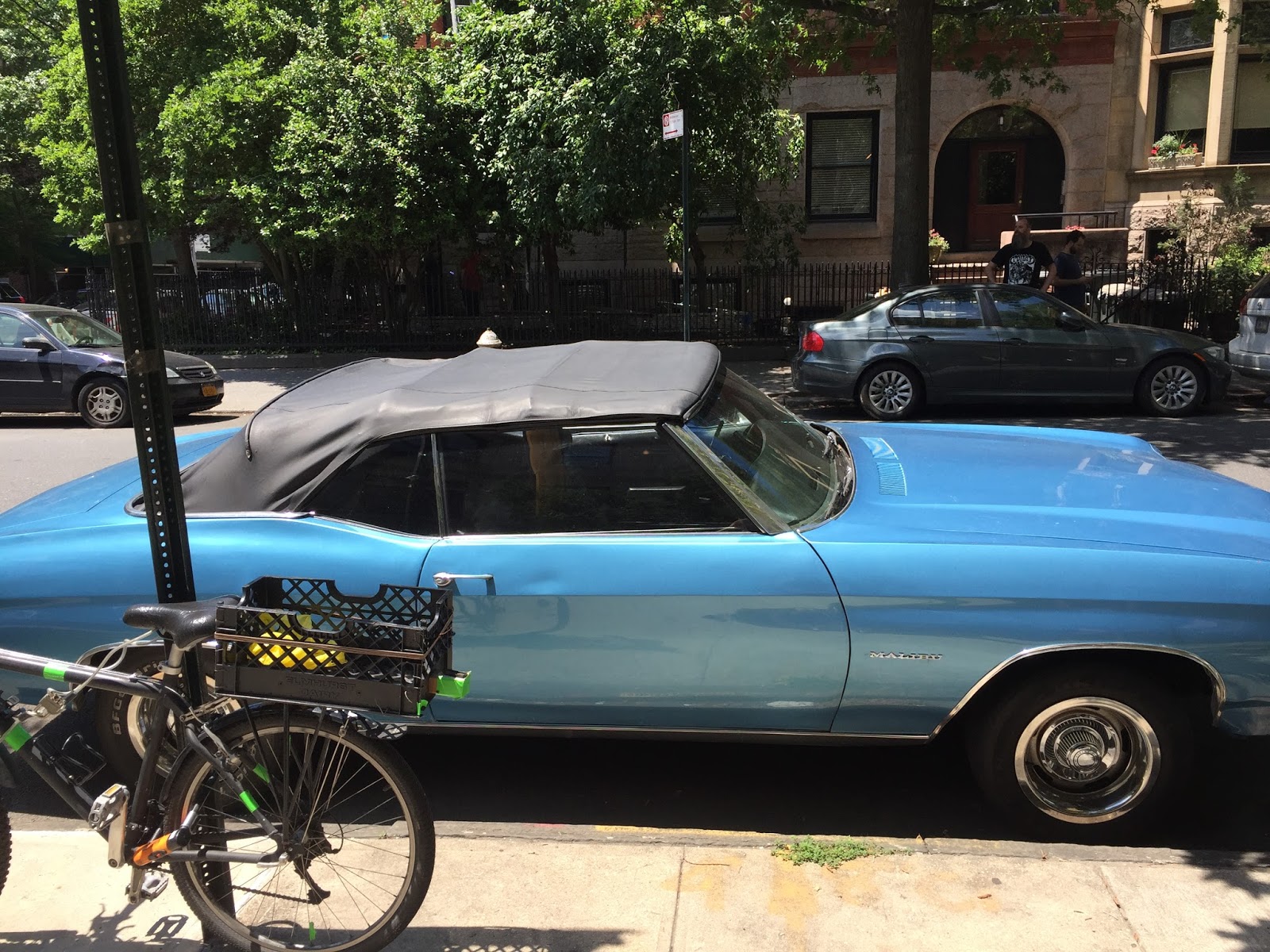
Today I'm featuring another unexpected find for tony Park Slope. Parked in front of mutil-million dollar stoops and amidst an ocean of boring black to beige vehicles was this blue beauty. It looks ready for the beach!
This is a 1971 Chevrolet Chevelle Malibu convertible in Mediterranean Blue. Malibu was the highest trim level for the Chevelle, and was required if the customer wanted to spring for the Super Sport option.
I love this car! The Chevelle was the mid-size offering from Chevy from 1964-1978. This is surprising as the name remains more legendary than you might expect from a mere 14 year run.
 There were much faster cars and definitely more luxurious ones, ,but I find this to be the perfect balance of comfort, power, and the all important cool factor. This is classic American muscle car cruising at its finest!
Those wheels are original Rallys from this era Chevy. Cragar SS rims are great but I think this is one of the prettiest muscle car wheels out there.
Everything you need to know to pinpoint the year is on display in this front pic. 1971 was the first of 2 years with this body style and a single headlight on each side as opposed to duals. In 1972 that single horizontal bar in the grill became 2, and the stacked dual turn signals seen here would become single units.
This hood is covering an engine bay that can accept almost anything you throw at it. Your choices were several V8s ranging in size from the 307 to the mighty 454 (called a Heavy Chevy when ordered complete with lettering saying as much on the fenders). I believe a 250 inline 6 cylinder could still be had but it would be a rarity.
The styling of this era Chevelle is clean as a whistle, especially this example which doesn't have any fancy doo dads like the Cowl Induction hood or SS Super Sport badges on the grill. Stripe packages were hugely popular too but the original owner of this ride opted for clean simplicity.
The General Motors siblings to this car are the Buick Skylark, Oldsmobile Cutlass, and Pontiac LeMans. This was a neat trick because they really are essentially the same body but with different front and rear facades. Still they couldn't look more different.
The top on this ride looks a little baggy but not actually ripped. I'm wondering if the owner either tried to install it themselves or if they're missing a cable or two. Loving convertibles myself I would have this thing down every chance I got!


The interior looks pretty good and complete on this ride. It didn't come with many frills for sure other than the radio. Column shift automatic, crank windows, and a bench seat all fit with the serene blue color. This is definitely more about cruising than burning out.
They need to take this ride to the top repair guys stat to fix that baggy window!
The trunk lock is missing which is pretty troublesome for a convertible. If you reach your finger in you can simply pop it open, climb into the trunk (there's plenty of room), and go right over the backseat into the car itself.
Some small rust bubbles are emerging but nothing seems to tragic at first glance.
These round taillights look identical to the Camaro of the same year but they're subtley different. The Camaro has perfectly round lenses while these are actually an odd shape from the side in order to integrate into the convex shape of the bumper. The following year would bring totally boring square taillights to the Chevelle.
Oh man somebody had the brass to key this poor ride!
Every single part is available for this car. If you wanted to blow mountains of cash as an experiment I bet you could literally order each bit from the frame to the body shell and all the thousands of pieces in between and build one from scratch. Tons of Chevelles were built and so many of the mechanicals were the same across GM lines. If you wanted a usable classic you could do much worse than pick up an old Chevelle. While I usually swoon over rarity and obscurity you have to give it up when a popular car is done right. Hats off Malibu owner!

Thursday, September 1, 2016

Convertible Week continues with an ivory bathtub!

SPEEDSTER
Ah the Gold Coast of Long Island! The playground for millionaires and billionaires with 25,000 square foot mansions on sprawling estates along the beaches of the North Shore. It shouldn't be surprising to see a classic exotic parked in front of a sweet little antiques shop. However this was parked in the corner of a Key Foods grocery store in Mattituck. Let's investigate.
At first glance this is a 1957 Porsche 356A Speedster in Elfenbein (Ivory in German). This is without a doubt one of the worlds most sought-after sports cars with nice examples routinely trading for a quarter million dollars or more. Everything here looks correct from the turn signal/horn vent grills to the fender mounted mirrors and the split windshield. Even the body-colored bumpers are correct.
These cars are absolutely cooler than cool. Using essentially the same layout as the Volkswagen Beetle (and designed by the same Dr. Ferdinand Porsche) they are quirky and fun. The rear-mounted air-cooled engine puts out a warbling chirp not unlike the Beetle, and creature comforts such as heat are similarly feeble. Still, who buys a Speedster for the heating capabilities?
The first of the 356 models was introduced in 1948 in coupe form, and is widely regarded as the first Porsche automobile (there was a similar version built in the late '30s but it never went into production). Those early 356 models are known as "Pre-A" and were built from '48 through '55. The engine was a diminutive 1,100cc 4 cylinder culled from VW parts.
1955 heralded the 356A which came with numerous small improvements. Engines went up in size to 1.3, 1.5, and 1.6 Liters with many performance enhancements. They are so scarce and valuable that kits have been available to recreate them for decades.
Ultimately it came down to this luggage rack in confirming the identity of this little bathtub.
One of the companies to offer Speedster kits is the terribly named Special Edition company (YAWN). The Special Edition brand BECK Speedster boasts this very rack as an option for their kits. They describe it as a "loose recreation of the very early, smaller luggage racks". Since this is identical to their optional rack and they admit it is a loose recreation it must be BECK. *No I don't know why it is all capitalized but if you'd like to contact the president of Special Editions and ask him about his naming practices please do so.
So here we have it; a replica of one of the coolest cars on the planet. Luckily the 356 A Speedster lends itself to being recreated as a kit car better than really any other. Many kits involve placing a goofy looking approximation of a classic on a VW Beetle chassis and rolling with it (for serious groans look up VW kit cars and be prepared for horrific Lamborghinis and the like). However the original 356 was built on a Beetle chassis so if anything you could improve performance by adding the larger 1600 VW engine. No matter how real or fake I'm certain this is a hilariously fun car to drive in summer.
Glückliche Autofahren oh gefälschte Porsche-Fahrer!