Showing posts with label Chevelle. Show all posts

Thursday, June 8, 2017

Brawny Bay Ridge Bumblebee

BRAWNY BAY RIDGE BUMBLEBEE
I strolled around the block from my house recently and this striking brute was waiting for me:
This is a 1972 Chevrolet Chevelle SS in Cream Yellow. This thing dead lifts more than you and has a tribal tattoo around it's bicep.
There are 2 simple ways to discern a '72 from the almost-identical '71. Those turn signals consist of a single lens on each side whereas they were split into 2 stacked rectangles previously. In addition there are 2 horizontal bars in this grill where the '71 had one. In the interest of overall toughness the owner has blacked out the chrome bars on this grill* (which is nothing compared to having a black hood and trunk I suppose).
*For the record there was a blacked out version of this grill as a part of the Heavy Chevy package. That was more of a base model Chevelle with the big engine than a true SS.
The Super Sport package had been available in some form on various Chevys since it was an option for the 1961 Impala (my favorite Impala for what it's worth). It has varied from a simple dress up package that adds stripes and badges to a legitimate performance upgrade. This year is thankfully the latter with front and rear sway bars joining that fire breathing V8 under the hood.
This ride is just beautiful in that delicate Cream Yellow. Chrome trim is very understated with thin moldings around the wheel wells, front and rear glass, and the drip rail above the doors only.
This was the final year for the Cowl Induction hood that brought fresh air directly into the thirsty 4 barrel carburetor. When it's hooked up properly it remains closed until you stomp your foot on the gas when a vacuum actuator pulls it open. When there is no vacuum in the system or it's not hooked up it stays open like this. As bad ass as this sweet detail is it added no horsepower to the car but who cares? COWL INDUCTION bro yes!
*Those functional hood pins are a part of the Cowl Induction hood package by the way.
This car is outfitted with the mightiest of the mighty for Chevrolet; the 7.4 liter Turbo-Jet 454 V8. The way horsepower had been rated had changed to net as opposed to gross in 1971 so the 454 was rated at "only" 270 HP (those are air quotes for effect you grammar nazis). The net HP was supposed to approximate the power at the wheels and the gross would be what the engine produced on its own. The gross HP for this engine was probably more like 365 but there is no disputing the torque rating which was a whopping 390lbs.
This ride is outfitted with the optional Strato-Bucket seats and a console mounted slap shifter for the automatic transmission. There's also a color coordinated Yellow Little Tree hanging off the dash which is Jasmin (I looked it up). Points for consistency.
This is the last year for the second generation Chevelle which debuted in 1968. While the body dimensions are the same the '68-'69 version looked very different in the front with a forward leaning grill containing quad headlights. For 1970 only there were quad lights with body color surrounds before switching to single headlights such as this ride.
I love the continuity across lines within Chevrolet for 1972. The Camaro had similar taillights as did the Corvette. Each taillight is actually different but they look identical to the layman. A single Michigan plate? Normally I would launch into a diatribe about how you'll never get a ticket in Brooklyn with one out of state plate on any car but this one is too nice so I think it's legit.
This is the mid size GM muscle car body which was shared by the Buick Skylark/Gran Sport, Oldsmobile Cutlass/442, and Pontiac LeMans/GTO. These cars sold spectacularly well overall, with the Chevelle being the 2nd best selling American car of 1972. Many consider 1970 to be the ultimate moment in the Muscle Car craze due to a combination of unbridled horsepower and lack of regulation. This generation Chevelle was square in the middle of the craze.
If I were smarter, more patient, or better prepared I would've saved this for my 454th post but too bad. My desires usually move away from such common cars as illustrated by my 1st gen Mustang takedown but I'm giving this one a pass. Why is that? The car above represents the final moments of the muscle car era with few exceptions (the Super Duty Trans Am from 1974 is, in my opinion, the very last remnant of the original MC era). The 454 wasn't even listed in most of the Chevelle brochures of the day. 1973 would introduce a new, larger era for Chevelle the likes of which can be seen in the movie Drive*. While those cars are cool enough it's a major departure from these more athletic rides.
*Heads-up music will play the moment that clip starts!
 

Monday, November 21, 2016

TAKE ME IN OH TENDER WOMAN

    TAKE ME IN OH     TENDER WOMAN    
I was out in some distant corner of Queens in Ozone Park or Woodhaven when I passed this tough beast with the ridiculous tagline (more about that later):
This is a 1972 Chevrolet Chevelle in flat black. We know it's a '72 because the '71 had one single horizontal bar in the grill as opposed to the 2 shown here. Another difference is that the turn signals were broken up into 2 individual rectangles on each side while these are solid.
What can I say about a Chevelle that hasn't already been said? Like every Chevy from the '60s and '70s the Chevelle was hugely popular and could be ordered with any number of configurations.
This is obviously the body of choice for the muscle car crowd. However the Chevelle could be ordered as a 4 door sedan, convertible, and station wagon as well. The sporty hardtop look of this coupe is accentuated by the omission of the little pop-out vent windows which still adorned the front of the doors on the sedans.
There was a 4 tier hierarchy in the Chevelle lineup. At the bottom was the 4 door sedan. Next up was a 1972-only curiosity called the Heavy Chevy. Above that and somewhat splitting the difference was the luxurious Malibu and the musclebound Super Sport. If you wanted cushier seats with headrests, hidden wipers, chrome trim, or a convertible you went Malibu. If you wanted the earth shattering 454 V8 you went with the SS.
Here we see the sweet '72 vintage NY plates the owner's using, but else is that on the back?
WHAT?
I was gobsmacked by this when standing before it. When I searched the term I found that these are lyrics from the 1966 Al Wilson song The Snake. Unfortunately I also discovered that the President-Elect gave a dramatic reading of these lyrics back in March. He went on to explain something about how we knew he was a snake when we let him in. Yeesh. BACK TO THE CAR:
So this beast looks mighty capable with its tough paint job and Rally wheels. The law of averages would dictate that this has a 350 small block V8 in it just because they produced so many and they remain immensely popular.
There's a big aftermarket tach on the column and some gauges under the dash so this is meant to run hard. We can just glimpse the original radio. As far as that column shifter goes there is a slight chance that this is one of the last 3-on-the-tree manual Chevelles but most likely it's the stalwart TH350 auto.
Looks like somebody added a pop-up sunroof at some point, most likely in the '80s when this car was worth peanuts. The thing about Chevelles is that they built so many of them in each model year that you need a rare combination of options, engine, or the highest level of originality for it to be worth a lot. You could go out and buy beautiful Chevelles for $20,000 or under all day long.
This is how I prefer them; ready to be enjoyed and used daily. Good luck Tender Woman!

Friday, September 2, 2016

Convertible Week continues with a beach ready cruiser!

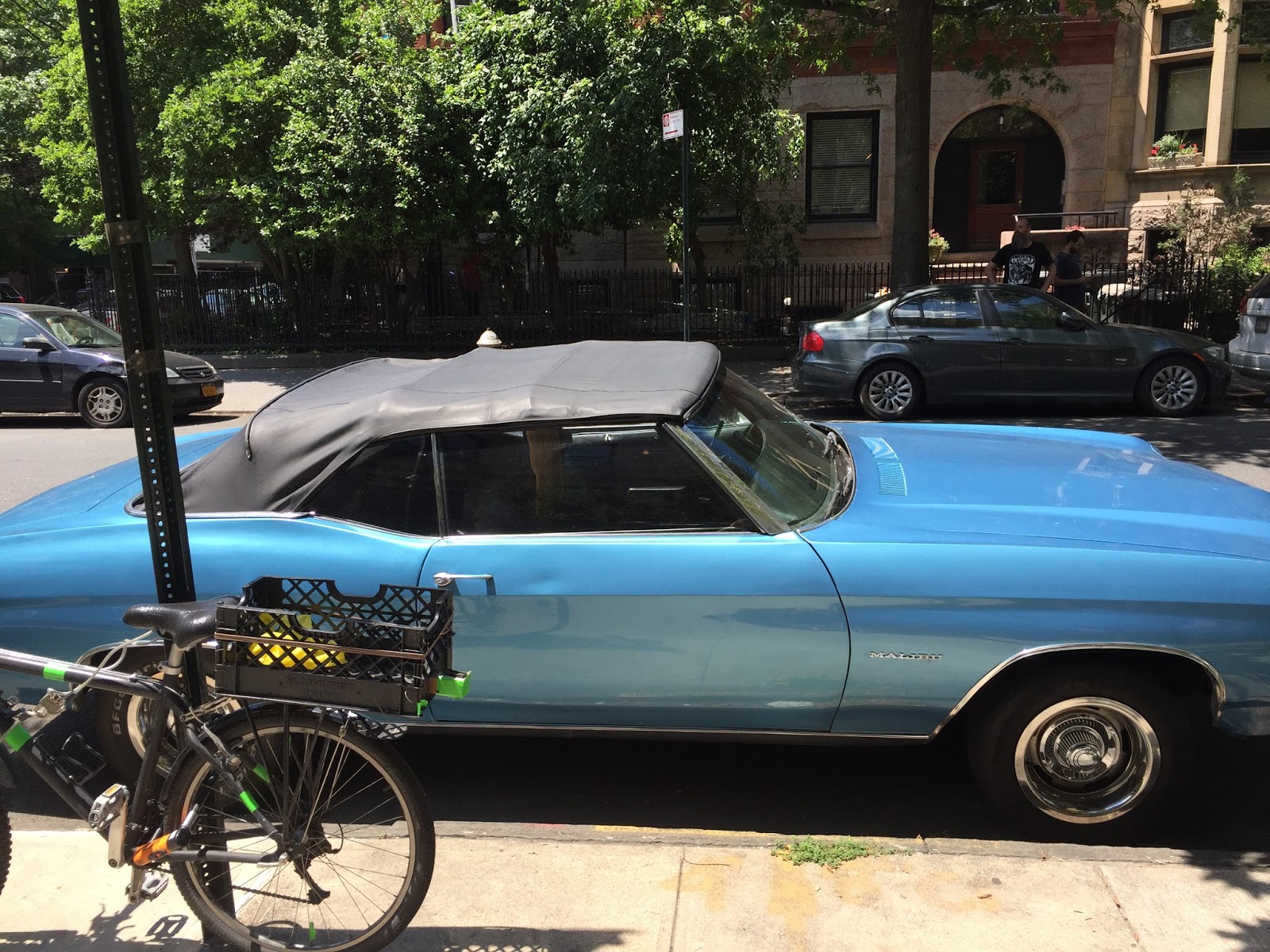
MALIBU BLUE
Today I'm featuring another unexpected find for tony Park Slope. Parked in front of mutil-million dollar stoops and amidst an ocean of boring black to beige vehicles was this blue beauty. It looks ready for the beach!
This is a 1971 Chevrolet Chevelle Malibu convertible in Mediterranean Blue. Malibu was the highest trim level for the Chevelle, and was required if the customer wanted to spring for the Super Sport option.
I love this car! The Chevelle was the mid-size offering from Chevy from 1964-1978. This is surprising as the name remains more legendary than you might expect from a mere 14 year run.
 There were much faster cars and definitely more luxurious ones, ,but I find this to be the perfect balance of comfort, power, and the all important cool factor. This is classic American muscle car cruising at its finest!
Those wheels are original Rallys from this era Chevy. Cragar SS rims are great but I think this is one of the prettiest muscle car wheels out there.
Everything you need to know to pinpoint the year is on display in this front pic. 1971 was the first of 2 years with this body style and a single headlight on each side as opposed to duals. In 1972 that single horizontal bar in the grill became 2, and the stacked dual turn signals seen here would become single units.
This hood is covering an engine bay that can accept almost anything you throw at it. Your choices were several V8s ranging in size from the 307 to the mighty 454 (called a Heavy Chevy when ordered complete with lettering saying as much on the fenders). I believe a 250 inline 6 cylinder could still be had but it would be a rarity.
The styling of this era Chevelle is clean as a whistle, especially this example which doesn't have any fancy doo dads like the Cowl Induction hood or SS Super Sport badges on the grill. Stripe packages were hugely popular too but the original owner of this ride opted for clean simplicity.
The General Motors siblings to this car are the Buick Skylark, Oldsmobile Cutlass, and Pontiac LeMans. This was a neat trick because they really are essentially the same body but with different front and rear facades. Still they couldn't look more different.
The top on this ride looks a little baggy but not actually ripped. I'm wondering if the owner either tried to install it themselves or if they're missing a cable or two. Loving convertibles myself I would have this thing down every chance I got!


The interior looks pretty good and complete on this ride. It didn't come with many frills for sure other than the radio. Column shift automatic, crank windows, and a bench seat all fit with the serene blue color. This is definitely more about cruising than burning out.
They need to take this ride to the top repair guys stat to fix that baggy window!
The trunk lock is missing which is pretty troublesome for a convertible. If you reach your finger in you can simply pop it open, climb into the trunk (there's plenty of room), and go right over the backseat into the car itself.
Some small rust bubbles are emerging but nothing seems to tragic at first glance.
These round taillights look identical to the Camaro of the same year but they're subtley different. The Camaro has perfectly round lenses while these are actually an odd shape from the side in order to integrate into the convex shape of the bumper. The following year would bring totally boring square taillights to the Chevelle.
Oh man somebody had the brass to key this poor ride!
Every single part is available for this car. If you wanted to blow mountains of cash as an experiment I bet you could literally order each bit from the frame to the body shell and all the thousands of pieces in between and build one from scratch. Tons of Chevelles were built and so many of the mechanicals were the same across GM lines. If you wanted a usable classic you could do much worse than pick up an old Chevelle. While I usually swoon over rarity and obscurity you have to give it up when a popular car is done right. Hats off Malibu owner!

Friday, July 29, 2016

The Jersey Blindbird and its multi-colored freaks

JERSEY RIDICULOUSNESS!
I was on a rambling drive to the Delaware Water Gap when I decided to roll through some local New Jersey streets to see if there were any cool industrial ruins or cars. I found plenty of both but this freaky vision takes the cake!
What? Why? Who?
Look I don't have the answers. NOBODY has the answers. I think this might be an answer to an unspoken question by a madman. Regardless, what we have here is a 1965 Ford Thunderbird convertible in some ungodly horrific aftermarket LOOK AT ME yellow. Whatever with the color let's get to the glaring fact that this thing is bizarrely customized to the point where there are no headlights. Dude! You got rid of the headlights? If you're going this bonkers why start with such a nice and somewhat rare car? Are you absolutely certain you only want to cruise in the daytime?
Alright perhaps there are lights behind that grill but still, what a strange decision. I love cars with their headlights behind power flip-up doors but this seems unnecessary. Maybe it's a fiberglass front to save weight but then why choose a convertible with its heavier reinforced frame? I'll lay off now.
I'm fairly certain the bumper is the original under that paint. The main identifying feature of the '65 is still on display here; that small faux vent indentation behind the front fender well is a 1 year only detail for this generation 'bird.
This just added to my frustration! It seems this particular 'bird is fitted with the rare roadster option. The backseat exists in this car, it's just hidden beneath this large removable cover from the factory. These are referred to as the Batman Roadster covers as they make the car look faintly like the '60s Barris Custom Batmobile when the top is down. This is a scarce and sought-after piece for sure.
This is obviously going through a revamping so it can continue to bring tears of shock to people for years to come. While the exhaust tips are poking out from underneath the rear bumper you can see the yellow protrusion just behind the lower edge of the front wheel suggesting that this might've had lake pipes at one point.
Let's turn our attention to that magenta schnoz poking out in front of this blindbird.
What we have here is a 1971 Chevrolet Chevelle SS all tarted up in some sort of trashy magenta. Really subtle with the high-rise hood scoop and fat tires in the back but you know what? On a Chevelle it makes total sense!
Both the '71 and '72 Chevelle had identical bodies and a single headlight on each side as opposed to quads, but the '71 only had a single horizontal grill bar while the '72 had 2.
This car should be all set up for the dragstrip. Heck I know a guy who races a '71 Chevelle on the quarter mile all season every summer. This one is sporting a vinyl roof which, while light as can be and not too much of a drag on aerodynamics, is superfluous when it comes to racing. Who knows how this started out. Maybe it has air conditioning too.
But wait a minute! There in the background lies one of the ultimate muscle car icons; a 1969 Dodge Charger. This is the same year, make, and model as the General Lee from the Dukes of Hazzard!
This example looks like it's wearing remnants of the original color Bright Blue Poly. That massive hood scoop is aftermarket but these could be ordered ready for the dragstrip from the factory in '69. The large enough 383 V8 was standard, but you could specify a huge 440 Magnum or the legendary 426 Hemi as well. Incidentally the way to differentiate the '69 from the '68 from the front is that the '69 had this center divider to the grill. There was a Nascar-inspired version called the Charger 500 that had exposed headlights which saved weight and very slightly helped with aerodynamics. Of course there was also the Charger Daytona which came with the pointed metal nose and massive rear wing (among other drag-killing aerodynamics) but that was so wild that it's hard to think of it as the same overall model.
This beast is in pieces with the entire quarter cut out and doors removed.
This goes to show the value and increasing scarcity of this car. Even if you have a frame and a vin tag it's probably worth the time and effort to try and create a car out of it. The Dukes of Hazzard went through somewhere between 255 and 320 1969 Chargers jumping and totaling them constantly. That and the fact that they were built to drive mercilessly used them up before they became valuable again.
Hats off to New Jersey for not disappointing!

Wednesday, July 13, 2016

Twofer Tuesday/Wednesday returns with 2 1970s cars that couldn't be more different

TWO SIDES OF THE 1970S COIN
I was on my way to drink these delicious watermelon tequila drinks on the sunny rooftop of Brooklyn Crab in Red Hook when I spied this little punk through the bars of the Fairway parking lot:
SWEET! What we have here is a beautiful 1977 Honda CVCC Civic in Forel Blue. We know it's a '77 because the grill and hood design only lasted from '75-'77 and this great color was introduced in 1977. This is the car that really put Honda on the map. The CVCC stood for Compound Vortex Controlled Combustion. Basically the design of the heads and fuel mixtures burned so efficiently that these cars passed stringent emissions without a catalytic converter.
They are also so tiny and cute that parking was easy and the fuel economy staggering.
One great anecdote about the CVCC is that the CEO of GM was asked about the technology and why it wouldn't be used in their cars (Ford and Chrysler had both licensed the technology from Honda). The GM boss stated that he had studied the design and "while it might work on some toy motorcycle engine I see no potential in using it in one of our GM car engines".
Word eventually got back to the great engineer and company founder Soichiro Honda. Soichiro took it upon himself to buy a brand new 1973 Chevy Impala with a 350 engine and have it freighted to Japan. He instructed his designers to build a CVCC unit for installation on the mighty GM powerplant. Afterwards he sent the CVCC equipped 350 Impala back to America for testing by the EPA. Not only did it work but it blew the emissions numbers of the catalytic cars out of the water. The moral is this: don't tell Soichiro Honda what can and can't be done!
The Achilles Heel on these rides was their prone to rusting out. The problem was so dire that Honda recalled all cars for front fender replacement on the condition that rust had taken hold within 3 years of it being sold new. Unfortunately that was the case for most CVCCs sold in states that used salt on the roads.
But enough of that innovative world-changing Japanese design. How about some good old American hubris I discovered last time I was in Alameda California?
 This unapologetic beast is a 1973 Chevrolet Chevelle Laguna in either Tuxedo Black or something close to it. The Laguna was the top of the heap for Chevelles produced from 1973-1976. The main styling difference is the front bumper being incorporated with the grill and lights into a single polyurethane unit not unlike the Pontiac GTO Endure Front of the day.
This was the era of Colonnade styling where the rear window was steeply raked and the thin pillar behind the door could support the body weight in a rollover crash. In '73 the regular Laguna sported this small opera window in the side of the landau vinyl roof. However you could also order a large quarter window that reached back all the way to the rear window.
I dig the Chevelles of this era as it manages to still look pretty tough even though it's a large car (for the record this was a mid-size Chevrolet in '73!). The four round lights in the back are similar to both the Camaro and Corvette, and the Colonnade roof give it a very forward-leaning stance. This is the same year that Ryan Gosling drove in Drive (though his was a Malibu; one step down from the Laguna). Even with the back bumper painted black and those Flowmasters poking out from underneath I would proudly roll in this ride.