Monday, November 14, 2016

Kicking off the work week with a yellow-bellied varmint!

OL' YELLER
The neighborhood and waterfront of Red Hook was cut off from Carroll Gardens and the rest of Brooklyn by the BQE. From Atlantic Avenue to Hamilton Avenue the highway sits in an open cut 30 or so feet down from street level. It was on this stretch that I encountered this queasy little crumpet:
This car has jaundice! What we have here is a 1974 MGB GT in the rare factory color Citron. If it weren't already yellow enough the owner has elected to install some matching headlights.
The MG Midget and the slightly larger MGB were built by the British Motor Corporation (though it was BLMC by the time this car was built, the L meaning Leyland). Most examples were 4 cylinder, manual transmission, rear wheel drive convertibles. However in 1965 this hardtop hatchback was introduced, adding GT to the name.
I don't know why the hood is black but that spoiler is legit.
These cars are super fun to drive in the classic sports car tradition; slightly underpowered, very mechanical, low to the ground, and prone to rattles & glitches. The Achilles heel is the standard British car complaint of the past century; wiring. The Lucas company did most of the wiring for cars built in the UK and the shoddiness is legendary. My own father had a '78 MGB that burned to the ground due to a short while just a few years old!
Another curiosity of the electrical system is that it is 12 volt, but the arrangement consists of 2 6 volt batteries set "in a balanced position"! Basically there are 2 small wells under the rear seat, each holding a battery. WHY? Weird weird set up and totally unique in the automotive world (I think).
The proportions are great on this body style. 2 door hatchback mini-wagons are rare. The Volvo P1800ES is another.
That long hood most likely contains an 1800cc inline 4 cylinder engine. Another version of this same body style called the MGC had an inline 6 cylinder. In a supreme act of awesomeness MG decided to release the MGB GT V8 between '73 and '76 that shoehorned a 3.5 liter Rover engine under the bonnet. The V8 engine block was made out of aluminum and as a result weighed 40 lbs less than the inline 4 cylinder! Performance wasn't as robust as you might imagine in factory form, but they are very collectible today and many extra horses can be coaxed from the engine.
To see any MG derivative totally rust free is astonishing! This color is hard to replicate and was an original option for this year so I'm thinking this is the factory paint. One benefit of having a cool car with terrible wiring is that many of them hibernate in garages for decades before someone comes along to fix them up.
I didn't get much info in this pic unfortunately but the beautiful wooden steering wheel is on display. You can barely make out the e-brake handle which is on the far side of the hump due to its British origins where the wheel would be on the right.
This is quite possibly the only car that the revolting NJ license plate color looks alright on.
The gas cap is exposed and in a tough location for anyone who doesn't want to drip fuel all over the paint and bumper. The reverse lights are as basic as can be.
This is the final year for the GT body style in the States. The aerodynamics were so much better with the hatchback even though it weighed more than the convertible it had a higher top speed.
Gotta love that period correct MGB stripe! The passenger side mirror was an option.
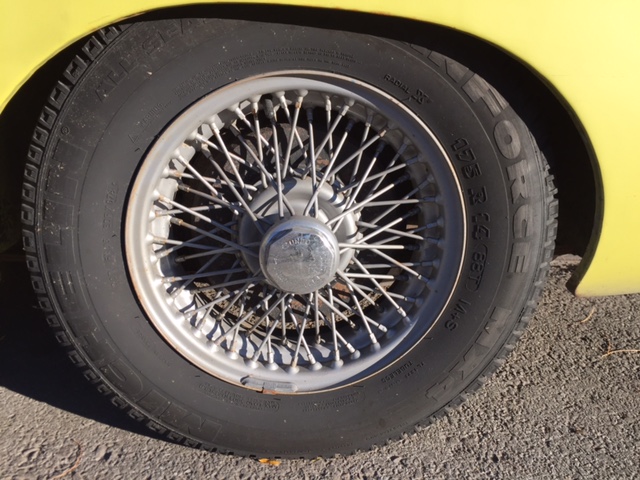
These spoke wheels are the genuine article; you need a huge wrench to remove that center nut to change the tire.
The charming looks of this ride are due in part to the small chrome grill in the front. However there is a 1974.5 edition that made it to our shores before the GT body was cancelled that sports the enormous black rubber front end of the late '70s MGBs. The federal safety crash regulations called for an answer to the delicate front bumpers. In a ridiculous over-solution MG replaced the grill and bumper with one massive rubber schnoz. My fathers flammable MGB had the big black snout on it as did all U.S. bound MGs through the final year of 1980. Because the '74.5 GT was a limited run they are actually collectible and sought-after.
Well that's that for this little MGBGT. If you want a fun classic and don't mind either chasing gremlins or re-wiring your ride this might be the perfect choice. They've been beloved and collected since they were introduced so parts and support are easy to get.

Saturday, November 12, 2016

The transitional car from the bloated '70s to the squared-off '80s

  SOMEWHERE BETWEEN QUAALUDES AND COCAINE   
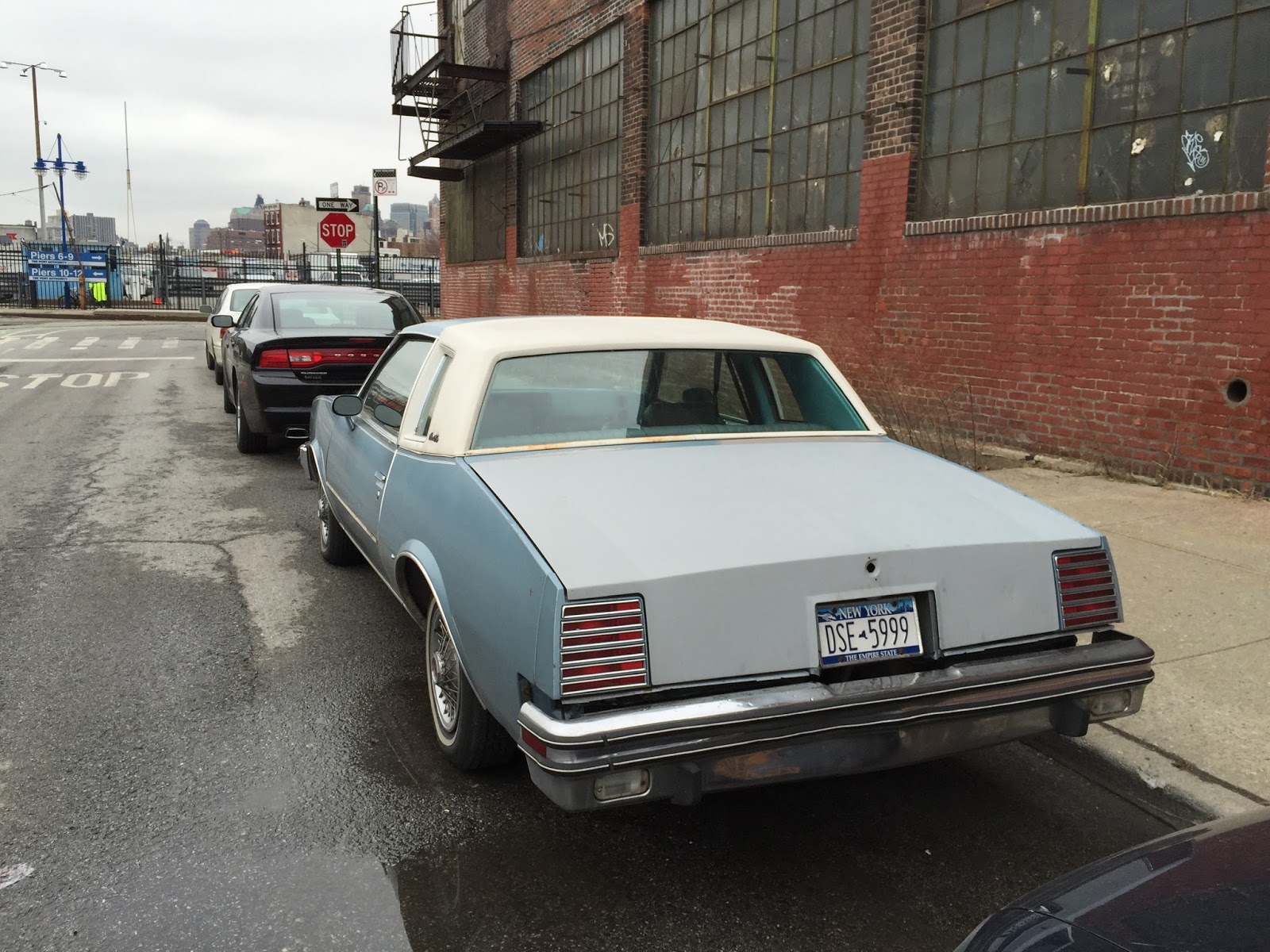
I was biking along the industrial waterfront of red Hook in Brooklyn when this gently colored ride presented itself:
This is a 1978 Pontiac Grand Prix in Dresden Blue with a creamy white landau roof. This is a car with one foot planted firmly in the tired past and one in the uncertain future. Amazingly the result is better than it sounds!
This color scheme is so Leisure Suit '70s but the dimensions are leaning towards the '80s. The Grand Prix from its inception in 1962 through this vintage was always a 2 door coupe in the Personal Luxury style. 1978 introduced the 5th generation for the Grand Prix with more squared-off, angular body lines than its predecessor.
The '78 GP was a foot shorter and 600 lbs lighter than the '77 so even in this era of strangled low horsepower engines the performance was decent. This was the first year in the models history that a 6 cylinder was standard equipment. Technically a 3 speed manual transmission was standard as well but finding a 6 cylinder 3 speed GP would be a rarity.
The surefire way to identify a 1978 model is the grill; the 5 vertical bars on each side were 1 year only. 1979 brought a crosshatched grill. 1980 went back to a similar grill design but there were 9 vertical grill bars on either side.
That gentle V shape going from the corner of the grill back to the lower corner of the windshield is a shadow of what once was. In the earlier '70s Grand Prix the center portion would be raised in a full length hood bulge. The spaces directly behind the headlights were sunken down between that center V and the raised edges of the fenders.
If you look at the relatively enormous 1977 GP you see headlights in a rectangular box with the turn signal in the center just like this. The main differences in the overall width can be found the the extra space between the headlight pods and grill in '77 as well as a wide body colored section in the center of the split grill.
Besides that swooping line from the front fender point, under the side windows, and down the top of the quarter panel this is very much a squared-off design. You could carve this car out of a block of cream cheese.
Just look at the point where the fender, hood, and front connect; it is a perfect corner. This is a premonition of the next decade of styling.
Incidentally this bumper looks so much more integrated into the overall look than the mid-'70s version. Having a car that weighs so much less means not as much bumper is needed for the 5mph crash requirements.
The padded rear landau roof would stick around for another several years though not so puffy as this. The GP was available with T-Tops, the rear of which lines up right where this vinyl roof begins.
This car was ordered for a family as opposed to someone trying to look as cool as possible. The bench seat and column shift could just as easily been bucket seats and a console with floor mounted shifter.
There are a full compliment of gauges in the dash as well as what looks to be a/c and power windows.  That steering wheel is a holdover from the larger mid-'70s models. The year after this brought a real bro-edition tough guy wheel that I think looks kinda goofy.
That trunk lid is ridiculously square!
The previous generation had a large V shape on the trunk lid mirroring the hood. It was raised up in the middle like the hood as well, with the taillights set into indentations. Likewise the bumper used to jut out in the middle to accommodate the trunk shape.
Pontiac had a history of taillights being split into individual bars going back to the mid-'60s, most notably in the Firebirds and older Grand Prix. This is the final moment for this multifaceted taillight before they move onto a huge square slab of red plastic with a gaudy GP medallion in the center.
Being a body-on-frame rear wheel drive American car from the '70s the gas cap is located behind the license plate.
That gap between the rear quarter panel and the bumper was originally filled with a body colored plastic filler piece. These are notorious for hardening over time and cracking to smithereens on all GM models of this era (you'll often see Cadillacs with the metal ends to the quarter panels standing alone like tombstones with the plastic supports long gone).
These are original Pontiac faux-wire wheels that snap on just like any old hubcap. The red center had the Pontiac arrowhead logo reminding folks that this automaker is named after War Chief Pontiac of the Odawa tribe in the Great Lakes region.  
Boo hiss! From this angle you can see that those gauges are blanks! Looks like nobody opted for the optional full gauges so we have plain dials in their place. This is even more demeaning than having a blank stretch of dashboard. Every time the driver looks into those empty sockets it's like the missing gauges are saying "why didn't you order us?"
Well we'll leave this swooping square powder blue brick against a brick wall in Industrial Red Hook. This is the closest sibling to my very first car - a 2 door 1983 Oldsmobile Cutlass Brougham in burgundy with a burgundy landau vinyl roof. I bought that car for $225 and it had a brand new $250 Alpine tape deck in it. I grabbed a couple of mismatched license plates off of 2 different friends wrecked cars, a registration sticker out of a wrecked Subaru, and drew my own inspection sticker with some markers before enjoying months of carefree driving. Life was great until I attempted a u-turn on a muddy field, sinking in up to the rocker panels in the process. I later got cornered by sheriffs while getting it towed out by a friend. That's a much longer story but suffice it to say this unglamorous body style has a lot of nostalgia for me.
Looking good at age 38 GP! Keep up the good work.


Sunday, November 6, 2016

Show Car Sunday gets its due with a knockout punch of a classy classic!

THE CLASSIEST UNICORN IN THE FORM OF A WASP
Take a minute to soak this all in.
Here I am standing between Brooklyn Heights and DUMBO with a classic in front of me that's so rare I can't even find production numbers. This is one of the only things I've ever Googled that wouldn't eventually auto-fill what it thought I wanted to search. Just like you never know WHAT is gonna come through that pawn shop door you never know what is lurking behind a closed garage door in Brooklyn.
What we have here is a 1953 Hudson Super Wasp 5C Brougham convertible in Honey Cream. It is just so damn beautiful in person that it's hard to imagine that somebody needed to drop it off at the shop to get inspected. This car is registered and ready for daily use right now. Where exactly do you drive this? To a palace?
Hudson was an innovative automaker known for unique advances in technology that placed them at the head of the pack in many ways. The bodies of this era are what they called Mono-Bilt. The frame wrapped around the lower perimeter of the car where the rocker panels usually are and the floor pans are set down in between the rails. This allowed for a low center of gravity and vastly superior side impact protection (just about every other vehicle was a box sitting on top of the frame). It is also referred to as the step-down chassis because you literally step down into the car as opposed to climbing up into it.
This car was built solidly in the Jet-Age era. We can see from this angle that the mock hood scoop approximates a jet taking off with the dreaded chemtrails beneath (contrails for you level-headed folk). I wish I'd taken a better pic of the grill emblem as it's like a piece of jewelry.
The most famous of all Hudsons was the mighty Hornet. It looked much like this but a bit bigger. Powered with the the inline 6 cylinder engine and Twin-H-Power (dual carbs) and with the cornering help of its low center of gravity it dominated Nascar for years.
In 1952 they introduced the smaller Wasp (replacing the former smaller offering called the Pacemaker). However if you ordered the Super Wasp you got the larger Hornet 6 cylinder in the lighter body, making this one of the first factory muscle cars. This one was also ordered with the optional Twin-H-Power so it's a true screamer! This drivetrain combination proved at least as powerful as the top of the line Hudson Commodore Straight-8 cylinder engine in '53.
Everything was just about perfect on this ride. You could easily fix your hair in the reflection.
That chrome molding on the lower edge of the body is about where the frame is. The fit and finish of the top could be improved if you were headed to Pebble Beach but that's about it.
It was a brilliant bright blue autumn day and I was conscious of the mechanics watching so I just snapped a quick interior pic. It looks to me like we have a 3-on-the-tre manual transmission and a radio from the factory. The door panel is off for some reason.
The '53 Hudson brochure is online and through it I discovered a sweet detail; the Steering wheel itself and the glass covered centerpiece are color coded to match the interior!
The one thing the brochure failed to mention was the existence of a Wasp convertible at all. I know they were built in their Detroit factory because others are around with flawless provenance but production must be truly minuscule. As an example they only built 30 Commodore convertibles in 1952 but that made the brochure!
That TWIN H-POWER emblem let's folks know you mean business. I like how the Super Wasp badge is only on the front near the engine much like the engine badges of the '60s and '70s while the trunk just gets Wasp.
Well there you have it; a real deal stunner of a classic ride. The license plates, inspection sticker, road tires filled up to the proper amount, and the fact that this was sitting at a mechanic all point to this beauty being driven. I can only imagine putting the top down and going on a lazy drive through the upstate autumn leaves (with the heater on your feet of course).
Recently Hornets have been gaining real value on the auction block. A beautiful 1953 Hornet Twin-H-Power Brougham convertible recently sold for $187,000 (more than 50% over the high estimate!). That is still the rarity with most Hudsons selling under $30,000. When you think of all the hugely mass-produced Mustangs and Camaros that sell for much more than that it's a wonder these classier rides don't get all the attention.

Saturday, November 5, 2016

A fox dressing up like a Cougar

FORGOTTEN FOX FOOTNOTE
First of all this represents the first time I was run off of someones property for snapping some pics of languishing cars! I've been asked to not take pics and move along please while standing on city streets (and I do for that matter as there are plenty of cars out there) but this guy came running across the street yelling and screaming. For a moment I thought he was going to take a swing at me! He cooled off eventually as I insisted that I meant no harm and wasn't touching anything. He asked that I not post where the cars were (or put them online but I didn't agree to that). This "private property" is literally the 20 foot stretch of ground between the curb and what looked to be a defunct used car office with no signs or chains warning the curious. Without further ado:
This scaly misbegotten wreck is a 1979-1982 Mercury Capri in Dark Blue Poly. This is the mostly forgotten upscale cousin to the Fox Body Mustangs of the '80s. As with most of their shared products from the '70s onward the Mercury is just a touch classier and more well appointed than the Ford.
I think the front looks great with its horizontal bar grill and upright headlight pods. The Mustang of this era had a slanted front and an eggcrate grill.
The paint on the hood is revealing the beginnings of the universe as the clear coat peels away. In 2016 paint has pretty much been perfected. Sure your car can rust out from beneath but this sort of horrific surrender is the hallmark of cars built from about '79-'99. The reason behind this is that EPA regulations made certain old style paint chemicals illegal so the automakers had to comply with more eco-friendly products. Unfortunately the learning curve with these new paints was steep. The problem was so bad that for a brief time Ford agreed to repaint any F-150 trucks of the era. Overwhelmed by demand they cancelled it quick and just covered their ears.
We can see some mid-'80s Ford Mustang wheels on this ride. The fender flares are Capri-specific which I think is a shame as they look fantastic. Subtle details make this a very different car than the Mustang.
Here is the easiest way to see that this Capri is from '79-'82: the hatchback has a flat rear window that looks pretty standard. From 1983 on they had a large bubble window that was very distinctive. In concert with the rear bubble window the taillights from '83 on were recessed a bit into the rear panel.
Dig the horizontal bars on the rear lights giving continuity to the overall design with the grill in the front.
Interior looks pretty basic from here; auto trans with that puny Ford T-handle shifter, sporty steering wheel that first heralded from the Mustang II, no optional console, and no A/C (there would be an upright rectangular vent between the heater controls and the gauges). As you can just glimpse here the rear seat folds flat offering up decent storage space.
Like the Mustang these could be ordered with any number of drivetrain combinations from a small 4 cylinder in regular and turbo form, inline and V 6 cylinders, and large 5.0 V8s in varying levels of output.
I have a friend who had one of these in high school that was black '83 with heavily tinted windows, the V8, and a 5-speed. The car was fun to drive for sure. I seem to remember all the gauges lighting up orange at night.
Well there you have it; a gentlemans Mustang with tons of available parts that's uncommon enough to make people stop and ask questions. If you want a reliable classic that's totally usable in everyday traffic but more unique that the standard 5.0 Vanilla Ice was so proud of this is a good bet. If you want TRULY rare try to hunt down a Mercury LN7 - their 2 seat version of the Ford EXP with a bubble back window like the '83-'86 Capri. I have never seen one in person!

Friday, November 4, 2016

Identity Crisis!

IDENTITY CRISIS!!!
I was walking through the East Village recently when I stumbled upon an old friend. I called out my friends name but the car ignored me. It turns out that this car has had many an alias and prefers not to talk about the past. From what I can tell this little box has had 7 different names just between it's birthplace and the States!
This is a 1987 Plymouth Colt E in Sarajevo White. The name of the color at the time celebrated the city that hosted the 1984 Winter Olympics. This is the same city where Archduke Franz Ferdinand was assassinated in an act that lit the fuse to start WWI. Unfortunately the city was also under brutal siege by the Serbs from 1992-1996 after declaring independence from Yugoslavia and gaining UN recognition. I don't think Plymouth kept up the color name for long.
Easy there Close Talker! This car just looks like it has coffee breath.
I was confounded at first by the centerpiece of this grill and how it looks removable. Then I noticed that shiny headlight on the left compared to that old toenail on the right. My guess is that the grill was smashed to oblivion parking on the streets of lower Manhattan and the replacement is a universal one. When this car was sold new it had COLT written in the middle of the grill. In its birthplace of Japan it had a large Mitsubishi logo. The replacement knows no allegiance.
Here we see the Colt in its home environment (amidst piles of garbage).
I think this is when I admit that I love this car even though I'm relentlessly bashing on it. The front and back side windows mimic each other nicely, as do the angles of the windshield and hatch. I had a friend in high school who was nice enough to lend me her Colt of this era long before I even had my drivers license. I would take it full speed down the Saw Mill River Parkway and spend the ditched school day driving all over Manhattan feeling like a champ*. At the end of the day I would deliver the car back to her after filling the tiny tank with the few gallons I used. This is a genuinely fun car to drive hard through corners!
*Champ happens to be one of the many names this car used in the '80s.
Usually I like to walk around the whole car before peeking inside but I'm breaking tradition to show you what a romper room it is. This is just a pile of old blankets and litter with multiple cushions and supports scattered about. I can just see the passenger saying "this cushion's no good I need a different one!" and just stacking the new one on the old instead of throwing it away. Imagine just adding a new band-aid to an old one.
The manual transmission makes this a much more fun car to drive than the auto at least.
Also, is that a cookie in the dashboard for later?
Gotta love that limo tint. You're not protecting identity with that tint, more like the reputation of whichever unlucky bastard contorted themselves enough to get into that backseat.
COLT E. Is that like culty? Is this a cult car or are you actually explaining that this the ECONOMY because that's what's written all over this little runt (it does stand for Economy actually).
Now we're getting to the bottom of this basket of lies!
This car is the definition of both Captive Import and Brand Engineering. It was the '70s and '80s when American automakers were at their lowest ebb producing tired, weak dinosaurs held together with glue and tape that the idea was hatched; why not buy reliable and tiny Japanese cars, slap our American names on them, and sell them to a public still staunchly Patriotic enough that they refused to buy the same cars from Japanese dealers? It worked beautifully.
This Colt is 100% Mitsubishi Mirage. It was also known as the Dodge Colt, the Plymouth Champ, and eventually the Eagle Summit among others.
Anyone for some nostalgic '80s movie racism on this topic is encouraged to watch the 1986 groaner Gung Ho! starring Norm from Cheers, Batman, and everybodys favorite Japanese comic relief Gedde Watanabe (you know; Long Duk Dong from 16 Candles). Never mind that Mr. Watanabe is originally from Utah. This movie perfectly captures the xenophobia of the domestic reaction to captive imports. 35% of people on Rotten Tomatoes can't be wrong!
Parkability is very high on the list of why to own this little bucket. In fact it is the list.
Talk about Hyperbole!
I research automotive minutiae almost as a profession but I can't find a single hint of what this claim means anywhere online. The perks of the S.E. probably consisted of the stripes and a cup holder, maybe a radio.
I'll slowly back away from this tiny car and let it keep doing its thing on the streets of the East Village. This example has a 1.5 liter 4 cylinder good for only 68 horsepower, but parking in the most dense neighborhoods in the city is worth plenty, as is gassing up monthly or less.
I have a fondness for these super boxy '80s Japanese cars built pre airbags and powered by the smallest carburetors you've ever seen. The generation before this one had an optional transmission called the Twin Stick. It had 8 forward and 2 reverse gears due to an additional shifter for the transfer case. If I stumbled upon one of those I would be very tempted to make a foolish purchase. The last cars to offer the Twin Stick were the Tredia and Cordia; talk about forgotten cars!