Sunday, January 15, 2017

A fierce desert wind descends upon Brooklyn: Scirocco!

A FIERCE DESERT WIND
I was walking down Grand Street in Williamsburg one lovely summer day when I found this little punk. Talk about forgotten rides!
 What we have here is a 1983 Volkswagen Scirocco in the yawn-inducing color Diamond Silver Poly. The name comes from "a fierce desert wind" according to the literature of the day. Scirocco was introduced way back in 1974 as a successor to the Karmann Ghia. This seems blasphemous as the Karmann Ghia was all voluptuous curves and this looks like origami but it did foreshadow the boxy '80s perfectly.  
I didn't get many pics so I'll point out the large single windshield wiper above. This became 2 traditional wipers in 1984 so we know this is earlier.
Our feature car is the 2nd generation Scirocco which is a little larger than the earlier version. Perhaps the easiest way to identify the pre-1981 models is that they had round headlights as opposed to the square units on this ride. Those older Sciroccos look like sporty VW Rabbits (Golfs to you Euro folks, or is it Golves?). The rear seating in this is tight but the 1st gen is absurd!
When this 2nd gen was introduced in 1981 it had the word S C I R O C C O stenciled in white on the rear window below that little spoiler. After 1982 that was discontinued which, along with that big windshield wiper, identifies this as '83.
The drivetrains in these were pretty diminutive with the standard inline 4 cylinder U.S. model putting out a measly 74 horsepower. Due to its low weight and center of gravity it could still translate into a lot of fun with the manual trans, but with the automatic you may as well walk.
I love the styling on these little rides, and you just don't see them anymore. Since the basic guts are similar to the Rabbit/Golf you can easily fit a GTI engine in one of these and create a little rally car. Tone of aftermarket performance parts are available. Thie 2nd generation seen here would continue on through the 1988 model year with few changes before retiring.
This car would be replaced by the more expensive and powerful Corrado. While the Corrado is a mean machine it is about as rare as the Scirocco today. The folks I've known that owned Corrados talked about wiring foibles that made for difficult daily driving (one of those cars suffered a dashboard fire that banished it to the junkyard). For my money acquiring an old Scirocco and upping the performance to Corrado levels would be the most rewarding. Regardless I'm always psyched to see a forgotten '80s VW on the streets. 

Saturday, January 14, 2017

THE BASS IS BUMPIN' OUT THE BACK OF MY F EETWOOD

THE BASS IS BUMPIN' OUT THE BACK OF MY F EETWOOD
Somewhere out by the elevated Broadway tracks in Brooklyn I found yet another huge old Cadillac. I've said it before and I'll say it again: the streets of Brooklyn are littered with Caddys from the '60s and '70s in every sort of condition.
This formidable beast is a 1967 Cadillac Fleetwood 75 in Tropic Green Poly. The 70 Series was the Caddy line that included a factory limousine so the appointments and comfort level were top notch. Without hubcaps or fender skirts this looks a lot tougher than if it was properly dressed.
This was the third year for the stacked headlights, but the forward leaning aggressive rake of the front end was new for '67. Most of the Cadillac line would look the same for '68 before a major restyling the following year. The big news for Cadillac in '67 was the Eldorado which, in addition to hidden headlights and a new body, adopted the front wheel drive layout of the Oldsmobile Toronado.
This wide lens is the side cornering lamp which illuminates the area you're about to turn into when the turn signal and headlights are switched on. The bumper is classic Caddy: unabashedly huge and deeply chromed. The little indentation on the top of the fender is the fiber optic indicator housing that shows when you need to replace a headlight or turn signal bulb.
F (L) E E T W O O D spelled out in individual letters is a classy departure from the frilly script on Caddys both before and after this year. This ride is actually in remarkably good shape with little rust.
Formal and stately are two words applicable to the full size Fleetwood with its straight back quarter panels and squared off roofline.
With no license plates or stickers in the windows it's anybodys guess what has become of this beast. Maybe it's holding down this edge of the garage lot in perpetuity? It was missing some small trim items but overall sat level and looked nice. This was the last year for the 429 V8 but that motor is a monster of torque and smooth power so driving this would be lots of fun. Hopefully it's found a new owner or set of plates to roll on.

Thursday, January 12, 2017

Chocolate Thunder!

CHOCOLATE THUNDER!
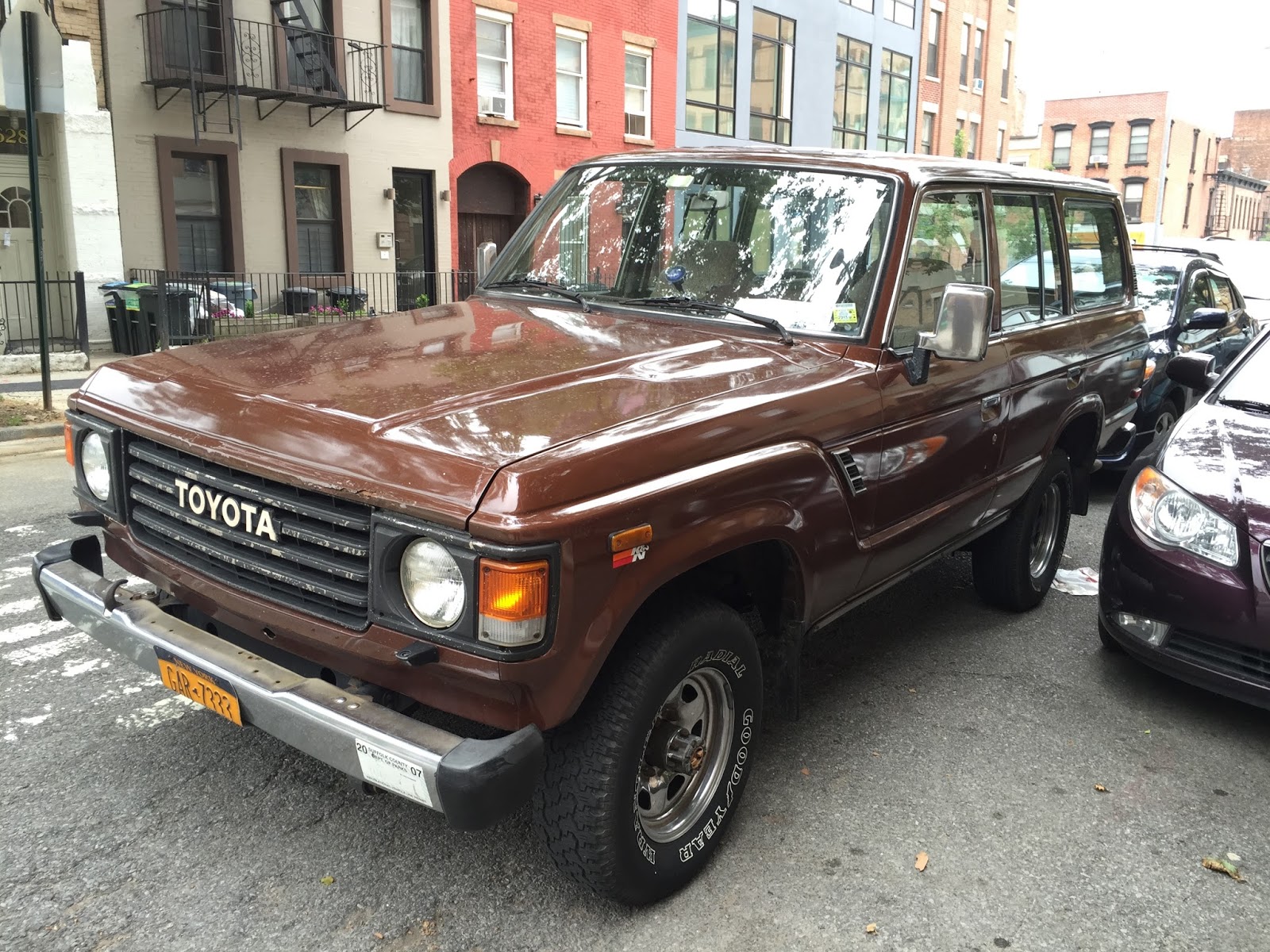
I was walking around Prospect Heights recently when a great brown cloud covered the sky. Once my eyes adjusted I realized I was standing before an enormous building made of rich chocolate. Behold!
This is a 1980-1989 Toyota Land Cruiser Fj60 in BROWN. There was a Copper Brown Metallic available in the early '80s but this doesn't seem to be it. I have a feeling somebody decided this was in need of a repaint at some point and instead drove it to Hershey Pennsylvania and had them coat it in rich molten chocolate.
I hate to give such a vast range of years when featuring a vehicle but this has me 100% stumped. 1980-1989 is the entire lifespan of the 60 Series Land Cruiser. When it was introduced it was sold alongside the Fj40. The 40 Series had similar dimensions and was the first station wagon style Land Cruiser that was geared towards comfort. It looked pretty primative as shown here in a pic I snapped of a red & white example in Oregon:

The round headlights are attached to the grill in the 40 like its predecessor in the background. The 40 and 60 Series were sold side by side from '80 to '84. When the 40 was dropped the 70 Series was introduced which had 4 square headlights. The Fj60 as a result never had the spotlight to itself.
This thing is huge in person. Unless you are 6'5" you climb up into this vehicle. While this might have a small lift it's close to (and might actually be) factory height. 
Power was supplied by a 4 liter inline 6 cylinder engine that was carried over from the 40 Series. Toyota engines of this era are some of the most durable ever built. The body will rot away completely but if you turn the key chances are excellent that it will start and move no matter how ugly.
The basis for this vehicle is that you can take 6 or 8 adults off road to any location on Earth. Even though this is a large vehicle its off-road capabilities are legendary. Customers of the larger Land Cruisers forego the ability to remove the roof and they only came in full size 4 door station wagon style (the term SUV hadn't been coined when this first arrived) but if the height wasn't an issue you really can coax this thing just about anywhere. When fitted with a snorkel for the engine you can conquer rivers and stream with ease. Keep in mind that the driver needs to get out of the vehicle to manually lock the front hubs to engage 4 wheel drive so you can't wait until you're stuck in waist deep mud.
The rear access consists of a large liftgate and smaller tailgate. It's not an accident that the fresh air ventilation output is located so high up behind the rear side window as water could get in otherwise when crossing rivers. This was the first Toyota off-road vehicle where creature comforts like air conditioning was available. It was dawning on automakers that their well-to-do customers who drive a Mercedes or BMW to work were starting to keep a capable off road beast in the garage for ski trips (or just to go to the store). Jeep came out with the Grand Wagoneer in '84 in an attempt to cash in on this trend.
I'll finish up with this shot showing the scale of this beast next to modern cars.
As with any Toyota these are reliable and economical to drive daily. Given their nonstick popularity and solid reputation they've never gone all the way down in value and are holding remarkably well. If you encounter one with no rust that seems to run good for under $10,000 I'd say you've got a solid deal on your hands. 

Tuesday, January 10, 2017

Prospect Park Colony Park

PROSPECT PARK COLONY PARK
I was strolling the border between the South Slope and Windsor Terrace in Brooklyn when I passed this great colossus:
This is a 1986/1987 Mercury Grand Marquis Colony Park station wagon in Oxford White with Rosewood wood-tone applique paneling. This executive looking beast soldiered on in it's 29th year of production in '86 oblivious to the changes all around it. Up front is a V8 engine powering the rear wheels just like the original Colony Park from 1957.
First of all I would like to give a huge shout-out to the accommodating woodgrain trim that neatly skirts around the soft impact zone behind the bumper. In a move I don't remember seeing elsewhere the woodgrain is also present inside the trim surround! Faux wood outlined by faux wood. This wagon is in near-perfect condition.
Here we see Colony Park in all its glory. A big selling point in the literature of the day was its size. According to the brochure you could haul 6 adults and still have 52.5 cubic feet of cargo space. Kick out the passengers and fold the back seat flat and you get 88 cubic feet of space. You can lay full sheets of plywood flat on the cargo floor like this was a truck. If you opt for a trailer hitch you can tow a 5,000 pound boat or camping trailer with ease.
This is exactly what the Colony Park looked like from '79-'91 as the body from the windshield back to the tailgate never changed (the front clip became more streamlined in '88). The only indicator that this is an '86-'87 version is that third brake light mounted on the tailgate.
I've got to hand it to Mercury for their realistic wood grain. It's like they finally got it right the moment it was about to disappear from the automotive scene.
Grand Marquis is the name of the this Mercury line. Colony Park is the name for the wagon only.
The tailgate is an old-school dual version. It can swing open like a door or open flat like a pickup tailgate. The rear window is powered and can be lowered by either the key or a button on the dash. In the rear area there was a Ford Motor Company only option of dual sideways rear seats where the passengers would be facing each other knee to knee.
This ride is 2 feet longer than the Ford Ranger of the same year!
That vertical white rectangle between the front and rear door glass is an '80s classic; electroluminescent coach or opera lights. These don't contain light bulbs but are actually a strip of material that will glow when charged. The problem is that they burn out relatively quickly and nobody knows what to do or where to go to replace them. Well almost nobody! This guy made a DIY post on how to rebuild your EL lighting for your '80s ride. I'm glad he did because I have a great admiration for people who take it upon themselves to conquer automotive problems that nobody realized they had.
We'll leave this smart wagon here to ferry kids from soccer practice in 1987. With its jutting sharp corners and crisp straight lines this is a ride that was built at the very end of its desirability. Minivans had been filling up family garages for years at this point, taking large portions of the target market with it. In addition another threat was emerging from its own parent company. The smaller Mercury Sable wagon was built on the same platform as the aerodynamic Ford Taurus. Both of these newer cars looked like the future and were instant hits. This Colony Park was like the highest end 8-track stereo money can buy while CDs are hitting the shelves. It would continue on into the '90s with a slightly softened look but the march towards oblivion had begun. These days when I do encounter one of these it's usually being used as a construction vehicle filled with ladders and debris. To see a flawless one was a surprise.

Friday, January 6, 2017

Bringing it back for back to back LTD posts

SWEET OLD FORD WITH A COOL SET OF SHADES
On a beautiful Summer day in Old Forge, PA I drove past this sweet ride:
This is a 1968 Ford LTD in Wimbledon White. In 1965 the LTD debuted as the highest trim level of the Galaxie 500. In 1966 the LTD had become its own line separate from the Galaxie. 
This is a 1 year only car as the main body remains the same as the '66-'67 but the roofline is more formal and the front got this awesome hidden headlight treatment.
This grill is one of my favorite moments in all of Ford history! The headlight doors are operated by a vacuum hose running off of the engine. If the vacuum was lost while the car was running the doors would default in the open position so you could still drive at night. I just think it looks cool with the front all grill like the General Lee Charger. The covered headlights were only available on the high-end LTD and the station wagon. I've seen a green wagon with these covered headlights and faux wood trim and it was fantastic.
The dimensions of the car are very straightforward but the subtle Coke bottle curve to what would otherwise be a perfect brick keeps it lively. The turn signals are tucked under the lower corners of the grill surround and don't take away from the look as a result.
This was a massively popular car in '68. In fact 138,752 total LTDs left the factory that year, most of them 4 door sedans like this one. Those dog dish or "poverty" hubcaps are from an early '70s Ford.
There was a Brougham trim package available that is really only identifiable by the interior. If this car were so equipped that bench seat would be split in the middle.
This has the optional Cruise-O-Matic automatic transmission. The radio has a small chrome rectangle between the knobs which means it's an am/fm model as opposed to the basic am. There was a Stereo-Sonic 8 track player as an option but it would be mounted under the dash with its own set of knobs.
You've gotta love the era when cars wore gaudy jewelry. 
Clean and crisp is the order of the day on the rear end too. 
These lights are an evolution of Ford design hallmarks going back to 1952. Rounded taillights with a jet engine look reached a crescendo with the early '60s Thunderbirds (they really look like spaceship rocket engines). 1968 provided the final iteration before becoming horizontal rectangles. 
I find the craftsmanship of these taillight housings beautiful. 
This ride is in great overall condition with the exception of that vinyl roof and some surface rust.
This ride sat for sale for at least a month until one day it disappeared. When I drove by at a later date it had been replaced with a slightly newer 4 door LTD for sale from the early '70s. Brand loyalty from a relative that passed away maybe? Regardless I slowed down each time I passed before finally getting out to snap these. Looking at these pics now I wish I'd at least called for a test drive. I did find it on posted on the local Craigslist (some people watch tv, I scroll through classic car ads) for $2,000. If I had driven it I might've felt compelled to drop an offer on it and who knows if the guy would've said "Sure $1,500 is fine" and then I'd have a 48 year old Ford. Maybe next time!

Tuesday, January 3, 2017

MEN IN BLACK edition Crown Vic

MEN IN BLACK EDITION CROWN VIC
On the tony hills of Park Slope I found this throwback. Once ubiquitous as a fleet vehicle for taxis and cops it is becoming more scarce with every year. I hereby present to you: the 1980s!
This is a 1983 Ford LTD Crown Victoria in Dark Blue Poly. This represented Ford downsizing just in time for the '80s and they did so with huge success. This car is built on the Panther platform which provided such hits as the Lincoln Town Car and the Mercury Grand Marquis. The Panther platform was versatile enough that it lasted from 1978-2011.
Under the skin is 100% old technology; V8 engine up front driving the rear wheels. The 1991 version of this ride with the larger 5.8 liter V8 was the very last American car built with a carbureted engine.
The name Crown Victoria harkens back to the 1955 Ford Fairlane Crown Victoria Skyliner. That original car had a chrome band going over the roof from between the front and rear windows just like this one, but the Skyliner had a glass panel replacing the roof from the band forward to the windshield. As lovely a concept as it was the reality was that you couldn't keep the car cool in summer! It lasted only 2 years but the legacy can be seen in that chrome band.
*If you really want to go back the name Victoria was originally given to a type of horse driven passenger carriage with a half roof from 1870.
These pretty cool turbine-style wheels were available on various Ford and Lincoln products over the years and might just be original to the car. The missing centerpiece would hold the clue as it always contained the logo of the division. 
This little crown lets everyone know you're royalty. 
Oh look at that plush padding on the landau vinyl half-roof! Nothing says "I'm around or past retirement age" like this cushy detail. By the way this is Dark Royal Blue vinyl in faux elk grain.
This is such a straightforward cop-car ride.
You can see the third brake light through the back window in this pic. It wasn't a federal requirement until 1989 so this is an early addition. 
In the 1980s domestic auto design tended to be totally squared off crisp lines. One advantage is that those huge bumpers look like they belong on the car rather than being a late addition.
This car is just a collection of rectangles right down to the taillights.
The chrome trim surrounding the wheel wells and running along the rocker panels denotes a passenger model rather than fleet. 1983 is a strange moment in the history of this name as the LTD was also a smaller car based on the Fox platform (like the '80s Mustangs and Fairmonts). However it was still employed in the stand-alone model shown here. Unlimited limiteds? 
We can see this beast is loaded with options from the split front seat to the cruise control buttons on the steering wheel and power windows. However I can't for the life of me figure out what is coming out of the dash just past the 2 o'clock position on the wheel. Whatever it is is installed where the passenger side center vent opening ought to be. I looked into optional CB placement but those were mounted to the left of the radio.
In addition to serving the police departments of the U.S. these were ultra popular as taxis. Checker stopped production right around when this ride was built and even though they drove side by side for years the yellow fleets eventually became Crown Vics or Chevy Caprices.
Well there we have it; an unlikely survivor on the city streets 33 years after it left Detroit. It's always a bit strange to see the luxury edition of what was mostly a fleet vehicle, and this one hails from a blind spot on the classic car timeline. Some 1983 cars are getting a second look (first generation Iroc Camaros and Knight Rider edition Firebirds) but for the most part people couldn't care less. Due to such ambivalence cars like this are almost always destined for the crusher. Give it another 10 years through and while I doubt it will be very valuable this thing will probably turn heads.