Showing posts with label VW. Show all posts

Wednesday, August 2, 2017

The perfect metaphor for Volkswagen 2017

FROM ROLLIN' JOINTS TO ROLLIN' COAL
Scott from South Jersey sent the following pics from a vacation up in Maine and they gave me an ironic chuckle. Behold opposites ends of the same coin:
This is a 1981-1984 Volkswagen Rabbit pickup in a cool color I can't be sure of (Assuan Brown perhaps?). The Rabbit Pickup was a plot twist because it is a VW that was first introduced in North America. In fact it was built in Pennsylvania and was sold only in the U.S. from 1978-1982. When it was made available in Europe it was given the name Caddy.
Look at that ridiculous smokestack sticking up out of the bed! 
We can see from the emblem on the side of the tailgate that this is a diesel model. Diesel Volkswagens have been the darling of the biofuel set as they are very environmentally friendly. From the factory these would offer up to 50mpg when mated to a 5 speed stick shift (incidentally the 5th gear was labeled E for Economy!). However that smokestack is a part of the recent Rollin' Coal movement. When you're Rollin' Coal you are blowing the maximum amount of black smoke from your diesel exhaust to thumb your nose at wimpy Prius drivers (and increasingly "protesters"). I'm totally serious folks! I suppose it is the perfect metaphor for VW now that it famously got caught cheating on the diesel emissions software of their rides.
So here you have the beacon of hippie environmental consciousness transformed into a pinko hating vehicle for the Right. Who knew?
Thanks to Scott for this schizophrenic vision!

Sunday, June 18, 2017

Representing Father's Day with the Car With Two Trunks!

THE MOST PRACTICAL CAR OF THE LATE '60S?
My little sister from another mister Neen spotted this little Kraut roosting in the Empire Region and sent me some snaps. I'm glad she did because I love these rides so much!
This is a 1965-1969 Volkswagen Type III Fastback in Savannah Beige. This is the "car with 2 trunks" and it is in lovely condition!
*One amazing detail is the windshield washer fluid dispenser which is that little dot between the cowl vents. It is powered by an air hose connecting the spare tire to the fluid reservoir. That means that if you use the windshield washer with abandon and forget to inflate the spare you'll have a flat tire in the trunk!
The Type III was named as such because the Beetle was 1st and the bus 2nd in production dates. These came in Fastback and Squareback (known in Europe as the Variant) body styles in the States. Europe also had a 2 door coupe version with a proper little trunk lid called the Notchback. The Fastback was introduced to replace the Notchback but both turned out to be so popular that they sold them alongside each other (in the rest of the world anyway).
Those vents along the quarter panel bring fresh air into the engine compartment which was truly essential as this is an air cooled car. Unlike the Beetle this is a flatter "pancake" engine that fits underneath the rear floor. If you lift up the hood here you'll see a flat floor leading up the rear seat (that folds forward for extra storage). To access the engine you would move the rubber mat to expose a removable panel beneath. The front hood is the main trunk with the spare tire and gas tank too.
We know this is a '60s version because of these delicate chrome ringed lights and smaller signals. Starting in 1970 much larger lights incorporating both brakes and turn signals arrived.
In 1968 the Type III became the first car to have fuel injection as standard equipment. They ran very smooth, always started easily, and offered great gas milage. This may or may not have that setup but regardless I would love to roll around town in this little beauty.

Friday, May 19, 2017

Lovely little Variant in Oakland

LOVELY LITTLE VARIANT IN OAKLAND
Some cars have languishing in my computer for no particular reason. I snapped these pics in Oakland at least 2 years ago. Look at this sweet freaking face!
This is a 1970-1973 Volkswagen Type 3 Squareback in Yukon Yellow (with the exception of a door and quarter panel that are in the color Amber). I can tell you from experience that this is a great car.
The Beetle was the Type 1 and the Bus Type 2. These were known as Type 3 or Volkswagen 1600 depending on the market. The Type 3 was launched in 1961 and initially consisted of the 1500 Notchback; a 2 door coupe with a front and rear trunk. These were never imported to the U.S. and as a result are very collectible today. The U.S. market first saw the Type 3 in 1966 when both a Fastback and Squareback 1600 were offered.   
These rides have a pancake motor which is essentially a flattened version of the 1600cc VW air-cooled 4 cylinder. It was compact enough that it set underneath the rear cargo floor. You open the rear hatch, lift up the black rubber mat, and there is a metal trapdoor that unlocks and opens to expose the motor.
The '60s Type 3s had smaller front turn signals, taillights, and bumpers as well as a slightly smaller body overall. Of all the myriad cars whose lights and bumpers grew to meet regulations I think the Squareback wears them exceptionally well.
The Squareback was known as the Variant in the rest of the world.
While there was a fully automatic transmission available for these the manual is the way to go. They are outfitted with the Freeway Flyer transmission which benefitted greatly by having taller gears for highway cruising. I once drove 4 people 4 hours at 70mph without issue in one of these.
The louvers along the top of the quarter panel feed air into the engine cooling system which worked very well even in hot climates. By 1969 these rides came with Bosch fuel injection standard. A major percentage of the VW community believes converting those old injection systems to dual carbs is the way to go. I had a 1970 Squareback with F.I. and it was fantastic; always starting in any weather, smoothly accelerating with plenty of power, and never needing adjustment for the 5 years I drove it. The caveat is that our car came with a manila binder full of records and someone had replaced the computer "brain" for the system years earlier for $1,200. In 1990s money that was a lot but it worked a treat!
Well that does it for this charming little daisy.
I was out at Ocean Beach in S.F. with my girlfriend at the time and we saw one of these in Baby Blue with a for sale sign in the window. After admiring it we walked into the Surf Coffee Shop talking about how cool it was. The guy sitting by the door said "wanna test drive it?" and handed us the keys! We didn't know that guy at all but we took him up on it. 5 minutes later we were back negotiating a deal for the car (I think $2,200 down from his asking price of $2,500). The clock didn't work but it was set to 4:20. The ashtray was full of roaches to boot.
We drove that car for 2 years in while living on California St. in S.F., and then trailered it back East to Western Massachusetts. There we continued driving it for another 3 years, parking it only for the few worst winter months. Each Spring she would start right up. After that the Squareback made the move to New York with us and she stayed with my ex as it was always really her car. I heard it was sold to someone in Pennsylvania and hopefully she's driving as I write this.
If you see one in good shape and running condition don't hesitate. These are spectacular, hilariously fun cars to use every day.

Saturday, May 6, 2017

The German troll under the bridge

THE GERMAN TROLL UNDER THE BRIDGE
In a fit of insomnia I rode my bike down to Brighton Beach recently at dawn. The sun rising over the wreckage of inner Coney Island was beautiful, and the breeze off the Atlantic fresh and invigorating. Then I turned back under an elevated block of the subway and found this:
Yeesh. I felt like I needed to say "sorry" and close the bathroom door because this thing looks like I walked in on it. How a beautiful car can get to looking so creepy is beyond me.
This is a 1973 Volkswagen Karmann Ghia in what looks to be a repaint of Bright Orange. It also looks like a bum that's getting a bit too close while trying to ask for something.
What happened here is a mystery to me as the engine is in the back. Was it parked facing something that burned? Is this a horrifically done dent repair? Who knows but the effect is icky.
Those nostrils originally had delicate chrome vents in them with 3 horizontal bars. That circle above the damage had the VW emblem at one point and shows the original Amber factory color. 
This car is 100% Beetle under the skin which makes parts and maintenance extremely easy. Basically the Beetle was the people's car and so VW decided to hire coach builder Karmann to design a foxy, sporty iteration to lure customers. Karmann decided to bring Italian design firm Ghia into the mix and thus the name was born.
The first Karmann Ghia was introduced in 1955 and looked very similar to this one. The body panels were hand formed which certainly justified the extra cost. Upon release the Karmann Ghia was a total success, surpassing even the most optimistic projections with 10,000 sold.
Unfortunately someone decided a generic tough guy steering wheel was better than the original. By '73 the factory steering wheel was made of black plastic and wasn't the nicest in VW history but it managed some class for the era. The early wheels are lovely with a thin ceramic rim and chrome horn ring. I can't blame them for the radio replacement or the under dash gauges (no water temp gauge of course). That button between the clock and radio is a cheap horn replacement. I had one just like it in a car where the previous owner replaced the steering wheel with a bro faux job.
These are the flat style hubcaps with castle Wolfsburg in the middle. I've heard these called Porsche caps as well and don't know if they were ever on a VW from the factory.
In front of the rear wheel there is a dark circle. That is the point where you should place the factory jack for lifting the car. So many older VWs are damaged because someone rolls a big floor jack under the car indiscriminately. The thin floors and rockers will buckle easily.
1973 was the first year for these large federally mandated bumpers. Unlike some larger American cars there's just no hiding these and they really take away from the delicate curves.
Herein lies the air cooled 1600 flat 4 hooked up to dual carbs. By '73 there was a decent amount of power for such a light car. They bragged that it was good for 93 mph which is PLENTY for this!
That guy in the distance had a fierce trudge going.
These taillights look pretty good to me, especially when contrasted against the Beetle version of the same vintage. They are larger than the earlier Ghias but they maintain a lovely feminine shape to go with such a voluptuous car. The earliest Ghias are known as Low Lights due to their tiny art deco style lights low on the fenders.
Well that's where I backed away to rejoin the Dawn's Early Light. I would suggest that few cars from 1973 have aged as well as the Karmann Ghia though this is a munchy example. Convertibles were available from 1957 through the end of production in 1974 and they really look great. However finding any VW from this era without debilitating rust is difficult let alone one where the roof is made of cloth. As with any VW if you're curious to shop for one I suggest checking the battery tray, spare tire well, and rocker panels for rust. Don't panic if you see some, but those areas are a good barometer for the overall condition.

Friday, March 10, 2017

F for Friday, F for Fox, and F for mad Fahrvergnügen

Fahrvergnügen
Look at this little box of fun. Doesn't it look like fun? Not really? Okay. Well this was sitting on a Red Hook street recently and I marveled at how long it had been since I'd seen one.
This is a 1990 Volkswagen Fox in (mostly) Tornado Red. Even though it was sold in North America for 8 years from 1987-1993 the Fox is an utterly forgotten car.
Two things happened in the U.S. that facilitated the Fox showing up on our streets: Yugo and Hyundai. These two interlopers came out of nowhere (Korea and Yugoslavia actually) with new cars advertised at astonishingly low prices. VW had these cheap wheels already in production in South America so they quickly brought them north to compete. The Fox was the cheapest VW of its era.
People can't resist striking poses in front of vintage European classics!
In 1990 VW had a new ad campaign centered around the word Fahrvergnügen. This is a made-up amalgamation of the German words fahren (to drive) and Vergnügen (enjoyment). The tagline was "Fahrvergnügen: It's what makes a car a Volkswagen". The campaign lasted only 2 years but this car was sold during that time. I wonder if the driver feels enjoyment every time they turn the key?
The Fox was available in 2 and 4 door sedans as well as a pretty cool 2 door wagon. The wagon was halted after 1991.
The Fox was manufactured and sold in Brazil as the VW Gol. That's right GOL like Golf without the Fun. This was no flash in the pan either. It was introduced in 1980 and production continues today.
All of the Foxes in North America had a fuel injected inline 1.8 Liter 4 cylinder engine. Despite the small engine the gas mileage was rated at 22 city and 27 highway. Not too impressive Foxy!
This interior shot is utterly useless save for one detail: the stick shift that we can see poking up from the floor. This is the one detail that guarantees at least a little Fahrvergnügen: the Fox was only available with a manual transmission. *I can't think of another car between '87 and '92 that didn't have an automatic trans as an option.
*Actually the Yugo didn't offer an auto trans until 1990 but calling that a car is a stretch!
This hardy little beast needs to be commended for existing on the city streets at almost 30 years of age. In many ways this is what VW did best; basic transportation.
Well that's where I'll leave this little lunchbox. These white noise cars come and go throughout history and tend to only get noticed once most of them have disappeared. However unlike other forgotten dogs like the Chevy Beretta the Fox was a good little car. Zero frills, cheap cost, and extremely available parts all make for a usable ride. Just don't expect to restore one as it wouldn't even be worth the cost of a paint job when complete. If you found one in museum condition I still wouldn't think it would be worth more than 3 or 4 grand.
Take a good look folks! These are marching towards extinction.

Monday, March 6, 2017

A brand new ride disguised as the most common car in the world

A BRAND NEW RIDE DISGUISED AS THE MOST COMMON CAR IN THE WORLD
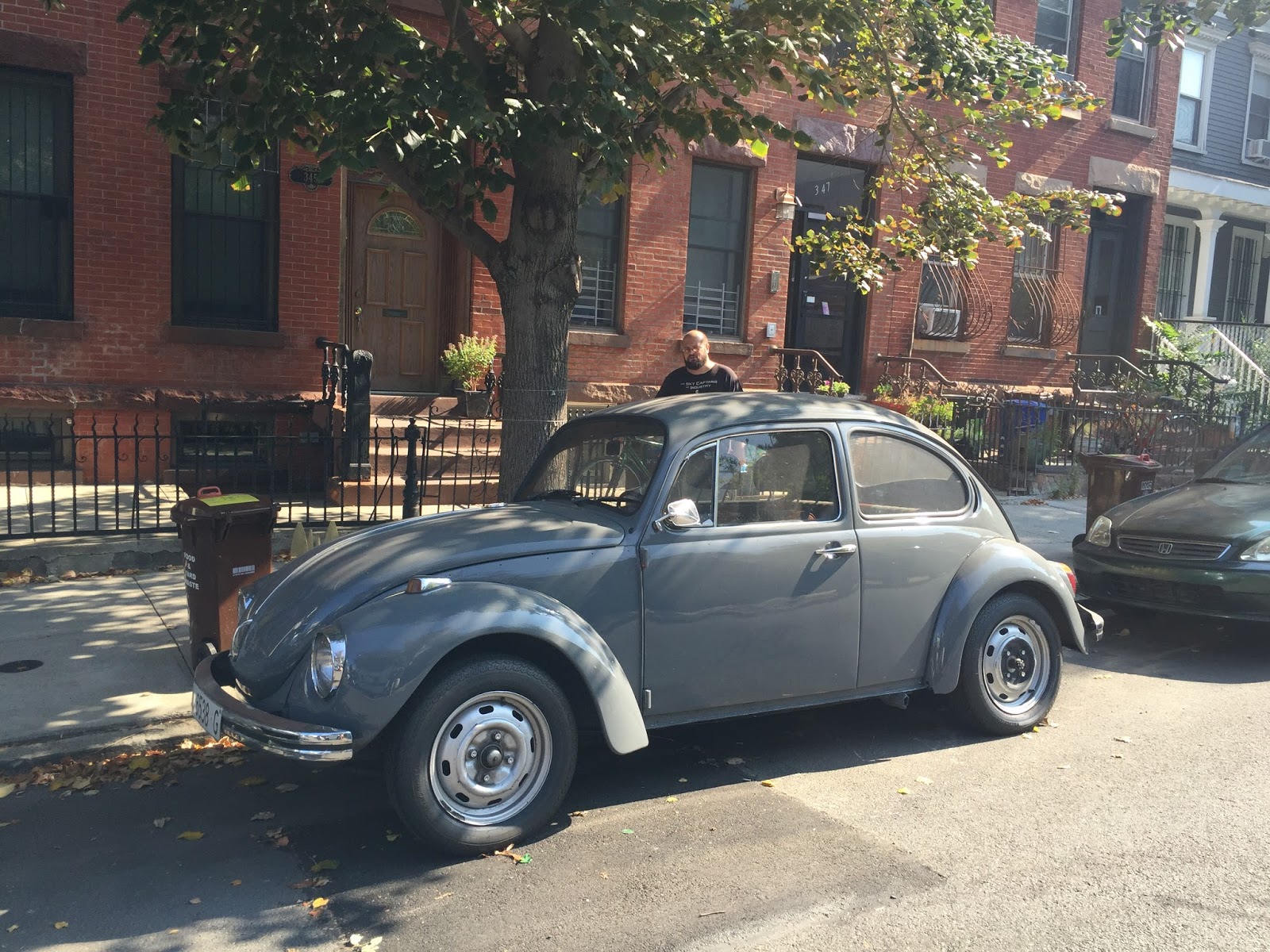
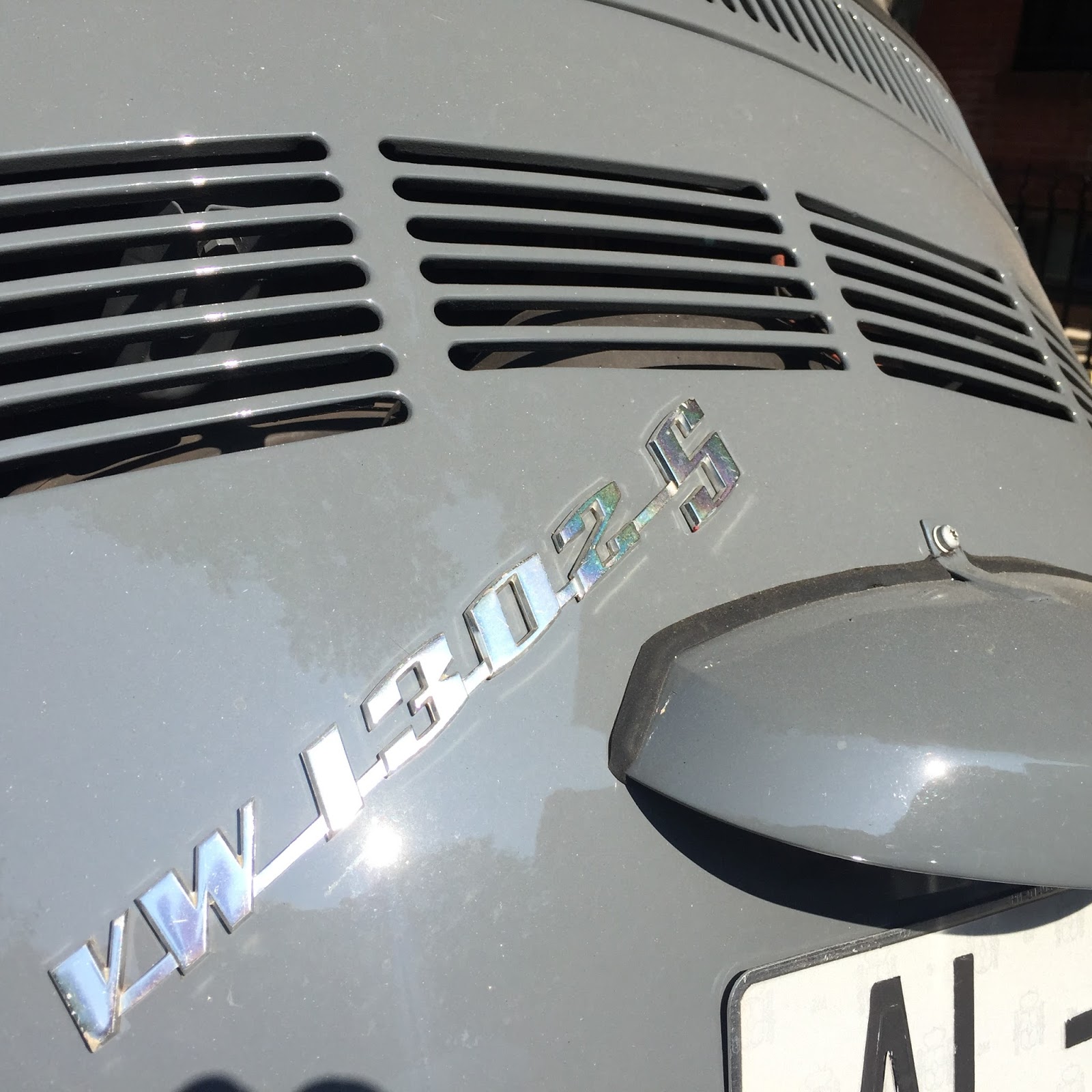
How many Beetles can you pass before you notice one that's special? Sure they're getting more scarce in the rusty Northeast but even here there are several in daily use. I was mid yawn walking by this ride before a strange emblem caught my eye:

VW1302-S? I've seen 1300 and 1500 emblems before which corresponded to the engine size, but what was this?
What it is is a 1972 Volkswagen 1302-S in either Silver Grey Poly or Chinchilla. The awkward 1302-S name was only used for 2 years but it was actually the first Super Beetle.
There are so many differences between the 3202-S/Super Beetle and the standard Beetle that it's hard to believe they look almost identical. The hood is longer, increasing the luggage capacity greatly. In addition the spare tire sat horizontally on the trunk floor for the first time. The front suspension on these larger Beetles was upgraded to independent struts as well. Handling was more like a regular car than a Beetle.
This one is missing the hubcaps and running boards but is in otherwise stellar condition.
Everything you need to know to pinpoint the year on this ride can be found on the back. The previous year 1302-S had 2 banks of 5 horizontal vents on the hood where this has 4 banks. The year after this sported massive taillights and a larger rear window (and is actually known as the 1303).
Confoundingly the 1302 was only available with the 1600 engine in the States.
That little crescent moon shape behind the rear side window is the outgoing vent for the new fresh air flow-through system introduced with the Super Beetle. Air conditioning was a new option.
For the first time in '72 there was a plug-in dock under the hood which can be hooked up to the VW diagnostic computer at the dealership. These early computers can be expensive to replace these days. I had a 1970 VW Type 3 Squareback with fuel injection. In the stack of receipts that came with the car was one invoice for the computer "brain" for the fuel injection. In the mid to late '90s it cost over $1,000 to fix!
The interior has been tastefully redone in cloth and vinyl. The steering wheel looks to be an earlier replacement due to that chrome horn ring.
In various forms the VW Beetle had been in existence since the late '30s. Official sales figures start around 1947 but it was the 1972 model year when the Beetle surpassed the Ford Model T as the greatest selling automobile in history. It has since been dwarfed by the Toyota Corolla.
Well there we have it; a cool little transition car hidden in plain sight. VW history changed dramatically with this ride. The old technology that carried the company from its inception until this car was built was bowing out. The engine was still air cooled and placed in the rear. The gas tank was still up front. The car still looked like a round classic from the 1930s. In the years following this the baton would be passed to the Rabbit (known as the Golf everywhere besides the States), the Dasher, and Scirocco. Engines would change to being water cooled. Creature comforts would take priority. For anyone who remembers the warbling buzz of a Beetle driving by this ride will still make you nostalgic.

Sunday, January 15, 2017

A fierce desert wind descends upon Brooklyn: Scirocco!

A FIERCE DESERT WIND
I was walking down Grand Street in Williamsburg one lovely summer day when I found this little punk. Talk about forgotten rides!
 What we have here is a 1983 Volkswagen Scirocco in the yawn-inducing color Diamond Silver Poly. The name comes from "a fierce desert wind" according to the literature of the day. Scirocco was introduced way back in 1974 as a successor to the Karmann Ghia. This seems blasphemous as the Karmann Ghia was all voluptuous curves and this looks like origami but it did foreshadow the boxy '80s perfectly.  
I didn't get many pics so I'll point out the large single windshield wiper above. This became 2 traditional wipers in 1984 so we know this is earlier.
Our feature car is the 2nd generation Scirocco which is a little larger than the earlier version. Perhaps the easiest way to identify the pre-1981 models is that they had round headlights as opposed to the square units on this ride. Those older Sciroccos look like sporty VW Rabbits (Golfs to you Euro folks, or is it Golves?). The rear seating in this is tight but the 1st gen is absurd!
When this 2nd gen was introduced in 1981 it had the word S C I R O C C O stenciled in white on the rear window below that little spoiler. After 1982 that was discontinued which, along with that big windshield wiper, identifies this as '83.
The drivetrains in these were pretty diminutive with the standard inline 4 cylinder U.S. model putting out a measly 74 horsepower. Due to its low weight and center of gravity it could still translate into a lot of fun with the manual trans, but with the automatic you may as well walk.
I love the styling on these little rides, and you just don't see them anymore. Since the basic guts are similar to the Rabbit/Golf you can easily fit a GTI engine in one of these and create a little rally car. Tone of aftermarket performance parts are available. Thie 2nd generation seen here would continue on through the 1988 model year with few changes before retiring.
This car would be replaced by the more expensive and powerful Corrado. While the Corrado is a mean machine it is about as rare as the Scirocco today. The folks I've known that owned Corrados talked about wiring foibles that made for difficult daily driving (one of those cars suffered a dashboard fire that banished it to the junkyard). For my money acquiring an old Scirocco and upping the performance to Corrado levels would be the most rewarding. Regardless I'm always psyched to see a forgotten '80s VW on the streets. 

Thursday, September 15, 2016

First generation American with dual citizenship

A CADDY BY ANY OTHER NAME
Today I'm featuring another selection from my Oregon heatwave visit from last year. Here we have a first generation American whose parents are from Germany. Who would've guessed this ride is as American as it gets?
What we have here is a 1981-1983 Volkswagen Rabbit Pickup Truck LX in Cashmere White.
VW introduced this spinoff of their popular Rabbit in 1980. In only that first year the turn signals were located within the bumpers. Starting in '84 the headlights were more flush with the grill rather than inset so we know it's in the '81-'83 range.
From the moment these little trucks were introduced they were built in a Pennsylvania factory making this the first foreign car built in the U.S.
Just like the AMC Gremlin this ride is a doppelganger of another vehicle from the doors forward. However where the Gremlin was a car chopped in half this one grew an additional 9 inches in length. The bed was 6 feet from cab to tailgate which was pretty good for a mini truck.
This looks so plain-Jane but it actually is the mildly upgraded LX edition. The only way we can tell (since the original tailgate with its badging is missing) is by the bumpers being chrome.
To see one of these so rust-free is astounding to any East-Coaster!
The VW Rabbit Truck spread to other continents and was known in the rest of the world as the VW Caddy. This fits the VW mantra as the Rabbit was always labeled  Golf outside of the States.
Production of the Caddy lives on to this day elsewhere in the world currently only in its 3rd generation (though face lifted several times). The 2016 Caddy has some amazingly-named versions such as Caddy Life and Caddy Maxi Tramper.
Even though the tailgate has been changed there is an excellent chance that this is a diesel. Most of the first generation trucks were diesel with a 5 speed manual. Interestingly the 5th gear was labeled E for Economy. If you wanted the automatic you had to choose the gasoline engine. None of these combinations (5 speed included) were quick but the truck proved very capable at small tasks. That same legendary diesel engine propelled Rabbits of the era to 300,000 mile lifespans, something that was absolutely unprecedented in its day.
Well there we have it; a small, cute, capable little donkey that just wants to work and please its owner. I remember as a kid riding in a friends moms Rabbit that they bragged was the cheapest version available. It had black rubber mats in lieu of carpet and no radio (it was the most yellow car I've seen to this day!). Finding a stripped-down truck to drive around in today would be great as reliability and parts availability are both top-notch. With a small camper fitted to the back it might be the ultimate road trip vehicle. Hats off Caddy!