Showing posts with label patina. Show all posts

Wednesday, November 8, 2017

First of its kind but last call before World War II

FIRST OF ITS KIND BUT LAST CALL BEFORE WWII
As the green leaves suggest these pics were snapped in Summer. I was driving upstate when I passed what looks to be an abandoned project. I had to turn around and pull over!
This is a 1941 Chevrolet Fleetline that may have once been painted Volunteer Green Poly. This car doesn't show up in any of the Chevy literature for 1941 as the Fleetline was a late addition to the model year. This simple 4 door was the only version available initially.
Despite looking truly abandoned this ride has many (if not all) of its components either installed or roosting in the backseat. A full set of original hubcaps still bearing a hint of the red accent swoops is present. One look at the dry rot on this tire and you know its only function will be to roll this on and off of a trailer. I was kind of shocked they held air at all.
Calamity!
This is what happens when you drop your car off for a full restoration and stop paying your bills. All of the trim has been carefully removed and most of the paint has been sanded off. Evidence of smoothed out Bondo where dents or rust repair were are visible all over. This beast looks like it was almost ready for paint when the clock stopped.
Yeah I know this is a terrible pic. I only include it to show off that upholstery.
This roofline is unique to the Fleetline as every other 4 door Chevy had rear quarter windows behind the rear doors. The worst of the body seems to be the rocker panels and lower door edges. OG paint remains only around the door glass.
The rockers on this side have been cut out completely. I'm guessing this was the straw that broke the camel's back.
"Runs & Drives!" meant slowly even when new. Under this mighty hood sits the 216 Blue Flame inline 6 cylinder engine good for a mere 90 horsepower. A three on the tree transmission and drum brakes all around complete the chilled expectations. This engine was later bored out to 235cc and it was a higher performance version of that block that powered the original Corvettes from 1953-1955. Variations of this motor were produced from 1937-1963. 
The lines for this are pretty sweet in my opinion. Production of all passenger automobiles ceased in 1942 so the factories could be used for the war effort. When production resumed in 1945 there was a pent up demand for new cars so they built what they could which meant that this car was produced with very little change through 1948. However back in '41 this was up to date.
Unfortunately these rides aren't worth much even in pristine condition. I can almost imagine the series of phone calls reaching the end of the line for this thing pretty quickly.
Someone probably drove this to the shop proudly figuring it didn't need much. They removed the paint and found damage which they started to repair. Then the rocker panel bad news came along with estimates for the interior and re-chroming. At that point you realize that you can go to the classic market and buy a perfectly preserved example for what you've already put into it.
Another scenario is that the elderly owner wants to restore his first car. The project starts and the owner dies or can't drive anymore. The relatives either try to sell it or look into finishing the restoration and see that the cost far outweighs the reward. Unless you have a deep emotional connection to a car like this it is akin to restoring a 1983 Ford Escort from the ground up.
*Notice the tiny opening at the bottom of the grill above the ER in New Jersey on the license plate. That's where you would put the crank if your starter failed! A true holdover detail.
**I also have no idea what that round thing is under the right turn signal.
I include two pics of the interior to show different aspects. Here you can see a perfectly round hole in the floor under the driver's feet. In my '47 Dodge this was an access panel for the master cylinder so I'm guessing it's the same.

The interior is actually pretty nice with the optional clock on the passenger side and speedometer in lovely condition. The horn ring is in place and the Bakelite gearshift knob is intact. My '47 Dodge had a massive under dash heater that would be clearly visible. Who knows if this came with one or not? If this ride was delivered to a Southern state there's a good chance it was never built with one. If you were a serious penny pincher you could order your Chevy without one all the way up through the mid-'60s but who would order a clock before a heater?
Well that will do it for this well worn example of a mass produced, very old car that few people want. Best bet for this beast would be for a father/son project or for someone to rat rod it out. I know it's sacrilege to say that about a running 76 year old car, but a truly stunning '46 fastback Fleetline sold recently for $3,800 so you know the cards are stacked against this thing.
Good luck faded trooper!

Tuesday, August 29, 2017

Strobogrammatic Savoy courtesy of Providence Pete!

STROBOGRAMMATIC SAVOY
Providence Pete has had incredible luck recently finding old rides. He recently sent me a couple teaser snaps of the car below and I begged him to head back for more. Behold this quirky spaceship from the most recent Strobogrammatic year!
This is a 1961 Plymouth Savoy with remnants of its original Mint Green visible amidst the rust/primer/patina ruckus. This car is awesome and you should show respect. Doff your caps!
Come on already! Few rides are as outlandish as the '61 Plymouths in the front.The grill, when taken on its own, is the shape of an anvil. Not only that but it curves rearward as it goes down. It has legit eyebrows and an eager (if kinda off putting) expression. The center of the bumper has that ribbed section drawing the air into its mighty maw. The movie car from Christine was a '58 Plymouth but this is easily sinister enough to have filled that role.
This golden emblem in the grill is a combination of hyper stylized images. The original logo for Plymouth was of the Mayflower (Plymouth Rock, get it?). By the late '50s it had become so abstract that you couldn't really tell what it was. Then the Valiant debuted in 1960 with a streamlined rocket emblem in the upright launch position. This looks to be a combination of the two, and a proper precursor to the Fratzog (a made up word for the 3 pointed emblem that would arrive later).
Look at this overhanging aggressive stance! The frowning eyebrows hang over the headlights, which in turn are leaning over the bumper.
The original parking brake; a log.
The rusty drippings on this beast make for crazy patina. Moments of Mint Green can be seen just above the wheel center and on the rocker panel.
The Savoy wasn't putting on airs. The dealership sales brochure from the era calls it "The economy line for 1961". Above the Savoy was the Belvedere, and above that the mighty Fury. That line running back from the eyebrow over the wheel well originally had a bit of chrome on it (only in the very front). The Belvedere had the same short chrome trim on the front fender but the rear chrome extended to mid-door. The Fury had an unbroken chrome line from front to back.
The rust pattern on the hood is so odd I figure it must have had a pile of leaves on the drivers side or something. I've also seen cars that spent years under a tarp for their protection completely rotted as any moisture couldn't escape.
 Give it up for Siddartha Guatama chilling on the front seat! A full width bench was the Savoy standard. The brochure bragged that the dealer could adjust the seat height and angle to perfectly suit the new owner.
The dashboard is stupendous! First of all the steering wheel has clear acrylic top and bottom, with that space age rectangular horn ring. The push buttons to the left of the wheel are the transmission controls (I'm 99% sure it's sitting in Drive). The buttons to the right are optional heating controls (below the furthest button is a lever for opening the vent). The white square below the speedometer is where the close would be had it been ordered. One amazing (not included) option that was available for this car was an under dash record player!
Even the smallest details are well thought out in this era.
This chrome spear would've continued further towards the front had it been a higher trim level.
From this angle you can see the huge reverse light on the back panel. This was an option in '61 with the sales literature going so far as to point out that it was a safety item.
This is the taillight housing for 1961. They just hung on to the side of the car like rocket boosters. It certainly looks cool when they're working properly but are very susceptible to damage.
A little more Mint Green remains on this side. The short roof 2 door with post is a Savoy exclusive. Both the Fury and Belvedere had a long, sloping roofline in a hardtop style.
Original poverty caps on Mint Green steelies complete the thrifty look. That tire with its dry rot and years of dirt in the flat crease says this hasn't moved in years.
Well there we have it; a super sonic space age slab holding down a driveway in Providence. Nothing beats the oddity of '60s Mopar design in my book. Every Dodge/Chrysler/Plymouth in this era had weird touches like square steering wheels, these overhanging eyebrows, pushbutton transmissions, and unique but equally crazy dashboards. These are unibody cars so tackling a really rusty restoration would be daunting. However the drivetrain technology is tried and true with everything easy to work on. Even the quirky pushbutton trans worked very well; it was only discontinued later in the '60s to save something like $1 per car. Some day I would love to own one of these. Pete - if you see a sign on this wreck one day hit me up!

Friday, August 18, 2017

I ran across a Faded Player recently . . .

FADED PLAYER
I was walking through the Northern end of Bay Ridge the other day when this well chewed blob of bubble gum made its presence known:
Okay, alright, there was once something to work with here.
This is a 1982 Ford Mustang GT in what might be a very faded Medium Red. The GT had special colors and the Medium Red leaned in this raspberry bubble gum direction but this also might be a flashy custom color from the go-go '80s.
This hood scoop does nothing at all. If the sun weren't so bright you'd see that it's blocked off with a body-colored panel. That Mustang emblem in front of it was a foggy as it looks in this pic.
The GT took over where the Mustang Cobra left off the year before. From '79-'81 the most powerful Mustang engine available was a turbocharged 4 cylinder! The V8 from '80-'81 was a smaller 4.2 liter 255 which got better gas milage than the classic 302 V8 of the previous decade. Our feature car today  brought the return of the famous 5.0 302 V8.
The GT has a great look with a special front spoiler and air dam, that mini faux scoop, and a wing on the rear. This was a cusp model bridging the gap between the first Fox Body Mustangs in '79 and the redesigned next step for the Fox in 1983. After the '83 redesign (more of a minor tinkering than a complete overhaul) this basic design carried all the way through the decade and into the early '90s.
Definitely trust the milage quoted by the seller of every classic car, especially when the dashboard has been completely torn to shreds! This dash has been WORKED; look at the hole smashed into the top in the middle. The dash pad, face, and vents have all been torn out. I can see that this is a stick shift though which makes this one fun car to drive.
Here's the 3/4 view of this hatchback pony. The dimensions are tidy for a rear wheel drive V8 sports car. Beginning in 1983 a convertible would be available for the first time in 9 years. Those are Mustang rims from a slightly newer car.
A single out of state plate is holding this thing down while the cops and tow trucks pass it by. Does this really look like a Vermont car? Can you imagine driving this thing in any amount of snow? Might as well sit on a diner stool and swivel in a circle.
D & D Autoworks had their hand in this beasts creation many moons ago as you can see from the faded lettering next to the trunk lock.
As munchy and weathered as this thing is it is standing up at the proper height with all its lighting and glass intact. Besides scuffs and scrapes there are no major dents to be found, and just a few rust spots are staring to creep.
Well that's where I'll back away from this '80s tough guy vision.
The 5.0 Mustangs of the decade were crazy popular and filled the streets when I was in high school. They remain affordable and are very easy to work on with parts availability second to none. If you want an easy classic to take to shows or just roll around in for summer you could do a lot worse.

Saturday, August 12, 2017

SAAB STORY. There I said it

FUNKY SWEDISH FISH GASPING ON THE PAVEMENT
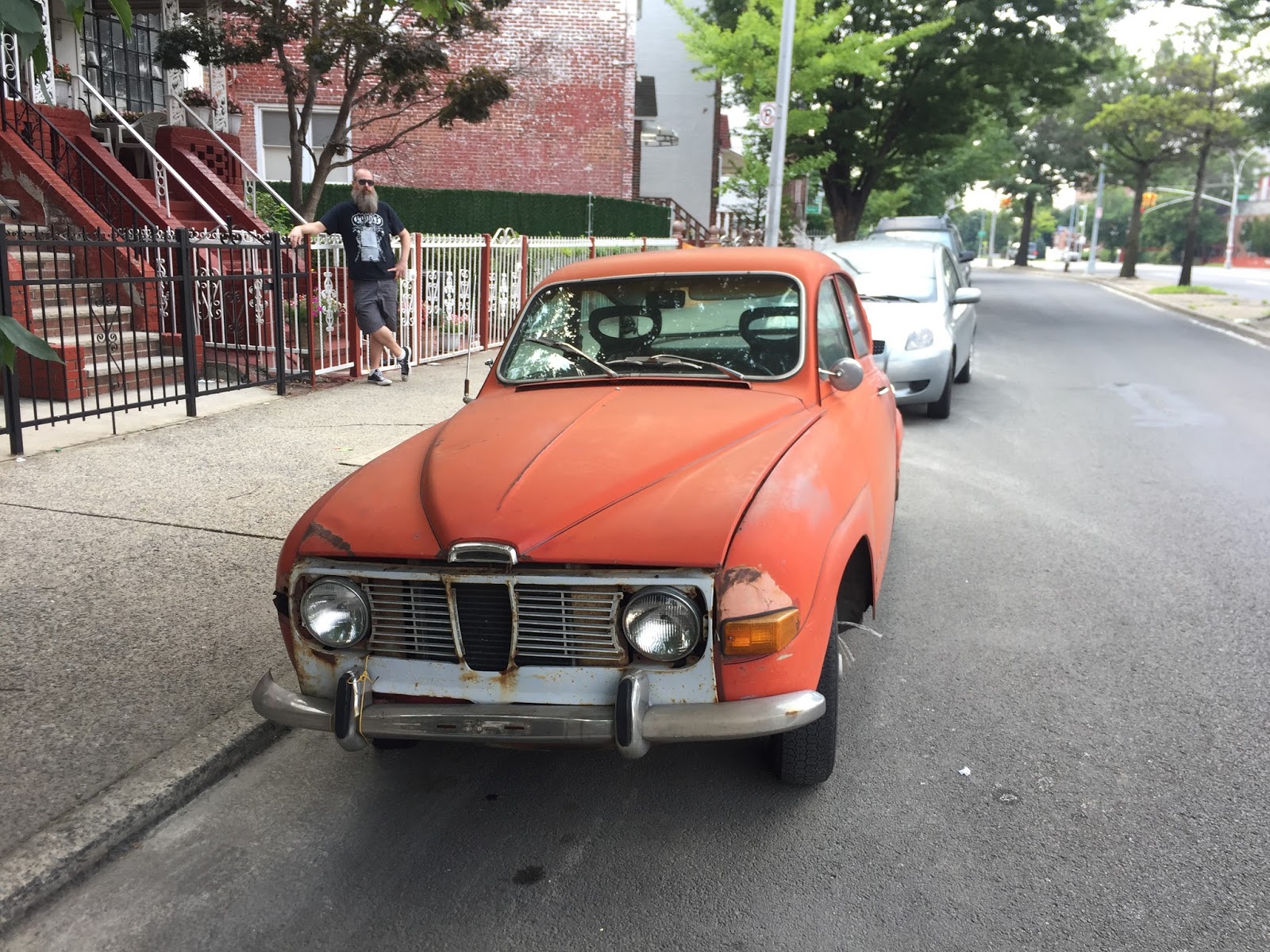
NYC is truly huge. 6 months ago I was driving out on the Kings Highway around the Flatlands neighborhood when I spotted this little frumper. It was facing the opposite direction across 5 lanes of rowdy traffic so I yelled out to myself but kept on my merry way. Recently I was in the same neck of the woods with my eyes peeled and there she was!
This is a 1973 Saab 96 in Burnt Orange (with a Silbermink or Silver Mink fascia around the grill). Most people don't realize that older Saabs looked like a cross between a spaceship and a VW Beetle.
Look into the grubby mouth of this well worn little punk! It looks like the "before" picture on a subway dental advertisement. The replacement fascia and bit of Bondo tell me that someone cares at least a little for this ride. That poor diminutive bumper is the veteran of many a parallel parking mishap. 
The 96 was introduced in 1960 and remained in production through the 1980 model year (though they stopped coming into the States after '73). My guess is that the tiny front bumper was the reason the '74 never made it to our shores because that year ushered in the federal crash safety regulations.
The line running along the lower body was where a piece of chrome trim once lived. I'm not certain but I think it denotes the trim level; the high end DeLuxe had 2 chrome strips, this had one, and some had none at all. In the DeLuxe the rear quarter windows were hinged and would pop open but these are probably fixed.
Saab was originally an aeronautical company and aircraft design elements made it into their cars. The very first Saab automobiles were straight-up bizarre! The engines were 2 stroke meaning that oil had to be added to the gas. The radiators in those first models were behind the engine just under the windshield. The door glass didn't roll down conventionally, just the rear edge would go down so that the front edge would remain above the sill. There are foreign cars and there are truly foreign cars!
By the time this ride was built the 2 stroke motor was replaced with a Ford V4. It was a great little engine in a tiny car and as a result the Saab 96 had a major presence in the rally world. All 96s were front wheel drive as well.
I love the slippery lines on this ride.
This old sticker confirms that the paint is original. It's hard to read in this pic but I believe this particular Swedish Motors was in Pennsylvania. The overall condition is great for a 44 year old car. 
No plates? No problem on King's Highway!
These awesome wheels are more commonly seen on the Saab Sonett; a very low to the ground fiberglass sports car built around the same time. They're referred to as Soccerball wheels.
Even beat down and tired this thing looks amazing!
This steering wheel was introduced in '73 which helps to confirm that this is a final year U.S. spec 96. The interior is straightforward and functional with toggle switches and knobs as opposed to flashy electronics.
The replacement for this ride was the Saab 99 which debuted in 1968. Instead of replacing the 96 they were both produced alongside each other until the last 96 left the factory in 1980. The 99 was remarkably modern in '68 when it hit the scene. It looked very much like the 900 that was built through the '80s and into the '90s. I've owned 3 different 900s including the only car I've ever had stolen from me! Oakland represent! 
This little punk isn't going anywhere any time soon.
These round headlights were only on the U.S. models at this point. From 1969 onward the rest of the world had rectangular headlights on the 96.
Well there we have it; an odd little import from the era when nobody in the States knew what a Saab was. There can't have been many of these sold back in '73 and very few remain on the streets today. Back in college a motorhead acquaintance bought a pair of these pretty cheap. He drove one around school and I think the other one was meant for parts even though they both ran. His plan was to set one up for rally racing. To this day I've never even sat in one of these. Hopefully someday I'll get the opportunity to drive one a bit just to see what it's like.