Showing posts with label orange. Show all posts

Saturday, August 12, 2017

SAAB STORY. There I said it

FUNKY SWEDISH FISH GASPING ON THE PAVEMENT
NYC is truly huge. 6 months ago I was driving out on the Kings Highway around the Flatlands neighborhood when I spotted this little frumper. It was facing the opposite direction across 5 lanes of rowdy traffic so I yelled out to myself but kept on my merry way. Recently I was in the same neck of the woods with my eyes peeled and there she was!
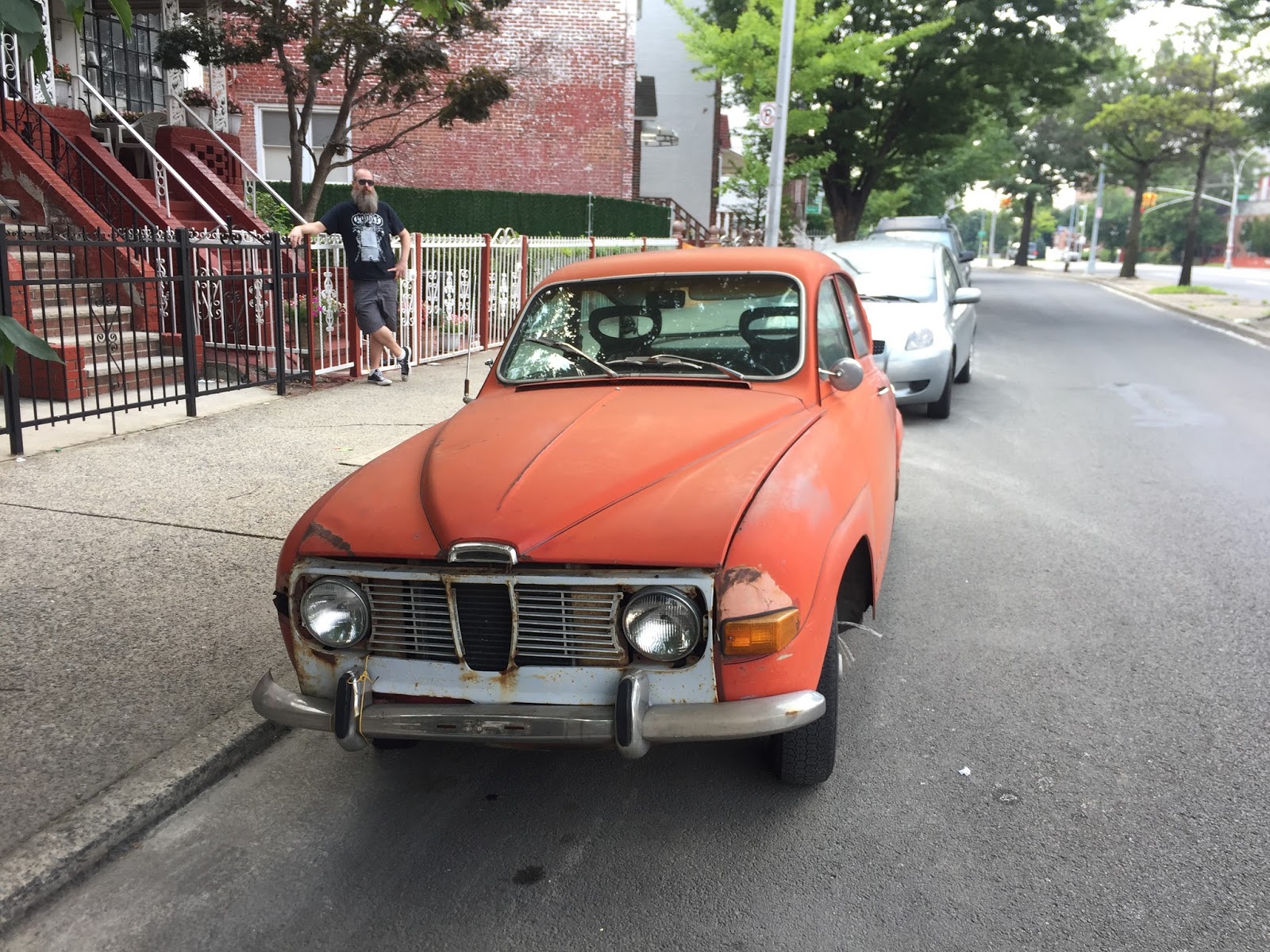
This is a 1973 Saab 96 in Burnt Orange (with a Silbermink or Silver Mink fascia around the grill). Most people don't realize that older Saabs looked like a cross between a spaceship and a VW Beetle.
Look into the grubby mouth of this well worn little punk! It looks like the "before" picture on a subway dental advertisement. The replacement fascia and bit of Bondo tell me that someone cares at least a little for this ride. That poor diminutive bumper is the veteran of many a parallel parking mishap. 
The 96 was introduced in 1960 and remained in production through the 1980 model year (though they stopped coming into the States after '73). My guess is that the tiny front bumper was the reason the '74 never made it to our shores because that year ushered in the federal crash safety regulations.
The line running along the lower body was where a piece of chrome trim once lived. I'm not certain but I think it denotes the trim level; the high end DeLuxe had 2 chrome strips, this had one, and some had none at all. In the DeLuxe the rear quarter windows were hinged and would pop open but these are probably fixed.
Saab was originally an aeronautical company and aircraft design elements made it into their cars. The very first Saab automobiles were straight-up bizarre! The engines were 2 stroke meaning that oil had to be added to the gas. The radiators in those first models were behind the engine just under the windshield. The door glass didn't roll down conventionally, just the rear edge would go down so that the front edge would remain above the sill. There are foreign cars and there are truly foreign cars!
By the time this ride was built the 2 stroke motor was replaced with a Ford V4. It was a great little engine in a tiny car and as a result the Saab 96 had a major presence in the rally world. All 96s were front wheel drive as well.
I love the slippery lines on this ride.
This old sticker confirms that the paint is original. It's hard to read in this pic but I believe this particular Swedish Motors was in Pennsylvania. The overall condition is great for a 44 year old car. 
No plates? No problem on King's Highway!
These awesome wheels are more commonly seen on the Saab Sonett; a very low to the ground fiberglass sports car built around the same time. They're referred to as Soccerball wheels.
Even beat down and tired this thing looks amazing!
This steering wheel was introduced in '73 which helps to confirm that this is a final year U.S. spec 96. The interior is straightforward and functional with toggle switches and knobs as opposed to flashy electronics.
The replacement for this ride was the Saab 99 which debuted in 1968. Instead of replacing the 96 they were both produced alongside each other until the last 96 left the factory in 1980. The 99 was remarkably modern in '68 when it hit the scene. It looked very much like the 900 that was built through the '80s and into the '90s. I've owned 3 different 900s including the only car I've ever had stolen from me! Oakland represent! 
This little punk isn't going anywhere any time soon.
These round headlights were only on the U.S. models at this point. From 1969 onward the rest of the world had rectangular headlights on the 96.
Well there we have it; an odd little import from the era when nobody in the States knew what a Saab was. There can't have been many of these sold back in '73 and very few remain on the streets today. Back in college a motorhead acquaintance bought a pair of these pretty cheap. He drove one around school and I think the other one was meant for parts even though they both ran. His plan was to set one up for rally racing. To this day I've never even sat in one of these. Hopefully someday I'll get the opportunity to drive one a bit just to see what it's like. 


Wednesday, June 21, 2017

Orange Bucket Truck

ORANGE BUCKET TRUCK
I was walking along some industrial corner of Brooklyn when I encountered this orange bucket truck:
I love the plainness of this thing! It's really very orange and the bumper looks like it's had 3 more lives than the truck itself.
I don't know anything about this beast and am not inclined to research it. Hope you enjoyed this mighty orange bucket truck interlude, and thank you for your support!

Tuesday, September 27, 2016

Keep on Vannin'

KEEP ON VANNIN'
Somewhere in the greater Bushwick area I found this Crayola-colored lunchbox. With its white outlined eyes and fun color it looks eager to please! Let's take a closer look.
This is a 1977 Chevrolet G10 Van in Tangier Orange. This style is known as the Shorty Panel since it's the shorter wheelbase and has no windows besides the cab and rear doors. This is the ultimate stranger danger model unfortunately due to its lack of side windows.
I love this van and for me a large part of the charm is the fact that it's the base model. Notice that the grill, bumpers, and mirrors are painted as opposed to chrome; every trim level above the base had those niceties as opposed to plain white.
This cool '70s logo was instrumental in pinpointing the vintage of this ride. This era of Chevy van ran from 1973-1977 but only in this final year was the number on top of a stylized sun. One thing that ran throughout the '70s on Chevy trucks is the use of that wild west font with the heavy serifs on the letters.
*The 10 refers to the load capabilities. Heavier-duty models were the G20 and G30.
I love how righteously plain this thing is. At first glance those square taillights seem to be the same as those used on Chevy trucks of the same vintage. However the truck versions are curved and wrap around the corners of the pickup bed slightly. This is a great example of lending continuity across different models from the same company.
YES!
I couldn't find a current listing for PAUL Chevrolet in Brooklyn but it's surprising that this vehicle still resides in its hometown. Being a base model van in the sort of garish color favored by municipalities makes me think this might have had some official use originally. Everything about this van screams FLEET VEHICLE. This is the sort of vehicle that brought road cones to job sites back in the day.
Plain white wheels and budget hubcaps complete the zero-frills look. That single exhaust makes me believe this ride has the stock inline 6-cylinder under its stubby hood. If it's really as basic as it looks it has a three-on-the-tree manual transmission too.
Someone added a little tinted window to the side in a crude manner.
How basic is it inside? Well there was never a radio installed which jibes with the fact that there's no antenna on the outside. Above the heater controls are two more blank squares where optional equipment would be. From here the floor looks to have a black rubber mat as opposed to carpet. Even the door panels look to be pressed metal.
This is 1977 though so even the base van has cool brown plaid seats!
Well we'll leave this orange lunchbox to roam the streets of its native borough. Evidence of a break-in on the top center of the grill probably stems from someone looking to lift the battery way back when. The customization possibilities are endless for plain panel vans like this so it's remarkable to see one so normal and untouched. I've had a few vans in my time and would gladly roll around town in this beast given the chance.

Tuesday, September 13, 2016

Mystery Mopar gets a piggyback through Brooklyn.

ABOVE THE ROAD NOT RUNNING AT ALL
Sometimes a vehicle passes by my shop in Brooklyn and by the time I recognize what I'm seeing it's long gone. Other times people are stuck in traffic. This vision presented itself the other day:
 Sweet Mopar relic! What we have here is a 1973/1974 Plymouth Satellite, Sebring, Road Runner, or GTX in what looks to be the color Hemi Orange. I realize that's a wide array of possibilities but this is a beater rolling by on the back of a flatbed! 
One detail that ought to be helpful in identifying but isn't is the Power Dome Hood. This was the standard hood for both the Road Runner & GTX but very well might've been an extra option for the pedestrian Satellite. That should be a '74 if that hood is vented, '73 if not (assuming it's wearing its original clothing).
You have to admit that it's a great silhouette. It's still athletic at this point where as the mid '70s would extend the hoods and shorten the trunks for most 2 doors.
The color looks so Mopar and perfectly faded that I'm inclined to believe it's original or a very old repaint. Regardless none of the identifying decals or stripes muscle cars of this era are so famous for are present so it could be a base model Satellite with optional hood.
The guy in the drivers seat of the truck said "it's for sale; 4 grand" when he saw me taking pics.
I asked "is it a 440 or a 383?"
He checked with is passenger and said "383".
Then I did some research and it looks like the 383 was last available in 1972 so I guess we were both wrong!
Just a quick pass by but the car looked complete and at least had a drivetrain in it. If most of the rarest parts such as interior are present this is a fine project and worth every cent of that $4,000. For now I was just happy to have an interesting ride cruising by that was snarled in enough traffic that I could catch up with it.

Tuesday, July 28, 2015

Twofer Tuesday returns with Two Twos

THE TRAVELER AND THE TOMATO
These Twofer Tuesday posts usually happen after I encounter a vehicle and remember that I took pics of a similar one months before. However this time I passed these 2 rides within days of each other. Without further ado;
High up on the hill in tony Park Slope I ran across the least expected vehicle ever for its surroundings. This is a 1977 International Scout II in Fire Orange. 
International got its start back in 1902 making agricultural equipment such as tractors and threshers. Soon after it began manufacturing trucks for farm and commercial use. Finally in the '60s it came out with the original Scout, meant to compete directly with Jeep. This is the larger, second evolution.
I owned a '79 that looked identical to this, save the color and condition. They are fantastic trucks!
These trucks want to rust so bad that it's almost impossible to hold it off. This one is pretty cherry and obviously well loved by someone.
No "shift on the fly" 4-wheel-drive here! To engage the 4x4 you need to get out of the truck and manually lock each front hub before jumping back in and using the separate transfer case shifter to select either 4 High or 4 Low. I only engaged 4 Low once in my old Scout to make sure it worked but it was basically undriveable with a top speed of something like 20 mph. Good for pulling stumps maybe.
This entire roof comes off making for a hilarious summer vehicle. The roof is metal and weighs plenty I can tell you from experience.
These beasts are super basic. From this angle you can see the front door glass is just a flat square.
The drivetrain on the Scouts is bulletproof, befitting a company that made its reputation building tractors. The engine blocks are some of the heaviest ever produced at 800lbs! They never bothered with any technology to lighten the motor so it never wears out. Scouts are known to go 300,000 miles as long as their body holds up.
Looking bizarre in a neighborhood of brownstones and mansions.
Inside we can see that this is a manual 4 speed like mine was. This one also has air conditioning as shown by the vents under the dash.
The ride height is only a touch higher than factory. Combined with the larger tires you can see how this towers over the Honda behind it.
The "Town of East Hampton" sticker on the bumper goes a long way in explaining why some colossal beach cruiser is parked in Brooklyn.
I had to get a close up of the winch, not because I know anything about winches, but because you never see one in NYC.
Now on to a more laid back version . . .
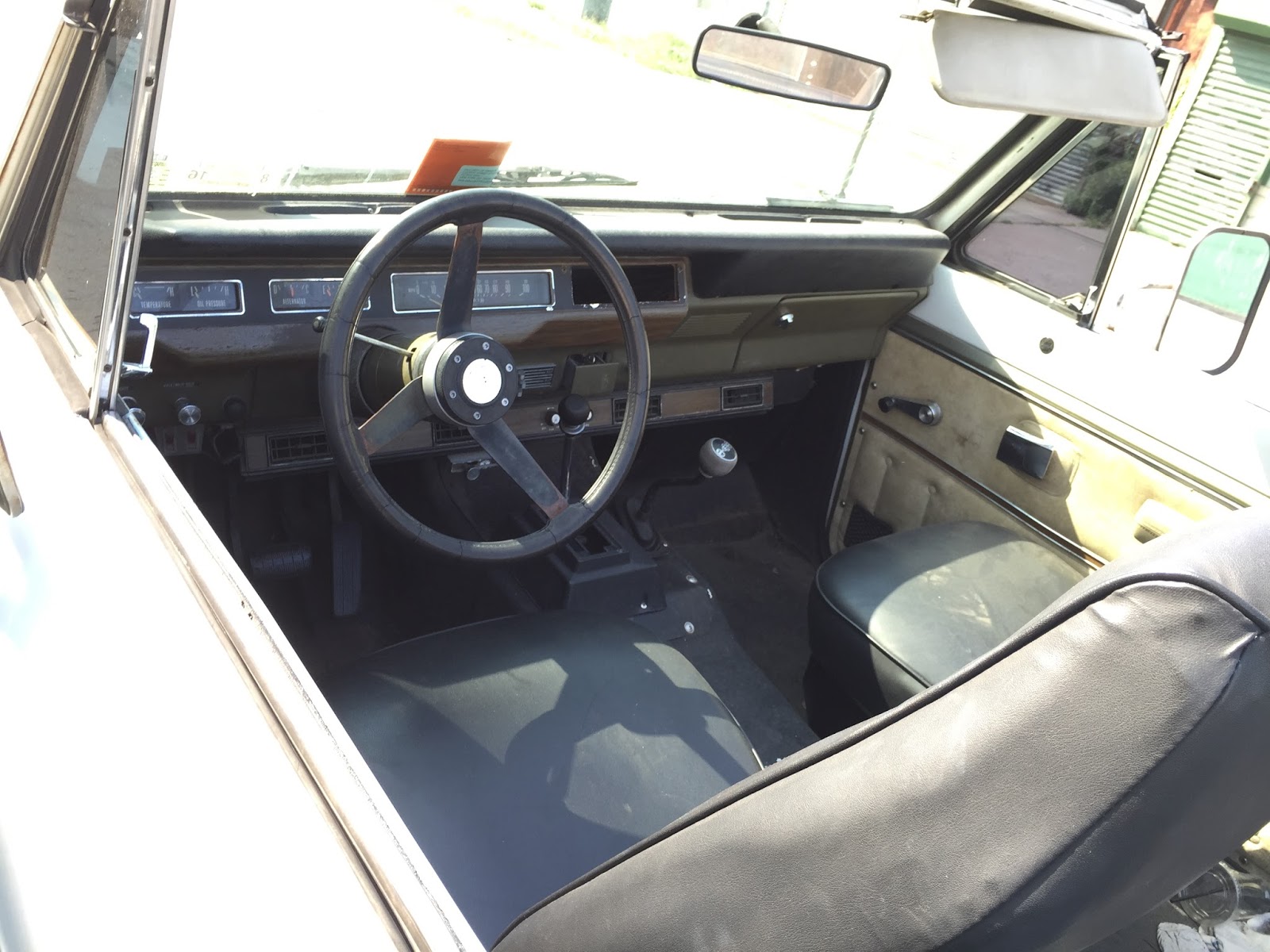
Sweet! This beast is dressed down and ready for action. What we have here is a 1976 Scout Traveler in Winter White.
You just saw how East Hampton rolls, but this is what an honest Scout is supposed to look like; rusty as hell, topless, and parked just anywhere without a single thought to security.
The Traveler is a full 18 inches longer than the Scout II. You can see the extra space between the door and the rear wheel well. The top for the Traveler is fiberglass with a slanted hatchback but who needs that on a hot week like this?
My Scout came with a full roll cage built into it and it's rare to see one without even a roll bar. They are so capable off-road but if you manage to flip it over only the puniest of windshield frames will be there to try and save your head.
There is a backseat in this ride but it's basically a flat bench with zero headrests. 
I'm confused by something on this rig which maybe somebody can help me with. From this angle it looks to have 2 gas tanks; not uncommon on a truck from the age of very low mpg. However, the front gas cap is mimicked on the passenger side as well. While there were a few trucks built in the '70s with a 3 gas tank option I couldn't find any reference to it in Scout literature. This is the sort of thing you want if you're going on some mammoth off road adventure and you need a 500+ mile range. Were the fronts actually antennae mounts or something? Who knows!
Straight-up basic Scout interior with no radio and an automatic trans. This, too, has the air conditioner though. The passenger is lucky as they get the only visor.
"Better than the floor" is how you'd describe this seat if you were in it. 
This proud donkey was flouting the law out in Red Hook where parking is such a non-issue that only sheer absent-mindedness gets you a ticket. Then again, whoever owns a convertible with no roof in sight must be pretty relaxed.
That about does it for the Scout roundup today. It is almost impossible to discern the vintage of Scouts except for the grills, which changed almost every year. the Traveler was introduced in '76 so this is the first. In 1979 International went through a debilitating strike lasting over a year which brought the company to its knees. By the time it was over they basically assembled the 1980 Scouts with parts they'd already made and closed their light truck division for good. If you see a Scout with square headlights you're looking at a rarity as it is the fabled 1980 model.