Monday, July 18, 2016

Personal luxury sleeper from the go-go '80s

V6 WITH A NAPOLEON COMPLEX
Way out on some side street in deepest Brooklyn I passed this primer Regal. Then I noticed the black bumper and decided to pull a quick u-turn to satisfy my curiosity. I'm glad I did!
Would you believe that this was the fastest production car in the U.S. back in 1987? Not only that, but it managed the feat with a V6 engine!
What we have here is a 1987 Buick Grand National that started out wearing shiny black paint all over. This was the final year for the Grand National high performance package based on the Regal. All Grand Nationals sported a turbocharged V6 engine that could (and did) blow the doors off of any V8 powered car of the same year. Even the Corvette couldn't keep up on the dragstrip and that car is made of fiberglass! The Buick GN is old tech; big steel body on a full frame, and an engine up front powering the rear wheels.
There's that proud little emblem extolling the virtues of an under-4 liter engine!
Buick had been experimenting with turbos on their cars since the late '70s. In 1979 you could've walked into a Buick dealership and purchased a Century Turbo Coupe or a turbocharged LeSabre. The Century was a good idea but the LeSabre was too big and weighty for that first generation engine. This example from '87 featured an intercooler and other upgrades for a dramatic increase in horsepower and torque.
Finally in 1982 the GN was introduced looking much like the car above. In addition you could order a Buick T-Type which was a non-Grand National turbo Regal in white or gray. However the all shiny black GN stole the show. After a 1 year hiatus it would return from 1984-1987, with the most powerful and popular being the final year. There was a special top-of-the-heap GN in '87 called the GNX (the X stands for Experimental). At about 300hp and 420 foot lbs of torque they are the holy grail of all GN collectors. 
These wheels and the T-tops are hallmarks of a GN, as are the front and rear spoilers and the wing.
I'm not buying that single Georgia plate at ALL but if you want to park with impunity on the streets of Brooklyn 1 out of state plate is all you need. It somehow makes cars invisible to cops.
I tend to think this body style has held up very well in the grand scheme of things. It's boxy for sure but the long hood, short trunk look is a fine farewell to the cars of old. Almost immediately after this was built domestic cars took on the rounded, bulbous shape of the '90s. This still looks like a car from the previous 2 decades.
I figured I'd close this out with something I rarely do; post a photo from the internet. This is what the GN should look like; menacing, powerful, shiny, and BLACK. They never made tons of these and they've been popular since new so there are no real bargains out there. However you can probably find a decent driving example for under $10,000 and it will only go up.

Saturday, July 16, 2016

Greenpoint classic round-up!

GREENPOINT CLASSIC ROUND-UP
I'm lucky to have friends think of me whenever they see an old car in the street. Several of these folks send me random pictures of classics which I love. However this takes the cake; my buddy Robin of Omaha jumped out of his cab one evening when he realized he was passing an impromptu car show in Greenpoint. All of the following pics are from this single event. I figured I'd do one gargantuan post to round them all up, loosely organized by make. Enjoy!
This is a 1963 Chevrolet C60 in Pine Green. This is the coolest, least expected classic to bring to a Brooklyn car show!
This beast looks like it drove here directly from the farm, yet somehow it's in near flawless condition. Definitely meant for work, the bumpers are painted white from the factory, as are the mirrors, grill, and steering wheel. No chrome for this monster!
This is a 1963 Chevy Impala convertible in Ermine White. This is the make and model Doughboy (Ice Cube) drove in Boyz in da Hood!
From the boat style angled antenna to the original hubcaps this thing is sweet. Also (and I say this from experience) having a white convertible top is brilliant. So many convertibles had black tops and it makes the car so freaking hot as to be unbearable. Same goes for black convertible interiors; why?!
1967 Corvette convertible in Silver Pearl Poly. This is the last year of this body style which debuted in '63. To my eyes this is the best generation 'vette in both hardtop and drop top form.
We know it's a '67 because those gills behind the front wheels are in a contained cluster where in previous years they were individual vents. The fact that the top stows away under that tonneau cover is sleek sleek sleek. 
1964 Chevy Corvair Monza in Palomar Red Poly. We know it's a '64 because that was the first year CORVAIR is spelled out on the hood but the last year of this older headlight style.
The name Corvair comes from combining parts of Corvette and Bel Air. The Monza designation meant a higher, sportier trim level. However the Monza package proved so popular that it's much more rare to find a non-Monza Corvair these days. In 1963 for instance 80% of all Corvairs were Monzas. In addition to the Monza there was the Spyder option which came with a turbocharged engine.
It looks a little dowdy and frumpy as a 4 door but the visibility is fantastic on these. The rear wheels are powered by a transaxle much like the older Beetles. The main drawback to a transaxle is that under extreme cornering you could experience wheel failure where the rim would fold under the car.
Here we have the very first year for Corvair; a 1960 coupe in Horizon Blue. The surefire way to identify a '60 is that it is the only year where that center trim piece on the front of the car doesn't reach all the way to the headlight buckets but rather sits in the middle.
It's hard to overstate how advanced this car was when it came out. The hallmark of the Corvair is that it is a rear-engine, air-cooled domestic car. Larger and more comfortable than a Volkswagen (with a vastly superior heater) but very similar underneath.
This is such an elegant design for 1960 United States when most domestic cars were gargantuan in proportion with hundreds of pounds worth of chrome trim dressing them up. Due to it's light weight and 6 cylinder engine the acceleration was comparable to the full-size Chevy Biscayne. It was wildly popular throughout its 1960-1969 run but the Ralph Nader book Unsafe at Any Speed targeted it and the Beetle as examples of machines that will kill you. THANKS NADER. Why don't you go ahead and skew an important election too you wet end!
This dilated beast is a 1965 Pontiac Grand Prix in what might be Nightwatch Blue. The Grand Prix was a combination of brute force and luxury in a 2 door coupe. The last thing on anyone's mind in '65 was efficiency. This is a full-size, heavy car with a huge 389 V8 as the standard engine. You could also get a higher horsepower 389 or your choice of two 421 V8s with either an automatic or manual transmission. Having a 421 Tri-Power (3 double barrel carbs) hooked up to a 4 speed manual trans in this ride would make it a monster. It would also get about 8 to 9 mpg.
Massive 2 door bruisers like this would continue on through to the end of the 1970s though the bottom would drop out in terms of horsepower. However in '65 it was all go and all show.
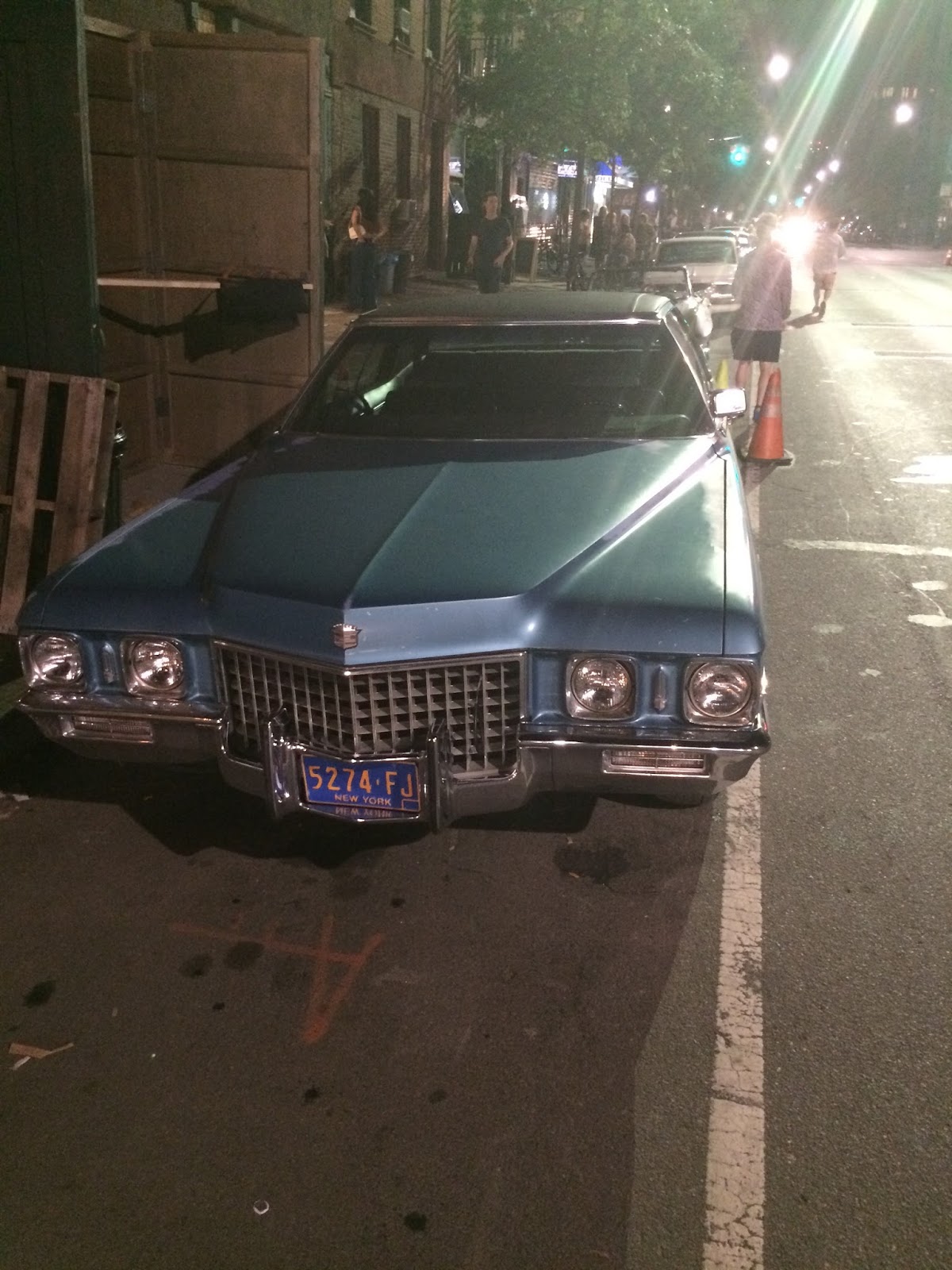
Here we've got a 1971 Cadillac Coupe DeVille in Bavarian Blue Firemist. The Firemist color line was available on Cadillacs from the '60s through the '70s and featured uniquely shaped metal flakes that made the finish shine like crazy. I had a '74 Caddy with Seafoam Firemist Green and it was beautiful in the sunlight.
The only difference between this and the 1972 model is that the grill is an egg crate design where the '72 sported horizontal lines only.
As luxurious as these cars were they are legitimate hot rods too. The engine is the mighty 7.7 liter 472 V8 rated at a whopping 375 horsepower. My own '74 Caddy had a slightly lower HP rating due to emissions equipment such as a catalytic converter but it would still do a standing burnout until you decided to let off the gas (look I was 17 and had priorities). Remember the Cannonball Run? In real life a bone stock '72 Coupe DeVille like this one placed third in that coast-to-coast race while having the highest average speed of 84.5 mph. It could do this while remaining almost silent too.
This is a 1964 Ford Falcon Sprint convertible in Pagoda Green. This is the same year, make, and model that the Rodriguez Brothers drove in the Greatest Movie of All Time; REPO MAN!
We know it's a '64 because the grill was simplified for '65 and the convertible was only offered in this generation of Falcon for '64 and '65.
This car is identical to the then-new Mustang under the sheetmetal. Since the Mustang was a genuine article game changer for the automotive world these Falcons never really took off like they should have. They would quietly fade away over the next 6 years.
Next up we have a 1966 Ford Fairlane in probably either Nightmist Blue or Ivy Green. The stacked headlights debuted in '66 and the following year introduced several vertical bars to the grill so we know the vintage for sure.
This was the mid-size offering from Ford in '66 and any number of engine and transmission combinations could be ordered. For the little old lady going to church there was the 200 inline 6 cylinder engine. However if you were so inclined you could order the mighty 427 V8 that turned this into a serious stock race car. I believe this example is an XL edition which was a higher trim package. The bright rocker moldings and fancy hubcaps would be included in this.
Here we've got a 1964 Mercury Comet in Platinum Beige Poly. This is an upmarket version of the Falcon and likewise shares most of the mechanicals with the Mustang. The entire front end is '64 only.
Being a Mercury it has more formal lines that the Ford. In this era the compact cars (which this is) looked much like their larger siblings.
We're sticking with a Mercury version of a Ford again! This is a 1972-1973 Comet in Light Blue. This car is 100% Ford Maverick with fancier trim.
The 2 door fastback body style shown here is a good approximation of the Mustang of the same era. The vinyl roof treatment that leaves the sides untouched is unique to the Comet.
Hidden in the shadows is a 1969-1971 Lincoln Mark III in what I think is an aftermarket green. Lee Iacocca was the president of Ford when he decreed that the designers should put a Rolls-Royce grill on a Thunderbird. That's basically what this is; a Thunderbird frame and underbody with lots of luxo doo-dads hanging off of it.
The Lincoln 460 V8 propelled this beast which was a good thing as it weighed 300lbs more than a Thunderbird. Incidentally this was the bad guy car in the French Connection; all of the heroin was stashed in the rocker panels of a brown Mark III.
This is a 1964-1965 Plymouth Barracuda in White. The Barracuda beat the Mustang to the marketplace by 2 weeks, a fact that nobody knows or cares about because the Ford was so much more popular.
That huge 1 piece wraparound back window is the definitive feature of the 1st generation Barracuda styling. Under the skin this car is basically a Valiant or Dart with the same range of engines. We can see from the front fender emblem on this ride that it is equipped with the 273 V8 engine.
And here is the sibling to the white Barracuda! This is a 1964 Plymouth Valiant in Turquoise Poly. This is the standard grocery getter for the '60s.
Chances are this was built with the legendary slant-6 engine. These cars are dead reliable and oh-so easy to work on. I've had a couple slant-6 powered Mopars from the '70s and they are the best classics I know of for daily use.
Well that wraps it up for the colossal round-up provided by Robin of Omaha. I'm assuming that most if not all of these rides reside in NYC so I'll keep my eyes peeled for them in the future.

Wednesday, July 13, 2016

Twofer Tuesday/Wednesday returns with 2 1970s cars that couldn't be more different

TWO SIDES OF THE 1970S COIN
I was on my way to drink these delicious watermelon tequila drinks on the sunny rooftop of Brooklyn Crab in Red Hook when I spied this little punk through the bars of the Fairway parking lot:
SWEET! What we have here is a beautiful 1977 Honda CVCC Civic in Forel Blue. We know it's a '77 because the grill and hood design only lasted from '75-'77 and this great color was introduced in 1977. This is the car that really put Honda on the map. The CVCC stood for Compound Vortex Controlled Combustion. Basically the design of the heads and fuel mixtures burned so efficiently that these cars passed stringent emissions without a catalytic converter.
They are also so tiny and cute that parking was easy and the fuel economy staggering.
One great anecdote about the CVCC is that the CEO of GM was asked about the technology and why it wouldn't be used in their cars (Ford and Chrysler had both licensed the technology from Honda). The GM boss stated that he had studied the design and "while it might work on some toy motorcycle engine I see no potential in using it in one of our GM car engines".
Word eventually got back to the great engineer and company founder Soichiro Honda. Soichiro took it upon himself to buy a brand new 1973 Chevy Impala with a 350 engine and have it freighted to Japan. He instructed his designers to build a CVCC unit for installation on the mighty GM powerplant. Afterwards he sent the CVCC equipped 350 Impala back to America for testing by the EPA. Not only did it work but it blew the emissions numbers of the catalytic cars out of the water. The moral is this: don't tell Soichiro Honda what can and can't be done!
The Achilles Heel on these rides was their prone to rusting out. The problem was so dire that Honda recalled all cars for front fender replacement on the condition that rust had taken hold within 3 years of it being sold new. Unfortunately that was the case for most CVCCs sold in states that used salt on the roads.
But enough of that innovative world-changing Japanese design. How about some good old American hubris I discovered last time I was in Alameda California?
 This unapologetic beast is a 1973 Chevrolet Chevelle Laguna in either Tuxedo Black or something close to it. The Laguna was the top of the heap for Chevelles produced from 1973-1976. The main styling difference is the front bumper being incorporated with the grill and lights into a single polyurethane unit not unlike the Pontiac GTO Endure Front of the day.
This was the era of Colonnade styling where the rear window was steeply raked and the thin pillar behind the door could support the body weight in a rollover crash. In '73 the regular Laguna sported this small opera window in the side of the landau vinyl roof. However you could also order a large quarter window that reached back all the way to the rear window.
I dig the Chevelles of this era as it manages to still look pretty tough even though it's a large car (for the record this was a mid-size Chevrolet in '73!). The four round lights in the back are similar to both the Camaro and Corvette, and the Colonnade roof give it a very forward-leaning stance. This is the same year that Ryan Gosling drove in Drive (though his was a Malibu; one step down from the Laguna). Even with the back bumper painted black and those Flowmasters poking out from underneath I would proudly roll in this ride.

Thursday, July 7, 2016

Almost mint condition grocery getter from 47 years ago

LEAST LIKELY TO SURVIVE SURVIVOR
I was riding my bike out to the Rockaways when I passed this anomaly parked at a dealership:
How? Why? Who knows but this is certainly a 1969 Dodge Coronet 440 in plain-ass White. How it survived in this condition is a true mystery that must have included a garage and a little old lady. This was the year that the iconic General Lee Dodge Charger of The Dukes of Hazzard fame was built. The same company made the Super Bee and Coronet RT performance models. Yet somebody went into the Dodge dealership in '69 and shook their head no to every nicety, probably clutching an ad with the base price listed on it.
The front and rear styling are identical to its fire breathing siblings but otherwise this is the classic grocery getter 4 door. I'm always more fascinated to discover a well preserved basic classic that wouldn't be worth restoring financially than a high dollar model. You can turn on the Barret Jackson auction and see Chargers and Super Bees cross the block all day long but how often do you see this?
That single strip of chrome on the lower body means that this is the 440 model. Confusingly this does not mean the engine is a 440. In fact you couldn't get a 440 V8 in this trim level; you would need to order an R/T for that. Chances are excellent that this came with the 318 V8 or even the base 225 Slant-6, maybe with a three-on-the-tree.
The 440 sat below the Coronet 500 and above the base model Deluxe in the hierarchy. The lowly Deluxe had no side chrome whatsoever and could be had with black rubber mats instead of carpet, and no heater installed if you were really cheap.
Those little objects on top of the fenders above the headlights contain fiber optic cables that go to the turn signals so the driver can see when the bulb needs replacing.
Too bad somebody smashed the window and scuffed up the rear quarter because otherwise this car looks to be in mint original condition. Those dog dish hubcaps add to the frugality. Many of these 4 doors were fleet vehicles that lived brutal lives as taxis and police cars.
The taillight treatment can help identify the trim level too; the 500 would have had three large rectangular openings with the center one being a reflector that looked like the taillights. On this ride the inboard 2 lenses are reverse lights.
It might seem strange to have a raised line running down the center of the trunk lid but it was to add rigidity to what was basically a huge flat sheet of metal.
I was genuinely shocked to see this parked at a dealership with 69 in the window like that was the sort of thing they sell every day. Months later I saw this same car parked in front of a garage elsewhere in Brooklyn so somebody took it home. I myself would be proud to lean back over the front seat and manually crank down the back windows for a cruise in this beast. Hopefully since it made it this far it will continue to be loved and cared for.

Tuesday, July 5, 2016

Twofer Tuesday returns with a couple of Malaise-era barges

"MY 98 WAS 87 ON THE RECORD YO"
I was ambling along the tony Carrol Gardens neighborhood when this schlub got in the way:
This grubby slab is a 1983 Oldsmobile 98 Regency Brougham in White. It is filthy and beat.
That octagonal hood ornament is nowhere to be seen on every Oldsmobile 98 I can find from '79-'84. My guess is that it was snapped off at some point when the car was somewhat new and that sort of thing was common, only to be replaced with a Pontiac Grand Prix or full-size Buick hood ornament.
This was the full-size pinnacle of luxury for Oldsmobile customers in 1983. Everything about this ride says ancient technology; big carbureted V8 up front, rear wheel drive, body on frame construction, and more thought to cushy plushness than performance.
This beast is a veteran of the Brooklyn streets! You can see that the owner has welded on additional huge bumper guards to augment the smaller factory ones still in place. They've also screwed the thick black rubber to the front of the guards after heavy use.
 There are reasons most cars are some sort of sandy beige gray these days; they tend to hide the everyday grime and wear better than say a white car like this. White cars show every grain of dirt and impending rust just like black cars highlight even the smallest scratch or scuff.
Love the mismatched $15 plastic hubcaps Mr. Luxury Owner Bro.
In between the front and rear door glass you can see a vertical black rectangle. These were the original opera lights typical of Malaise-era luxo barges. When new they would cast a white glow when the headlights of running lights were on. There are no bulbs to replace as they are actually electroluminescent panels; printed layers of phospor onto a surface that conducts electricity. The result is a glow much like a nightlight. Much to my astonishment I found a 10 page tutorial online on how to restore them on your Malaise yacht. Thanks Internet!
Whoa! Up close the roof is NASTY to the point of absurdity. This thick icing treatment might be waterproof but it looks like it was applied by the same little old lady that "touched up" the Jesus portrait on a Spanish church wall a few years ago.
The overall design inspiration for this ride was a brick. Those have to be the biggest reverse light ever put into production.
This corner sums up this ride perfectly; more welded bumper guards, white touch-up paint directly over the pinstripe, and more silly putty filling up the space between the bumper and the body. At least he placed several plastic reflectors to the bumpers in case you were about to miss this beast somehow.
Something that feels strange to type is that this is actually a much more aerodynamic redesign of the 1977-1980 version! That actually was an almost perfect square.
Being a full size American car these still sold very well to everybody accustomed to such things. As hard as it is to imagine now there was still a great deal of animosity towards Japanese and German imports in 1983. My own grandfather flat out rejected a Honda my aunt purchased new until she lead him out to the metal plate on the doorjamb where he could see that it was built in California. If you want a glimpse into the state of domestic auto production I highly recommend the first film by Michael Moore called Roger & Me.
Don't you just love German Black Forest Cake?
This Regency and Brougham emblems denote the highest of gaudy luxury. It included extra plush velour seats, deep carpeting, this sweet formerly-vinyl roof, and of course those opera lamps.
Is this where I should feel bad about pointing out all the home repairs? Naaa.
Now that's a lock! Your puny Club means nothing compared to my armored neckbrace that actually contains the entire ignition switch!
The AM/FM Stereo in the dash has no cassette player that I can see. The year before this one was the last for the 8-track player in Oldsmobile. Amazingly there was the option of having an 8-track player installed by the factory in certain GM trucks all the way through the 1988 model year. Incidentally that was the year the last 8-track commercially produced came out; Fleetwood Macs Greatest Hits.
Well let's just back away from this dirty slab of cream cheese and gaze upon its sibling.
Here we have exactly the same year, make, and model in Black (though it is NOT a mighty Brougham). This one is in great shape!
This is the correct hood ornament for the '83 98.
The lack of a side parking light between the lower edge of the bumper and the wheel is an indicator of the non-Brougham model.
This ride is parked near my shop and is definitely someones pride and joy. These were winter pics when every car gets dusty but this car is usually gleaming.
The Ninety-Eight name originally meant full-size 90 Series with an 8 cylinder engine. The meaning was moot when 6 cylinder engines became available as standard from 1981-1982.
This is the standard placement for the non-Brougham opera lights. Most look like this; faded and cracking from the sun and utterly devoid of lighting ability.
This car has a small handful of aftermarket doodads but it's just short of too much. The fender skirts might have been an option, but the mudflaps and chrome visors over the side windows are add-ons.
We can see a couple of hail-Marys to curry favor from the cop running your license on the bumper; 2 American flags and an NYPD sticker. There were also a couple of police stickers attached to the windshield on the drivers side.
The black wheels look pretty tough on this ride.
There isn't much else to say about this black beast. Chuck D used to brag about driving his Olds 98 on his first couple of albums. Eventually though his "98 was 87 on the record yo, so now (he drove) Bronco". Rolling effortlessly from GM to Ford? Chuck D is a magnanimous customer.
Well there we have it; two of the biggest last-gasps of the Malaise era. The punitive Federal bumper regulations of the '70s were rolled back in '84 meaning that these were the last vehicles with egregiously massive guardrails hanging off the ends. The following year would be the last for rear-wheel drive 98s. It also happened to be the first year for the FWD replacements making it possible to go into a dealership and have the old and new next to each other for sale. Whatever, over and out.