Showing posts with label 1970. Show all posts

Tuesday, April 18, 2017

There goes the neighborhood

POSSIBLY THE GRUBBIEST CAR I'VE EVER SEEN
I was strolling along next to Prospect Park a few weeks ago when a great dark cloud sucked the sun out of the sky. What wrath was about to befall our great city? Behold the horror of Windsor Terrace!
This is a 1970 Cadillac Sedan DeVille in Bayberry Green. It is in truly horrific condition throughout. Astonishingly it has a matching set of plates and current registration & inspection stickers in the windshield. Who is the mechanic who put their certification on the line in approving this heap?
I can't blame the public for shoving garbage in the mouth of this behemoth.
This is as close as you can get and still imagine this as a usable car.
I started this blog way back when with a 4 door green Cadillac that was beaten almost to death in the East Village, yet somebody kept driving it. I'm going back to my roots with this thing.
AAAAAGGHHH!!!!!
What is this nightmare?! Some lady asked me "Is this your car?" while I was snapping these pics. A small laugh escaped my lips in the "you must be joking" ilk before I managed: "No. NO! My god does anybody actually own this?"
She said yes indeed and it makes it across the street for alternate side parking regulations every week!
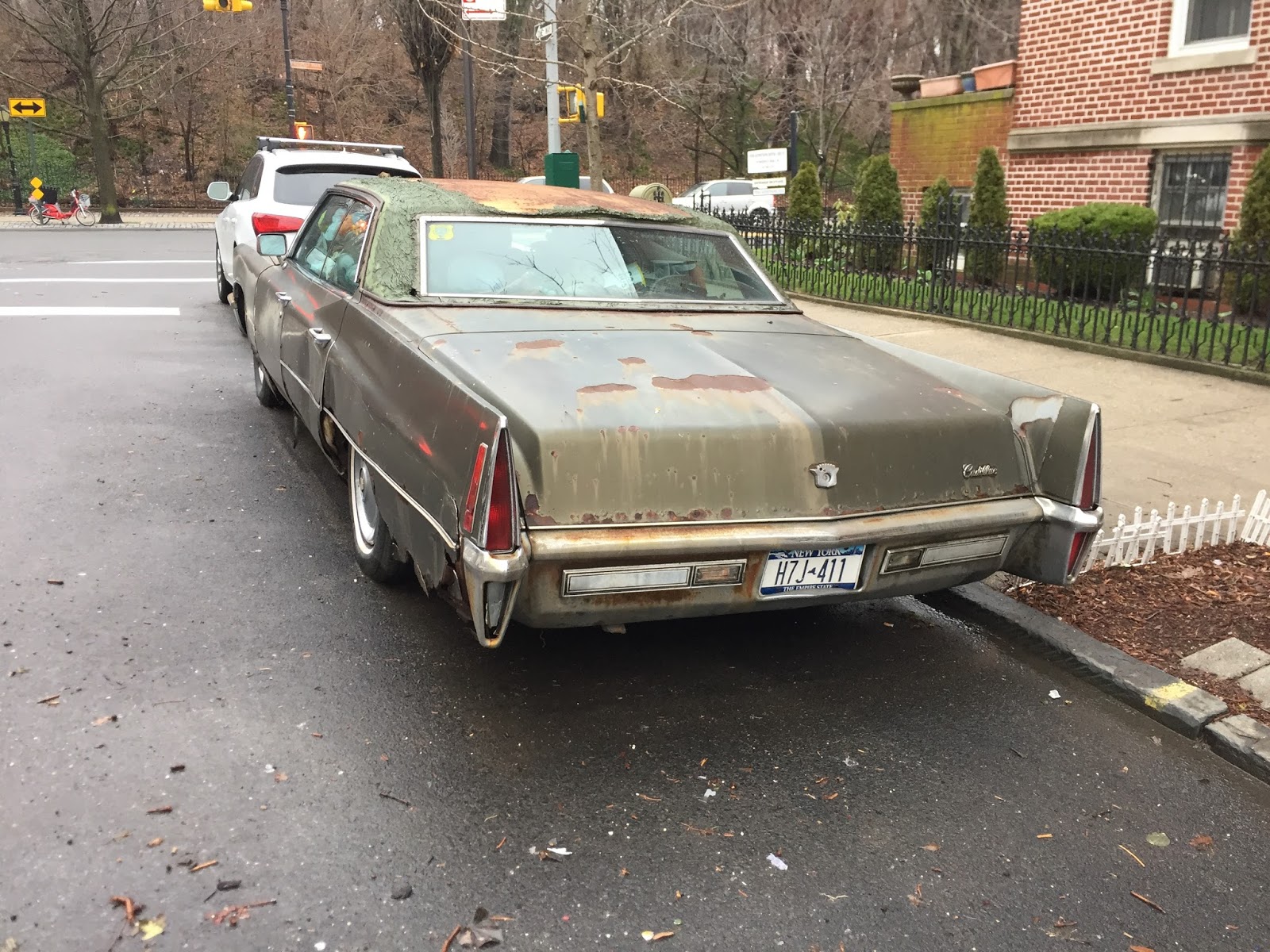
I love big old Cadillacs. My grandparents kept a steady supply of these enormous brutes going from their hands down through the family tree when I was young. My father had a '74 Eldorado. I had a '74 Coupe DeVille in high school. Even I can't find a single redeeming quality about this ride.
When you get closer it just gets worse. I think you could actually kick this car to pieces in 10 minutes or so if you didn't mind getting it all over your shoes.
I've been on the receiving end of some highly questionable inspection stickers in the past but this car really takes the cake. If your horn or reverse lights don't work you can always claim they went out that very morning if you get pulled over, especially with an old car. Maybe this would pass in the lights and brakes department but the suspension looks seriously saggy. Mostly though this is a rolling red flag if I ever saw one. If this were a building it would be condemned. 
Let's squint hard for a second and try to look at the original design. These pointed taillights are some of my favorite from Caddy history, second only to the '59 fins a la Ecto-1.
This thing needs a toupee stat. When vinyl roofing has an opening moisture can get underneath and wreak havoc on the metal. There are at least two holes in the roof itself above the passenger side front.
This has the GM Halo version of the vinyl roof where a strip of body colored metal surrounds the edge above the windshield and side windows. Dig the sheer scale of the trunk in this pic!
Looks like she's sporting 3 out of 4 Buick hubcaps from around the same era. I'm a fan of how massive these front bumpers are where they go back far enough to outline the wheel well.
Somewhere behind all that mouth trash lies a 472 V8 good for 375 horsepower from the factory. A showroom stock Coupe de Ville placed 3rd in the real life Cannonball Run with this same engine. It managed the highest overall average speed of 85mph too. These cars can really move despite their size.
Well that's where we'll back away from this frightening vision. People love to bemoan the loss of "old New York" and claim that the more run down version was their favorite. To those folks I suggest they go down to Prospect Park Southwest around 11th Avenue in Windsor Terrace. Cars like this used to be burned out and abandoned all over the city. Enjoy your lunch leaning against a big fender before depositing your litter in the grill for a trip down memory lane.

Thursday, December 29, 2016

Escape Machine

ESCAPE MACHINE
I was walking around the area of Grand Army Plaza in Brooklyn when I saw this unlikely survivor in great shape:
This is a 1970 Oldsmobile Delta 88 Custom in Viking Blue Poly. Oldsmobile called all of the vehicles in their 1970 lineup Escape Machines. As large and in charge as this ride is it was still just the midsize offering from Olds in '70 with the colossal 98 being the flagship.
This is the standard 4 door car of the day positioned between Buick and Pontiac in the GM hierarchy. Power comes from either 350 or 455 V8 engines mated to an automatic transmission (the 4 speed manual was discontinued after '67 for the Delta 88). This ride was built in the same year that the Environmental Protection Agency was established which would go on to control the amount of pollution automobiles produce. However in '70 the engines were free-breathing without emissions controls and exhaust went through mufflers whose only purpose was to lower the volume. 
The panel fit is pretty bad on this ride as shown by the hood gap. This car gives the impression of being used as a daily driver parked on the streets even though it is in great overall condition.
There are aftermarket doodads on this ride I don't agree with like the wheels and that cheesy wing. The lines are great though with the flared fenders from the factory and integrated bumpers.  The lack of side trim going down the middle of the body makes for a clean look.
Like any veteran of the city streets this has an anti theft device. There is a heavy duty metal collar padlocked around the steering column holding the gearshift in place. We can see from this angle that the climate control systems are out of reach from the passengers. Cadillac had similar placement.
The vinyl roof is in perfect condition which is remarkable for a 46 year old ride. I'm guessing this spent its first few decades in a garage somewhere.
Somebody gave this beast a good knock, taking out the taillight in the process. I suppose the 3 is for the late Nascar racer Dale Earnhardt Jr. but it's not the correct 3. Who cares?
This is the pillared sedan where the door frame goes around the windows. There was also a 4 door hardtop where the opening would be unobstructed when the front and rear windows were down but they lack the rich chrome surrounds that this model has. From this angle you can see the rectangular pattern of the seat leather.
That's where we'll leave this blue beast. This is a 1 year only design as the '71 ushered in a different front where there was a pointed prow on each side between the headlights. The year before this had the headlights contained within the grill openings. 
To see a non-sexy body style like this standard 4 door sedan in great shape is curious in the States but that's not true around the world. In Australia and New Zealand 4 door sedans make up most of the classic muscle cars. Here in the U.S. convertibles, hardtop coupes, and station wagons are all more valuable and sought after than sedans, but that's what makes this one special. If you want a usable classic and one of these comes up for sale you can rest assured that all parts are still available and the price ought to be reasonable.

Tuesday, June 21, 2016

Twofer Tuesday returns with a couple of Rockets from coast to coast

ROCKETS COAST TO COAST
On a brutally hot day last summer I stumbled upon this imposing beast around Kensington:
This is a 1970 Oldsmobile Cutlass in Matador Red with 2 big black stripes on the hood that I'm 90% sure were added later. These cars are cool in just about every configuration.
This was built in the middle of Oldsmobiles heyday. Their popularity soared throughout the '60s and never stopped climbing even in the dark Malaise era of the late '70s. The 1976 Cutlass was the best selling car in America. It managed to hold that title for years after too. Cars like this are arguably why it all really got going.
There were so many body styles available for each iteration of Olds in '71 that it's a wonder they didn't saturate their own market. You could get a Vista Cruiser station wagon with skylights in the roof, a convertible, 2 door coupes in hardtop and pillar versions, and 4 doors with and without pillars as well. In addition to that the base model was still known as the F-85, with the Cutlass above that, Cutlass Supreme higher still, and the mighty 442 at the top. Break it down even further and you could choose between the Sport, Holiday, or Town version of most of the above. Whew!
This is what I believe to be the lowest production number (with the exception of 442 convertibles and the '70-only Rallye 350 special editions) body style available; the 4 door hardtop Holiday. The 4 door Town Sedan had pillars between the front and rear door glass, ruining your holiday.
The opening when all the windows are down is colossal! There is a reason 4 door hardtops were referred to as hardtop convertibles. This body style was doomed later in the '70s when rollover safety regulations went into effect.
That CS emblem on the vinyl roof denoted a Cutlass Supreme. This was the highest trim level which got you all the little chrome doodads and niceties. All 442s were essentially Cutlass Supremes with the 442 option package. While 442s were only available in 2 door coupes and convertibles in '71 there were ten 4 door versions built in 1964 when it was an option available for anything but the wagon.
This one's getting a little munchy around the edges.
Even flaking apart this thing looks tough and ready to run. Dual exhaust is promising.
The taillights being integrated into the bumper was a signature look for Oldsmobile for many years. The taillights alone can be used to identify the year.
This looks like a dog just started chewing on it. I don't know what hail-Mary attempt that brown smudge is supposed to be but my man should just get to sanding and welding because it's long gone.
Sure this is a big car, but the proportions are pretty good due to the exaggerated Coke Bottle styling. This was the smallest offering from Olds in '70. The larger Delta 88 and full size 98 were both monumental in scale.
Getting into engine possibilities would fill up an entire page but suffice it to say that this probably has a 350 or 400 in it. If there were an SX badge on it we would know it had a 455.
Now onto the dusty cousin of Big Red:
This is a 1971 Cutlass in Palm Green Poly. Unlike the above Cutty this is not a Supreme but a standard Hardtop Coupe. It was also discovered in Oregon so no matter how filthy it is 100% rust free. 
Notice the larger grill openings which would continue for '72. The three horizontal chrome bars in the grill were '71-only.
I've always loved this year and think the look holds up today. As opposed to hood scoops you can see the grill openings are bulging out of the body like flared nostrils.
I would love to have run a hose over this thing as it seemed flawless under the muck.
That line running from the trailing edge of the bumper up over the quarter panel and around the rear window is sweet! The folded paper crease of the bumper keeps everything clean too.
I've seen variations of the '71 model year where OLDSMOBILE was spelled out on the trunk in individual chrome letters as opposed to being imprinted on that piece of trim on the lip of the lid. Perhaps this is the non-Supreme treatment?
Here's an angle where we can see the same pronounced rear wheel swoopy arches that the red '70 has. That tiny emblem on the sail panel of the vinyl roof is just the Olds rocket symbol as opposed to CS if it was a Supreme. I would love to own another Olds of this general era; easy to work on, responsive and quick, and almost every part is widely available.

Thursday, April 28, 2016

Twofer Thursday (?) comes through with a Grand Prix Fixe

LAST MUSCLE DAYS AND THE DAWN OF MALAISE
Well it's been a beautiful spring week here in Brooklyn and the cars are starting to roll out of their winter hiding spots, rubbing their eyes and shaking off their hibernation. This first ride arrived on a block near my home recently:
Here we have a 1970 Pontiac Grand Prix SJ in Baja Gold Poly. This is an interesting car, as the Grand Prix was Pontiacs full size luxury coupe throughout the '60s before the name was transferred to this smaller midsize platform in '69. This change, along with the fact that these were still the days of huge free breathing engines, made the GP a luxurious muscle car.
Even though it's midsize this car has the distinction of having Pontiacs longest ever hood.
This thing looks like a bully with the back jacked up and some dents.
This car doesn't give a shit about mouthing off in the bar! No, this thing wakes up with the occasional black eye and just heads right out to work. The bumper guards are doing their best so far but this beast has been around.
As usual the grill is a great reference point when assessing the year of a '60s to '70s GM product. In '69 the grill inserts were horizontal as opposed to these vertical slats. This prominent schnoz was aped on the 1971 Thunderbird.
The standard engine was the very capable 400V8, though a 455 could be ordered for the first time this year. Emissions equipment like catalytic converters and smaller ports within the engine were still years off so this thing could get up and go.
This car dwarfs everything else on the block. The hinges for that hood needed to be extremely robust.
This small series of faux gills replaced the Grand Prix nameplate in '70. The wheels are stock originals, but missing the red center which said PMD for Pontiac Motor Division.
Lots of little rumples all over the body. Scrapes along the side. This thing has been driven and parked on the mean streets of Brooklyn since new.
Curiously enough this was where the faux gills were the year before.
The interior looks pretty good when considering the amount of damage sprinkled about the exterior. That wrap-around cockpit would continue on through the '70s, with a similar steering wheel and gauges as well. Too bad it's not a stick shift!
These door handles are a bit of a novelty; press in on the grooved left side and the handle pops out to the right.
These slotted lights are pure Pontiac. The turn signals on the larger Grand Prix from '67-'68 and the first iteration of the Firebird had a similar treatment.
Gold car = trunk full of gold! At least that's what somebody was thinking when they mercilessly tore the lock off of the trunk.
From what I can gather the taillight on the left with the chrome lines is correct. The right side seems to be a replacement from a '69.
From what I could find Atlantic Pontiac was located where a huge auto parts store now resides between Grand and Classon Streets. Being that that's around 2 miles away it doesn't seem that this car has left the vicinity in 46 years!
Time to move onto the younger sibling of that gold bruiser:
What we have here is a 1972 Grand Prix in Starlight Black. After the '70 model year outlined above the front was changed from quad headlights to a pair. The '71 looked much like this one but didn't have that crosshatched grill pattern.
Something about the single headlight bulging out of the hood on each side gives this car a menacing air. Black is the right choice for this beast. I like how Grand prix is written between the grill and the right light. It's pretty uncommon to see a name placement right on the face.
This was parked a block from my shop at a combination fix-a-flat and rim shop. Occasionally cool old rides will show up.
Very thoughtful to leave the vinyl around the lettering on the roof. Tearing off the material is actually a smart move as any moisture trapped under the vinyl will rot your roof out completely.
*Nice to see an old police sticker on the window. I remember when common belief was that if you had any sort of police sticker on your window your chances of getting a warning rather than a ticket went up dramatically. 
Much of the body is similar or identical to the '70. The trunk now has that V prominence mimicking the hood, but the quarter panels are the same.
Another clue that this is a '72; the triple taillights were added this year after only 2 per side the year before. The lines on the trunk allude to its larger cousin the Buick Riviera Boattail of the same year.
Here is the red centercap missing on the gold car.
Everything is the same inside as the gold car with the exception of this bench seat.
This was the final year before a redesign that added size and weight in concert with lowered horsepower. You can just see the beginnings of the Malaise Era in this ride; personal luxury coupe, vinyl roof. long hood/short deck combo, etc. It didn't really take hold until the following year, which is roundly accepted as the beginning of the end for American automotive design.