Showing posts with label gold. Show all posts

Tuesday, April 25, 2017

Park Slope Swinger

PARK SLOPE SWINGER
I was a block from my house when I walked past this sweet beauty:
This is a 1972 Dodge Dart Swinger in Honey Gold. It sure looks like Honey Gold or honey mustard. I want to dip a chicken nugget right into it.
I love this car as I do all Darts from the larger 1960 original through 1976 when the baton was passed to the Aspen (the newer Darts share only a name with these cooler, earlier examples).
Pinpointing the year on a Dart means paying attention to the grill. This (the 3rd) generation lasted from '66-'76 with the body pretty much untouched. The grills changed every year.
Chances are excellent that this is equipped with the 225 Slant Six cylinder engine though it might have the 318 V8. Both are legendary for their durability, eclipsing anything else on the road by a solid 100,000 miles. It wasn't until the improved Japanese imports of the '80s and the Diesel VWs powered by Mercedes engines that there were other cars good for several hundred thousand miles.
This seems to be a lovely original example. The dot of rust in front of the rear wheel is almost reassuring in its honesty. While we're on this angle dig that intensity of the concave rear window!
Here we have one of my favorite details: the fiber optic powered turn signal indicator that does double duty in reminding you that you left your signal on as well as giving a heads up that you need to change the bulb.
This is a pretty sweet original interior! The drivers side is almost always torn at least a bit.
From those under dash vents we can see that this ride is outfitted with air conditioning. There is also a radio in the dash. The '72 Dart sales brochure brags that it was the first year am/fm was available in a Dart! Lower your expectations folks and you'll rarely be disappointed.
That single exhaust means that this is not equipped with the awesome 340 V8. Cars that have that motor are highly sought after today.
This design pleases me with its folded paper lines and clean overall look. The last Dart convertible was built in 1969 which is a shame. When you see the flat body lines going right past the roof to the front it seems a natural drop top shape.
I guess the paint is original! The fact that this sweet ride was sold new in Brooklyn and remains in the borough to this day is remarkable.
The vinyl top is immaculate. Once moisture gets underneath it will rot the metal underneath. This must have been garaged its whole life.
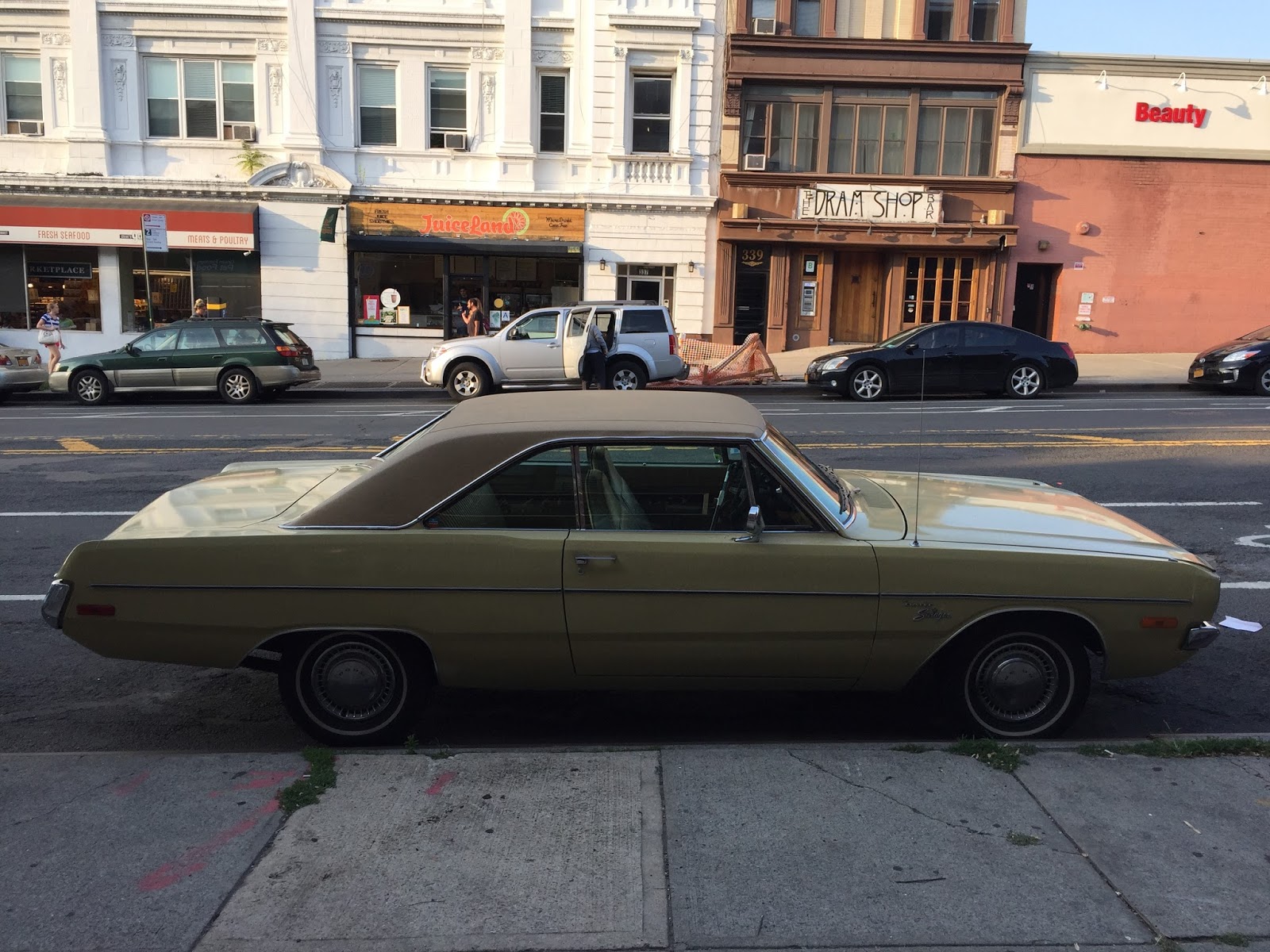
This was a compact car in 1972 America, and to this day it is a very parkable size.
The Swinger name with its awesome flower dotting the I was the name given to all coupes.
Well there we have it - one of my favorite cars of all time. Over the years I've owned both a '72 Plymouth Duster (a twin sibling to this ride) and a '74 Dart. Both had the 225 Slant Six and both were spectacular cars. My Duster was the greatest value of all time. I bought it for $60 (yes SIXTY DOLLARS) and delivered pizzas with it. It paid for itself in a shift or two. Then I had to replace the transmission with a $300 unit. Once the new trans was installed I drove it from Rhode Island to New York every weekend as well as trips to Philly, Baltimore, New Hampshire and Maine. Somebody ran a stop sign and smashed into it but their insurance company gave me $700 for it and I sold the wreck for an additional hundred. Fantastic cars!
PS - the Duster was gold with a green faux snakeskin roof from the factory!

Wednesday, June 22, 2016

It's Gold Jerry!

G-BODY BECAUSE G STANDS FOR GOLD
Somewhere in the heart of Williamsburg I noticed this very square brick holding it down. Even though it's not that old it's looking less and less like cars of today with each year.
This is a 1987 Pontiac Grand Prix in Light Driftwood with the last bastion of Malaise-era design; the padded landau vinyl roof! This is the last year for this boxy body style that was introduced back in 1978. Old Goldie here represents the end of an era. Starting the following year the wildly different Grand Prix became front wheel drive.
That smallish grill jutting out with a bit of an underbite continues a GP styling cue that harkens back to the 1969 model year. This would continue in some regard until a 1994 facelift.
Unfortunately in this decade of slow and square cars this was no different with a collection of anemic V6 and V8 choices all offering a pretty dull driving experience. You couldn't even get a manual transmission with a special order sheet for this beast (a wrong that was righted with the next generation where a 5 speed was again available).
The only way I know to pinpoint the year on this ride is to look at both the taillights and trunk lock. That small circle in the center of each taillight was introduced in '86, but the swing away trunk lock cover arrived in '87.
Like mold growing we see body colored plastic starting to cover those gargantuan bumpers. There's still no hiding that fact that the bumper was large enough to provide a nice seat behind the license plate recess. 
Well she's just getting a little rumpled and the rust bubbles are making their appearance so I would consider this a crucial time in the life of this car. Either someone os going to be one of the first folks to attempt a restoration of an '87 GP or it will continue its slide into full-blown hooptieville. My first car was an '83 Olds Cutlass Brougham in triple burgundy with the same dimensions and landau roof so I have a soft spot for this beast. That Cutty cost $250 and I would happily lay out another quarter-thousand to roll gold in this sled.

Thursday, April 28, 2016

Twofer Thursday (?) comes through with a Grand Prix Fixe

LAST MUSCLE DAYS AND THE DAWN OF MALAISE
Well it's been a beautiful spring week here in Brooklyn and the cars are starting to roll out of their winter hiding spots, rubbing their eyes and shaking off their hibernation. This first ride arrived on a block near my home recently:
Here we have a 1970 Pontiac Grand Prix SJ in Baja Gold Poly. This is an interesting car, as the Grand Prix was Pontiacs full size luxury coupe throughout the '60s before the name was transferred to this smaller midsize platform in '69. This change, along with the fact that these were still the days of huge free breathing engines, made the GP a luxurious muscle car.
Even though it's midsize this car has the distinction of having Pontiacs longest ever hood.
This thing looks like a bully with the back jacked up and some dents.
This car doesn't give a shit about mouthing off in the bar! No, this thing wakes up with the occasional black eye and just heads right out to work. The bumper guards are doing their best so far but this beast has been around.
As usual the grill is a great reference point when assessing the year of a '60s to '70s GM product. In '69 the grill inserts were horizontal as opposed to these vertical slats. This prominent schnoz was aped on the 1971 Thunderbird.
The standard engine was the very capable 400V8, though a 455 could be ordered for the first time this year. Emissions equipment like catalytic converters and smaller ports within the engine were still years off so this thing could get up and go.
This car dwarfs everything else on the block. The hinges for that hood needed to be extremely robust.
This small series of faux gills replaced the Grand Prix nameplate in '70. The wheels are stock originals, but missing the red center which said PMD for Pontiac Motor Division.
Lots of little rumples all over the body. Scrapes along the side. This thing has been driven and parked on the mean streets of Brooklyn since new.
Curiously enough this was where the faux gills were the year before.
The interior looks pretty good when considering the amount of damage sprinkled about the exterior. That wrap-around cockpit would continue on through the '70s, with a similar steering wheel and gauges as well. Too bad it's not a stick shift!
These door handles are a bit of a novelty; press in on the grooved left side and the handle pops out to the right.
These slotted lights are pure Pontiac. The turn signals on the larger Grand Prix from '67-'68 and the first iteration of the Firebird had a similar treatment.
Gold car = trunk full of gold! At least that's what somebody was thinking when they mercilessly tore the lock off of the trunk.
From what I can gather the taillight on the left with the chrome lines is correct. The right side seems to be a replacement from a '69.
From what I could find Atlantic Pontiac was located where a huge auto parts store now resides between Grand and Classon Streets. Being that that's around 2 miles away it doesn't seem that this car has left the vicinity in 46 years!
Time to move onto the younger sibling of that gold bruiser:
What we have here is a 1972 Grand Prix in Starlight Black. After the '70 model year outlined above the front was changed from quad headlights to a pair. The '71 looked much like this one but didn't have that crosshatched grill pattern.
Something about the single headlight bulging out of the hood on each side gives this car a menacing air. Black is the right choice for this beast. I like how Grand prix is written between the grill and the right light. It's pretty uncommon to see a name placement right on the face.
This was parked a block from my shop at a combination fix-a-flat and rim shop. Occasionally cool old rides will show up.
Very thoughtful to leave the vinyl around the lettering on the roof. Tearing off the material is actually a smart move as any moisture trapped under the vinyl will rot your roof out completely.
*Nice to see an old police sticker on the window. I remember when common belief was that if you had any sort of police sticker on your window your chances of getting a warning rather than a ticket went up dramatically. 
Much of the body is similar or identical to the '70. The trunk now has that V prominence mimicking the hood, but the quarter panels are the same.
Another clue that this is a '72; the triple taillights were added this year after only 2 per side the year before. The lines on the trunk allude to its larger cousin the Buick Riviera Boattail of the same year.
Here is the red centercap missing on the gold car.
Everything is the same inside as the gold car with the exception of this bench seat.
This was the final year before a redesign that added size and weight in concert with lowered horsepower. You can just see the beginnings of the Malaise Era in this ride; personal luxury coupe, vinyl roof. long hood/short deck combo, etc. It didn't really take hold until the following year, which is roundly accepted as the beginning of the end for American automotive design.

Sunday, August 9, 2015

Show Car Sunday returns with an original paint beast!

THE LOST CITY OF GOLD
Just a block away from my shop is a combination flat-fix and place to buy some fancy rims for your ride. Every once in a while they have a classic parked out front. Check it out!
This sharp beast is a 1969 Cadillac Eldorado in Shalimar Gold Poly. It looks like any old big car of the era but in reality it's a technological marvel (like it's cousin the Olds Toronado). For as large as it is this car is front wheel drive! Handling is actually shockingly good when compared to its peers.
From these angles you can see the '69 and '70 only Halo Roof option where a strip of the body color outlined the vinyl as opposed to it going all the way to the tops of the windows. The main identifying feature for pinpointing the year as '69 is that it says Cadillac in the grill. In 1970 the word Eldorado replaced it.
Sure it's a huge hood! The motor is gargantuan; a 7.7 Liter 472 V8. The following year the Eldorado would gain the mightiest engine of the decade in the 8.2 Liter 500.
I like how the paint is worn off the passenger side front fender proving that the paint and condition is original.
The jutting schnoz like the prow of a ship.
I think the turn signals are beautiful on this ride, and they play well against the bumper.
Little details abound, all very high quality. This lamp lights up when the turn signal is used to help illuminate where you're heading. The tiny Cadillac crest on the front keeps it classy.
This basic design was launched in 1967 and would continue through the '70 model year. One detail that made the '67 and '68 Eldorados extra tough was the fact that they had hidden headlights. Imagine how badass this car would be if there was just an unbroken stretch of black grill from turn signal to turn signal!
Here we can see the tiny rear side window which was power of course. You can also see the sharp downward angled crease below the lower corner of the window like a shout-out to the separate fenders of years gone by. The wheels are what you might expect from a gold Caddy parked in front of a wheel shop.
The knife-edge of the rear quarters house the taillights and are basically the remnants of fins.
The rear bumpers are somewhat delicate and serve more to add to the overall look than protect the body.
Just a few years after this Eldo came off the factory floor federal regulations required enormous bumpers. While huge rides like the Cadillacs of the day wore them better than most you still couldn't hope for something resembling elegance.
We'll close it out here with the Cadillac wreath symbol as used for the rear side marker light.
As large as this generation of Eldorado was it would gain a full 6 inches in length in 1971. These are the last that managed to look (and act) athletic and nimble, all the while able to shuttle 6 adults comfortably. I've wanted one of these ever since I saw a '68 with a chopped roof and "EL DOG" spray painted on the windshield 20 years ago. They're getting scarce now but are still somewhat  available and the prices are just creeping up.