Showing posts with label Impala. Show all posts

Wednesday, February 22, 2017

Winner of the popularity contest

WINNER OF THE POPULARITY CONTEST
I was walking through Bed Stuy on some hot summer day when I found this beast. Call me Ishmael!
This is a 1965 Chevrolet Impala in Ermine White. The Impala sat near the top of the heap in trim level with both the Bel Air and Biscayne below. That being said this is a pretty spartan Impala.
The heavy brow gives this either a distinctive or somewhat seedy look depending on where you're standing. From this angle the car look like it's trying to fake a smile while asking you for something. Still you've got to admire the sheer presence of this brick!
That's a hood you could play ping-pong on. From this angle the front looks determined with its forward rake and full width chrome. Behind that grill lies the base V8 engine; the 283 Turbo Fire. If you really weren't in a hurry you could still order the Turbo Thrift inline 6 cylinder.
Like all of the Chevys from this era it wears its very large proportions well. That Coke bottle bump-up that carries down the rest of the quarter panel helps a great deal. The lines are clean with no side chrome save for the rocker panel molding which is in shadow here. It's amazing the difference in styling ethos from the late '50s through the mid '60s.
Not the best shot of course but this is the proud possession of somebody possibly nearby so I had to attack and retreat immediately. We can see that there is a radio in the dash, bench seats, and an automatic transmission on the column. The round gauge closest to us doesn't seem to have anything in it but I've seen both a tachometer and a clock in that spot depending on the options. One detail I love is the mini crank to roll open the vent windows. How cute is that?
This 4 door post sedan represents the base body style in 1965. In addition there were 2 and 4 door hardtops, a station wagon, a convertible, and the hot rodders choice: the 2 door post coupe.
These taillights are some of my favorite from all of Chevrolet history. If these don't remind you of rocket engines taking off I don't know what will! As it had been since 1960 the Impala boasted triple taillights on each side while the lesser models had only two.
The clean lines and tarantula eyes on the rear are great. If this were the Super Sport the chrome panel under the taillights would be blacked out. In the following year the lineup gained the Caprice. For a time the Caprice was even higher on the ladder than the SS.
The trunk is gargantuan! The advertised capacity is 17.7 feet of space. The turning radius of this yacht is a full 44 feet so don't go expecting to maneuver a slalom course.
It is official that Chevy did everything right with the 1965 Impala as it remains their record year of over 1,000,000 cars sold. Parts are so plentiful that you can build a car with just a frame, cabin shell, and a catalog. If you're yearning for a classic daily driver you could do a lot worse than one of these beasts. Finding one that hasn't been turned into a lowrider is a legit challenge as the Impala lineup has been the darling of that community for decades. Seeing one this clean in Brooklyn was a treat.

Tuesday, September 20, 2016

Greenwood box coupe

GREENWOOD BOX COUPE
I was recently walking past the mighty Greenwood Cemetery when I saw this boxy beauty.
This is a 1979 Chevrolet Impala in original two-tone Carmine over Red (with a single Dark Blue fender of course). 
This generation of Impala replaced the massive yachts produced through '76. When this scale arrived in '77 it heralded the direction Domestic cars were headed for the '80s. The 1977 Caprice/Impala line received the Motor Trend Car of the Year award.
This somewhat flimsy looking grill is a surefire way to identify a '79. '78 had only 3 chrome horizontal bars within the surround. In 1980 the entire car was different even though at first glance they look similar.
Drivetrain combinations were many from a baseline 6 cylinder through 305 and 350 V8s. There was even a much maligned Oldsmobile diesel engine for anyone who wanted that sort of thing.
The 2 door coupes from 1977-'79 had this angled rear window foreshadowing the Monte Carlo Aerocoupe of the mid-'80s. Overall I think the design has aged remarkably well. With those huge forward-leaning wheel openings it retains a pretty aggressive stance too.
Two tone wasn't something common in this era of domestic cars but they pushed it in the literature for this generation Caprice & Impala. The brochure shows a very '80s dark red over silver combo.
Boxy was the new look for the decade to come and Chevy got it right on time. The huge federally mandated safety bumpers look alright on such a big slab.
That rear window really makes for a great profile on this ride.
For many years the way to discern an Impala from a lower trim offering was that the Impala had three taillights on each side while the Bel Air or Caprice had two. In '79 each model of this mid-size range had three openings. However Impala had the revers lights in the center of the center lenses while the Caprice had separate rectangular lenses below the taillight cluster.
I really dig the subtle way the rear panel has a crease 1/3rd of the way up where it angles back. The concavity of the tops of the taillights highlight this small detail well.
Purple tint & multiple 6x9s on the back deck mean this is owned and operated by pretty much exactly the sort of dude you're picturing.
Bench seat, crank windows, plain-ass steering wheel with a column shifter; no frills people! The interior is in great shape. I can just about smell that little tree from here.
Nothing like a set of Cragar SS wheels to make your ride look tough.
The orange slotted side marker light is Impala-only as well; Caprice had a wrap-around lens on the corner of the grill surround. The Caprice also had a stand-up hood ornament while the Impala has the bow tie logo in the grill center.
Well that's where we'll leave this Brooklyn tough guy. The 2 years previous to this one are my favorite for the later Impala, if only due to the slightly cleaner grill. Still this era looks great today especially in the 2 door coupe version. The 1980 model year would truly usher in the Box Chevy era which is hugely popular in some circles. This basic design lasted all the way up until the infamous and bulbous "Shamu" or Bubble Chevys of the '90s. Parts couldn't be easier to locate and the usability on a daily basis is great. If you're looking for a cheap way to get into car shows and drive a classic with a full compliment of creature comforts like reliable heat this might be the best bet out there.

Wednesday, August 31, 2016

Convertible Week continues with a Broad Channel Bow Tie

BROAD CHANNEL BOW TIE
Believe it or not the following images were taken in New York City. The city is so vast that if you explore enough you can find yourself in what appears to be a small village in Cape Cod.
The Broad Channel neighborhood sits in the middle of Jamaica Bay between Howard Beach and the Rockaways in Queens. I was riding my bike out to Far Rockaway and thought I'd finally explore this remote enclave. Within minutes I was looking at this:
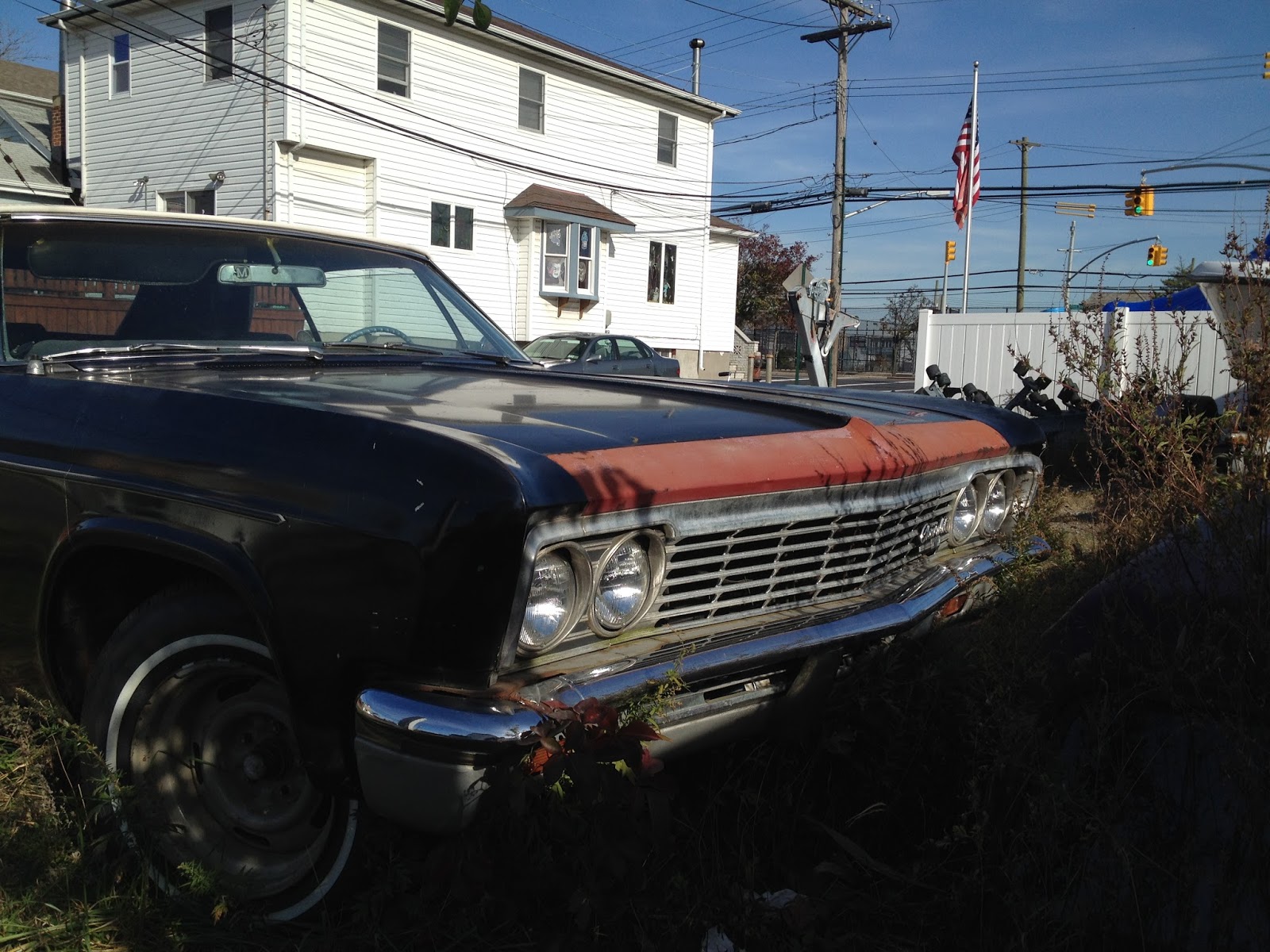
What we have here is a 1966 Chevrolet Impala convertible in Tuxedo Black. We know it's an Impala and not a Caprice because contrary to online rumors Chevy only produced a single Caprice convertible for '66. As a result the Impala was the #2 selling convertible in the U.S. that year behind the Ford Mustang.
This thing has seen better days for sure but it's sitting up at the correct ride height with a nice set of fully inflated tires and the roof is in good condition. There are no plates on it but it has a parking space of its own so nobody is bothering it.
The rectangular taillights of '65 and '66 were a major departure for the Impala lineup. In the years previous and subsequent to this design the Impala had 3 separate lights on each side while the Bel Air and later Caprice had only 2.
Throughout the decade of the 1960s Chevrolet was a massive seller. The Impala could be had with any number of drivetrain combinations from a 250 inline 6 cylinder to a 396 V8 with several choices between those two.
The rusty wheels on this ride look to have started out as chrome units. The identifying Impala emblems are missing from the front fenders of this car. If it were a hardtop we'd have an impossible task deducing whether it was an Impala or Caprice.
Oof! This lower rust eating right through the rocker panels and lower door are tough spots necessitating some pretty serious welding and panel replacement. Between the chrome wheels and this somewhat odd spot for bad body rot I wonder if this car road out Hurricane Sandy in this neighborhood. Broad Channel was hit particularly bad with just about everything submerged under a few feet of water. The local fire department lost their trucks and ambulance in the storm, so it's not a leap to think this poor ride might have been flooded as well.
The interior at fist glance looks complete if a bit dirty. I see a bench seat but can't make out a column shifter so I'm hopeful it has a manual transmission!
Here we can get a glimpse of the front end with its distinctive mid-60s forward-leaning stance. The more I look at this ride the more I feel like it must be a Sandy survivor. Everything from the beltline up looks too great; the windows are all plum and on track, top tight and presentable, interior complete, etc to warrant the kind of wholesale damage to the lower half.
I took these pics well over a year ago so hopefully this old Chevy has been cruising the streets this summer. It is loaded with potential and has the benefit of being a classic where just about every part is widely available in the marketplace. Maybe I'll head back down that way to check in on it and see if she's still holding down that same parking spot. If I can I'll post a follow-up
Stay tuned tomorrow as Convertible Week continues for Labor Day!

Tuesday, May 10, 2016

Malaise Era Glasshouse

MALAISE ERA IMPALA
Before the leaves were on the trees I walked by this big beast:
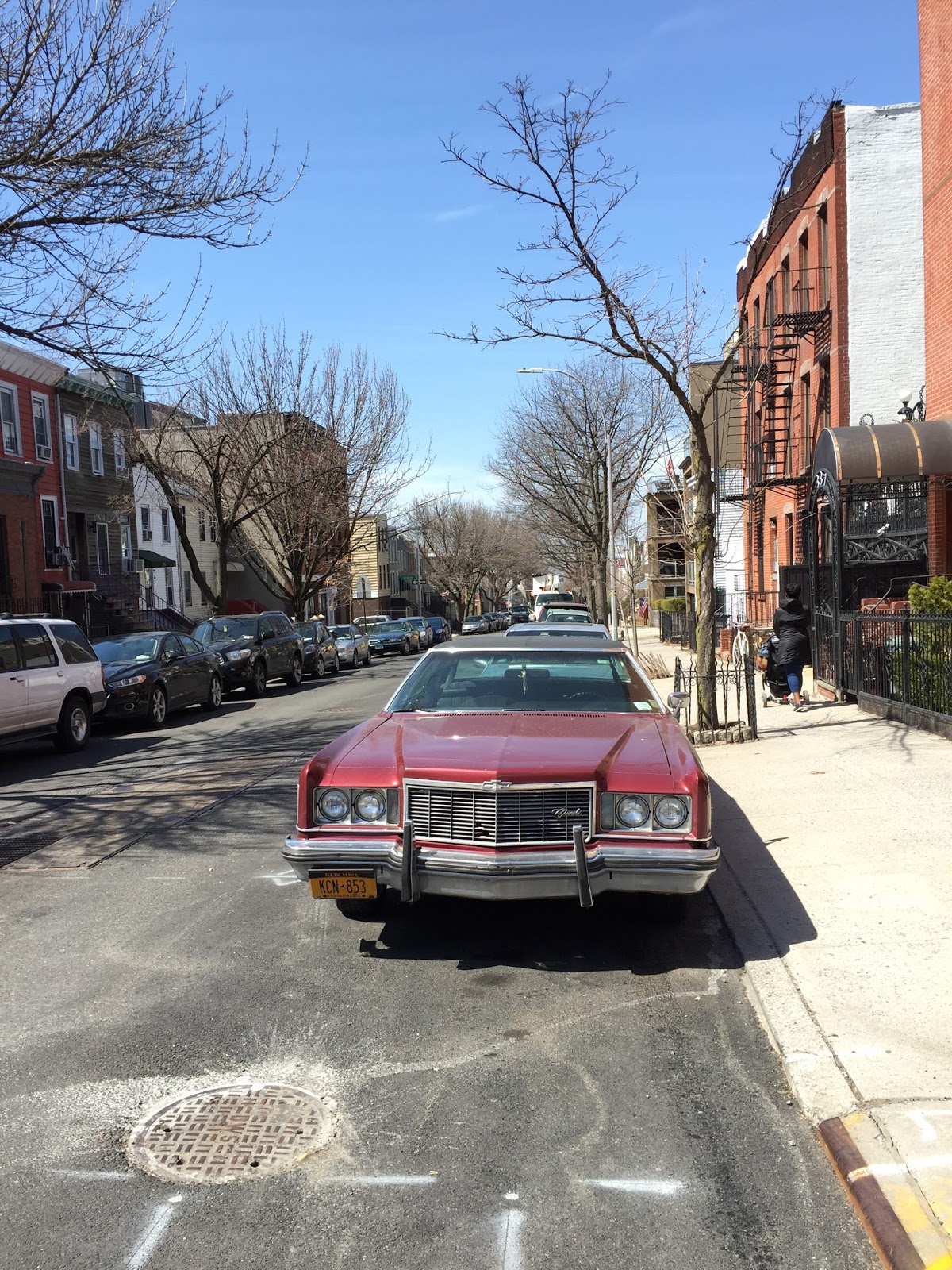
This is a 1975 Chevrolet Impala in Medium Red. If you've never heard of the term "Malaise Era" when describing a car, listen up! This perfectly fits within the Malaise realm; enormous, underpowered, choked with emissions equipment, and heavier due to safety regulations. Other hallmarks of the Malaise Era are baroque adornments like opera windows, vinyl tops, and big crests or hood ornaments.
Even with a guardrail of a front bumper the grill managed to lose a couple teeth. The rubber bumper trim has come in handy enough times to warrant being screwed back in place. Just in case that wasn't enough 2 big bumper guards are yet another line of defense (or offense I suppose).
The quickest way to identify a '75 full-size Chevy is the turn signal location inside of the headlights. In '74 they were on the leading edge of the fenders, and in '76 the headlights became square.
This body style is known in the Chevy community as the Glasshouse due to it's window-to-pillar ratio on the roof. All '70s Impalas were enormously popular with the lowriding set so a large percentage of the surviving examples are customized. 
This is one of the last true hardtops as 1976 would be the final year. Federal safety standards would call for rollover protection so a fixed pillar between the front and rear doors became essential. Too bad as there's nothing like cruising around with the windows all down in one of these. 
Sweet big ol' opera window on the sail panel. The vinyl trim from that window has come off at some point as well as the top of the back window. Check out the superfluous bit of faux trim on the top back of the rear door so that it blends in with the roof. Continuity people!
*I'd also like to point out the distance between the edge of the trunk and the back of the backseat visible through the rear window. That's just more and more trunk folks! A full size spare is most likely living in that space.
Terms like Land Yacht get bandied about a lot when describing any large car. This one deserves it though as it's not fancy or anything, just BIG.
For most of its history the Impala could be identified as being the top trim level of the full size lineup by the fact that it had 6 taillights as opposed to 4 for the lesser Bel Air. In '75 the Caprice also had 6.
That heavy slab bumper is pure Malaise. When you're producing 2 ton + cars and all of a sudden the government decrees that they need to withstand a 5mph crash without any damage you get these chrome monsters just tacked on.
This side is sporting both of the original hubcaps.
That little round keyhole on the fender front is a vintage alarm!
This was parked in front of an open garage where a proud older man was sitting in a lawn chair talking to his buddy. For a 41 year old ride from the Northeast this looks great! I'm sure it's his pride and joy and perhaps he bought it new. If I see him again I'll stop to ask about it, but for now hats off!

Thursday, August 27, 2015

Long winded breakdown of full size GM offerings from '66 through '75

FIVE OF A KIND
The dog days of summer have me relaxing as opposed to posting so I figured I'd drop a whole handful of rides that are close siblings. Without further ado;
What we have here is a 1967 Chevrolet Caprice in what might be Madeira Maroon Poly. While this is a sweet classic now it was one of the most popular cars of its day when built. Over 124,000 left the assembly line in this year alone!
Here she is parked on busy Bedford in Williamsburg. The forward-leaning style of the front end was a one year only design. The year previous didn't have those running lights on the outer edge of the grill (the turn signals are actually located down in the bumper), and the top of the grill was lower than the tops of the headlights in the following year.
The venerable 327 V8 powers this beast but it could have just as easily been a 283, 350, 396, or 427 (a mere 50 of the 427 equipped Caprices were built though so if you see one rotting away somewhere let me know!). Transmission options were also many, with 3 and 4 speed manuals and 2 different automatics all available.
This was the first year for the Caprice as a stand alone model and it represented the top of the heap for the full-size lineup.
I love the old dealership emblems they used to produce for cars. A decal is usually present now (or the phoning-it-in license plate frame) but the ones where they gave some effort to ape the chrome script of the factory emblems really stand out now. As is often the case this one has a couple of screws going directly through it to hold it in place.
Fit and finish is slightly wonky and scrapes and scuffs abound, but this is a solid and really good looking driver. If it were a show car you probably wouldn't want to park it on a busy street.
Look at all that trunk hanging out past the rear axle! In the '70s the trunk would shrink and the hood would grow to enormous lengths. This car is pretty huge by todays standards but it is somewhat balanced in its proportions. 
Well we'll leave this eager punk where it sits looking ready to pounce. Now on to a more sedate, later example:
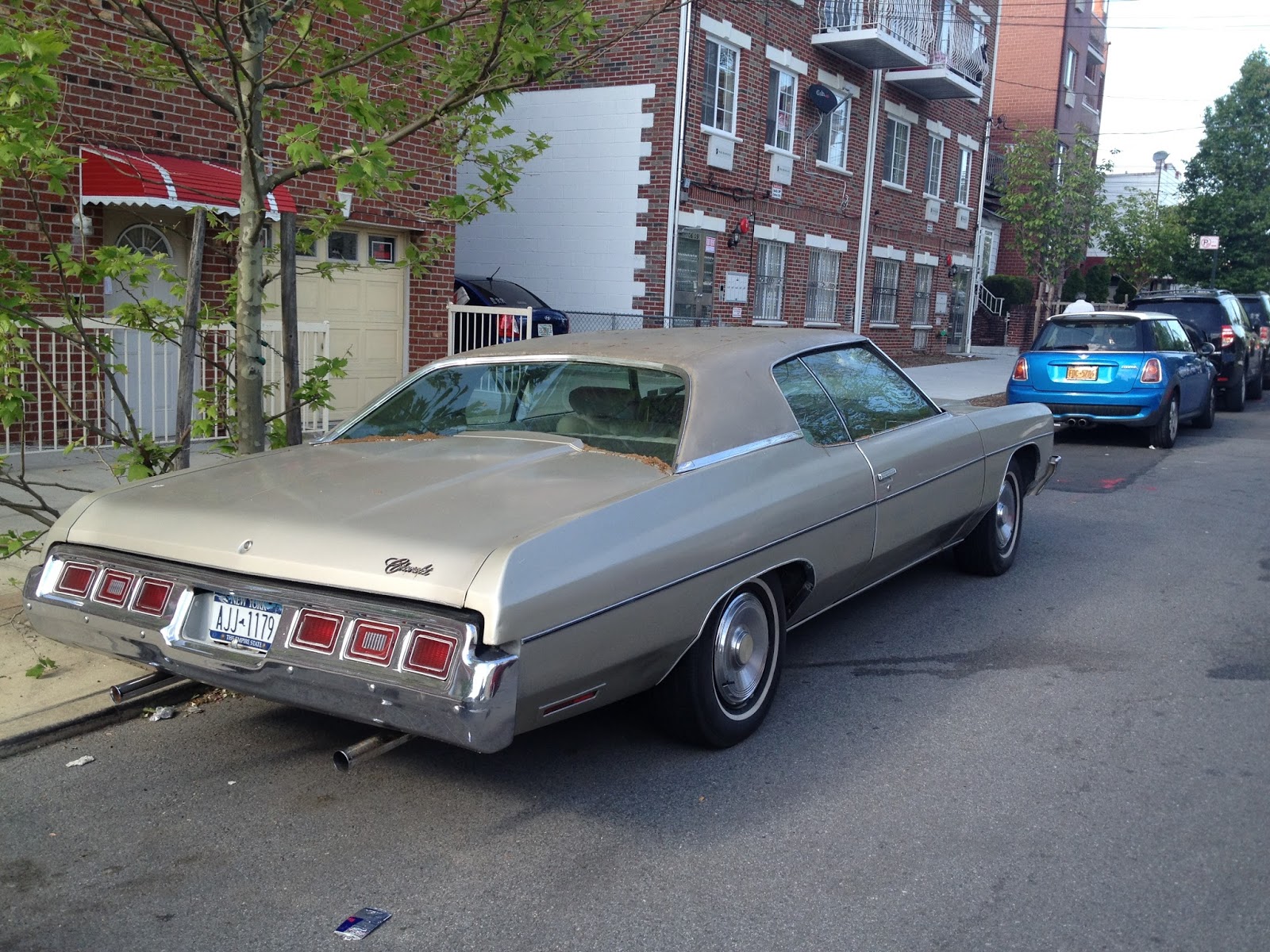
Ahhh yes, here is the serene 1973 Chevy Impala in yawn-inducing BEIGE. This color looks so gentle that it looks like it came from a hospital. If your psychologist is suddenly unavailable they could let you sit on the big bench seat inside this ride and you would feel calm.
*By the way, the only way I know of discerning an Impala from a Caprice in '73 is the grill. The Impala has twice as many horizontal and vertical lines in it as the Caprice.
This is pretty darn close to immaculate which is shocking for two reasons; first of all it's a 42 year old car in New York with no rust! Second of all this was the car of choice for lowriders everywhere. So many of these got used up with 100 spoke Dayton wheels, upholstered steering wheels, and hydraulics that encountering a stock version is almost impossible.
There's some faint rust at the lower edge of the concave rear window but that seems to be the extent of the damage. The trunk lid has what seems to be a mock hood scoop which is something I haven't seen on any other car.
The federally mandated bumpers were introduced in stages. This year is on the cusp where the huge front bumpers ready to withstand a 5mph crash are already in place. This is the last gasp for rear bumpers that incorporate the taillights before the regulations for the rear came due in '74.
The stock hubcaps are nice enough, and the lower body crease helps temper the dimensions of this beast. The 350 V8 was standard in '73 but you could also order a 400 and 454. Now lets lose the roof:
Here we have an EVIL 1972 Impala convertible in Tuxedo Black. This is the last year for an Impala drop-top as it would move to the upscale Caprice the following year.
The grill has been spray painted black (for extra toughness I suppose). Those cheeseball plastic mirrors are not original and I'm calling the owner out on it! The originals were square brushed stainless steel examples that fit a large car.
You can see the lineup I was presented with on this block! We'll see those other rides in a minute.
The hubcaps on this beast are Chevy, but they come from an early-'80s Suburban.
A white roof on a convertible is a stroke of genius since it helps keep the interior cool in the sun. I had a convertible with a black top and interior once and even though it looked great the seats were 1,000 degrees no matter what.
Next we'll flip-flop color schemes:
This is a 1974 Caprice convertible in Antique White. It's very easy to date this car because it's the last year for the headlights being tucked in behind the leading edge of the fenders and the first year for the huge rear bumpers. This basic design would continue through '76 but the final two years had the a flat grill out front with the headlight pods on an angle leaning back. The overall impression of that look is a fainthearted attempt at making a square slab aerodynamic. 
Here's that ridiculously huge rear bumper hanging off like a park bench. It also gives the impression of squinting or lazy rear taillights to me. Why you would need those additional little bumper guards on there is a mystery to me.
This was the first year for a Caprice convertible. The name on the hardtop was located on the sail panel behind the rear side window. For the convertible you can see the emblem located on the leading top edge of the quarter panel.
Now on to an interloper:
Here we have a 1975 Buick Electra 225 Limited in Arctic White with a Maroon vinyl landau roof. We can pinpoint the date because this is Buicks first year for square headlights and the following years would see the turn signals directly under the headlights instead of down in the bumper.
Buick was above Chevy, Pontiac, and Oldsmobile in the GM hierarchy but still below Cadillac in luxury. Some of those extra touches exist here though like the stand up hood ornament and the cornering lamps on the sides. Under the skin however this car is the same as the Impalas and Caprices from the same year (along with the Olds 98, Caddillac Coupe de Ville, and Pontiac Grandville for that matter).
The plastic bumper extensions missing here are easily the weakest link for all GM cars of the era. Most Buicks and Cadillacs need them replaced at some point. This car is a true hooptie with the trunk lock missing and dents, scrapes, and rust all over it.
Well there you have it for GM full size beasts from '66 and '72-'75. I've ridden in at least one example of each of these yachts and they all ride nicely with plenty of power and cushy comfort. Parts for them are readily available too since all were made in vast quantities. These days one can still be had at a reasonable rate and would be a breeze to maintain.